
COVID-19 大流行对德国大学生压力、心理健康和应对行为的影响——大流行前后的纵向研究。
The impact of the COVID-19 pandemic on stress, mental health and coping behavior in German University students - a longitudinal study before and after the onset of the pandemic.
机构信息
Institute for Social Medicine and Epidemiology, University of Lübeck, Ratzeburger Allee 160, 23562, Lübeck, Germany.
Institute of Family Medicine, University Medical Centre Schleswig-Holstein, Ratzeburger Allee 160, 23562, Lübeck, Germany.
出版信息
BMC Public Health. 2021 Jul 13;21(1):1385. doi: 10.1186/s12889-021-11295-6.
BACKGROUND
The COVID-19 pandemic has led to massive restrictions in public and private lives, including a shut-down of face-to-face teaching at universities in Germany. We aimed to examine the impact of these changes on perceived stress, mental health and (study-)related health behavior of students in a longitudinal study.
METHODS
For two timepoints - the year before the COVID-19 pandemic (2019, n = 1377) and the year during the COVID-19 pandemic (2020, n = 1867) - we surveyed students of all faculties at one German university for perceptions and preventive behavior regarding the COVID-19 pandemic using standard instruments for stress, anxiety, depression, and behavior and experience patterns.
RESULTS
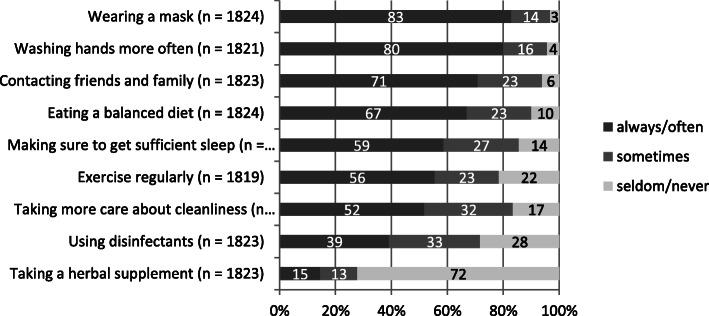
About 90% of students (n = 1633) in 2020 did not have a known contact infected with SARS-CoV-2, while 180 (9.8%) did have one. Only 10 respondents (0.5%) reported an infection with SARS-CoV-2. Wearing masks and washing hands more often were practiced by ≥80% of students. Taking more care about cleanliness (51.8%) and using disinfectants (39.2%) were practiced much less. A higher percentage of female compared with male students and medical/health science students compared with science, technology, engineering, and mathematics students engaged more frequently in specific or nonspecific preventive measures. More than three quarters (77.1%) of all students rated their general health as (very) good. There were no significant differences in general health, stress, and depression between 2019 and 2020 in the students who responded at both timepoints. The distribution of behavior and experience patterns for this group showed a slight but significant difference from 2019 to 2020, namely decreasing proportions of students with a healthy pattern and a risk pattern for overexertion. Students with different behavior and experience patterns showed marked differences in perceptions and reaction to the COVID-19 pandemic as well as psychosocial stress and symptoms, with higher scores for mental health symptoms and lower scores in preventive behavior regarding risk patterns.
CONCLUSION
Despite massive alterations to students' lives in 2020, there were only moderate consequences for mental health compared with 2019 in the total student group of this German university. However, identifying students at risk would offer opportunities to foster mental health in relevant subgroups.
背景
COVID-19 大流行导致公众和私人生活受到大规模限制,包括德国大学面对面教学的关闭。我们旨在通过一项纵向研究,考察这些变化对学生感知压力、心理健康和(学习)相关健康行为的影响。
方法
在 COVID-19 大流行之前的一年(2019 年,n=1377)和 COVID-19 大流行期间的一年(2020 年,n=1867),我们使用针对压力、焦虑、抑郁以及行为和经验模式的标准工具,对一所德国大学的所有院系的学生进行了 COVID-19 大流行的感知和预防行为调查。
结果
2020 年,约 90%的学生(n=1633)没有已知接触 SARS-CoV-2 感染,而 180 名学生(9.8%)有接触。只有 10 名受访者(0.5%)报告感染了 SARS-CoV-2。≥80%的学生更频繁地戴口罩和洗手。更多地注意清洁(51.8%)和使用消毒剂(39.2%)的做法则要少得多。与男学生相比,女学生和医学/健康科学学生比科学、技术、工程和数学学生更频繁地采取特定或非特定的预防措施。超过四分之三(77.1%)的学生总体健康状况被评为(非常)良好。在两个时间点都有回应的学生中,2019 年和 2020 年之间,一般健康、压力和抑郁没有显著差异。对于这一组学生,行为和经验模式的分布与 2019 年相比略有差异,但过度劳累的健康模式和风险模式的学生比例有所下降。具有不同行为和经验模式的学生对 COVID-19 大流行的看法和反应以及心理社会压力和症状存在明显差异,心理健康症状得分较高,风险模式的预防行为得分较低。
结论
尽管 2020 年学生生活发生了巨大变化,但与 2019 年相比,这所德国大学的学生总体心理健康状况只有中等程度的影响。然而,识别处于危险中的学生将为促进相关亚组的心理健康提供机会。

 Zotero 插件