Department of Public Health, Graduate School of Medicine, The University of Tokyo, Tokyo, Japan.
Cancer Control Center, Osaka International Cancer Institute, Osaka, Japan.
J Med Internet Res. 2021 Jul 23;23(7):e27982. doi: 10.2196/27982.
The use of telemedicine outpatient visits has increased dramatically during the COVID-19 pandemic in many countries. Although disparities in access to telemedicine by age and socioeconomic status (SES) have been well-documented, evidence is limited as to how these disparities changed during the COVID-19 pandemic. Moreover, the equity of patient access to telemedicine has been scarcely reported in Japan, despite the huge potential for telemedicine expansion.
We aimed to investigate changes due to age and SES disparities in telemedicine use during the COVID-19 pandemic in Japan.
Using data from a large internet survey conducted between August 25 and September 30, 2020, in Japan, we examined the associations of participant age and SES (educational attainment, urbanicity of residence, and income level) with their telemedicine use in the following two time periods during the pandemic: April 2020 and August-September 2020.
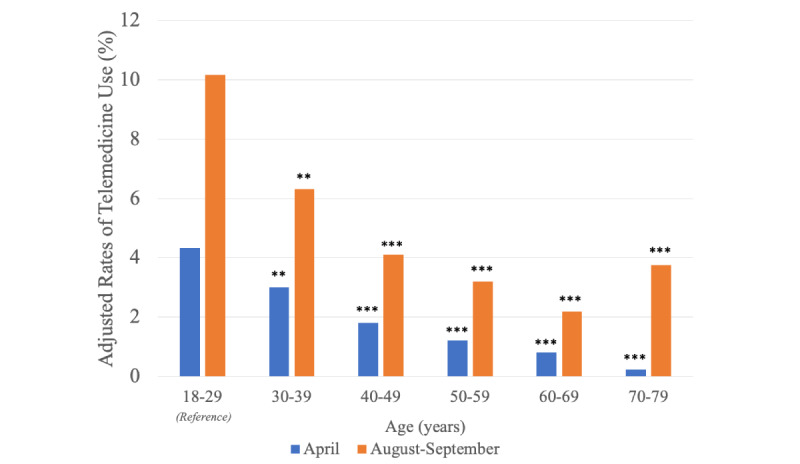
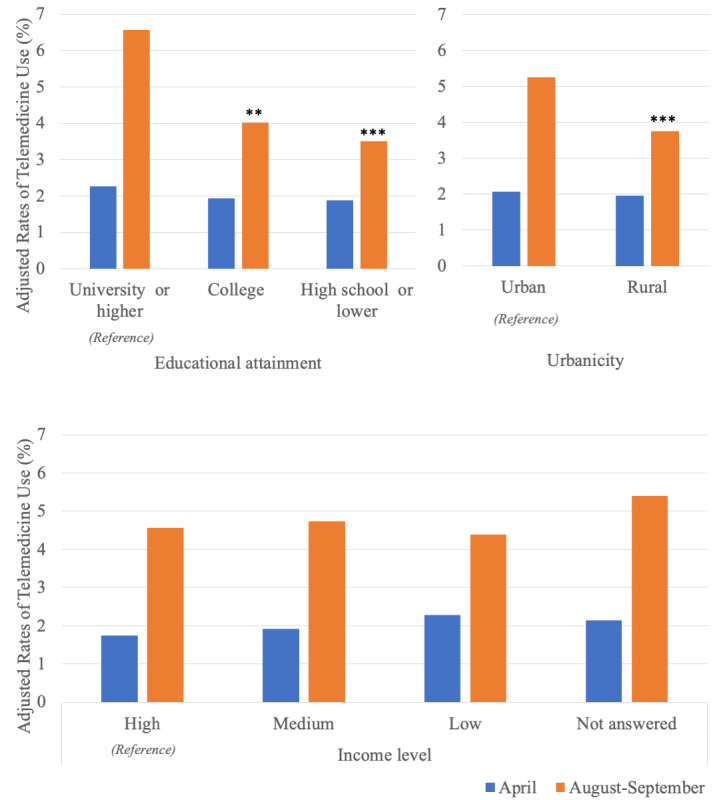
Of the 24,526 participants aged 18 to 79 years (50.8% [n=12,446] women), the proportion of individuals who reported using telemedicine increased from 2.0% (n=497) in April 2020 to 4.7% (n=1159) in August-September 2020. After adjusting for potential confounders, younger individuals were more likely to use telemedicine than older individuals in April 2020. Although this pattern persisted in August-September 2020, we also observed a substantial increase in telemedicine use among individuals aged 70 to 79 years (adjusted rates, 0.2% in April 2020 vs 3.8% in August-September 2020; P<.001 after multiple comparisons). We found disparities in telemedicine use by SES in August-September 2020 that did not exist in April 2020. In August-September 2020, individuals with a university degree were more likely to use telemedicine than those with a high school diploma or less (adjusted rates, 6.6% vs 3.5%; P<.001). Individuals living in urban areas exhibited higher rates of telemedicine use than those living in rural areas only in August-September 2020 (adjusted rates, 5.2% vs 3.8%; P<.001). Disparities in telemedicine use by income level were not observed in either time period.
In general, younger individuals increased their use of telemedicine compared to older individuals during the pandemic, although individuals in their 70s also increased their use of telemedicine. Disparities in telemedicine use by educational attainment and urbanicity of residence widened during the COVID-19 pandemic.
在许多国家,COVID-19 大流行期间远程医疗门诊就诊量大幅增加。尽管年龄和社会经济地位(SES)方面获得远程医疗服务的差异已经得到充分证明,但关于这些差异在 COVID-19 大流行期间如何变化的证据有限。此外,尽管远程医疗具有巨大的扩展潜力,但日本几乎没有报告患者获得远程医疗服务的公平性。
我们旨在调查 COVID-19 大流行期间日本因年龄和 SES 差异导致远程医疗使用情况的变化。
使用 2020 年 8 月 25 日至 9 月 30 日期间在日本进行的一项大型互联网调查的数据,我们检查了参与者年龄和 SES(教育程度、居住地城市度和收入水平)与他们在以下两个大流行期间使用远程医疗的关联:2020 年 4 月和 2020 年 8-9 月。
在 24526 名年龄在 18 至 79 岁之间的参与者(50.8%[n=12446]为女性)中,报告使用远程医疗的比例从 2020 年 4 月的 2.0%(n=497)增加到 2020 年 8-9 月的 4.7%(n=1159)。调整潜在混杂因素后,2020 年 4 月年轻个体比年长个体更有可能使用远程医疗。尽管这种模式在 2020 年 8-9 月持续存在,但我们还观察到 70 至 79 岁个体使用远程医疗的数量大幅增加(调整后的比率,2020 年 4 月为 0.2%,2020 年 8-9 月为 3.8%;多重比较后 P<.001)。我们发现,2020 年 8-9 月 SES 与远程医疗使用之间存在差异,而 2020 年 4 月不存在这种差异。2020 年 8-9 月,拥有大学学历的个体比拥有高中学历或以下学历的个体更有可能使用远程医疗(调整后的比率,6.6%比 3.5%;P<.001)。仅在 2020 年 8-9 月,居住在城市地区的个体比居住在农村地区的个体更有可能使用远程医疗(调整后的比率,5.2%比 3.8%;P<.001)。在这两个时期都没有观察到收入水平对远程医疗使用的差异。
一般来说,与年长个体相比,年轻个体在大流行期间增加了对远程医疗的使用,尽管 70 多岁的个体也增加了对远程医疗的使用。2020 年 COVID-19 大流行期间,受教育程度和居住地城市度方面远程医疗使用的差异有所扩大。