
利用核糖体谱数据对蛋白质合成进行定量建模。
Quantitative Modeling of Protein Synthesis Using Ribosome Profiling Data.
作者信息
Yadav Vandana, Ullah Irshad Inayat, Kumar Hemant, Sharma Ajeet K
机构信息
Department of Physics, Indian Institute of Technology Madras, Chennai, India.
Department of Physics, Indian Institute of Technology Jammu, Jammu, India.
出版信息
Front Mol Biosci. 2021 Jun 28;8:688700. doi: 10.3389/fmolb.2021.688700. eCollection 2021.
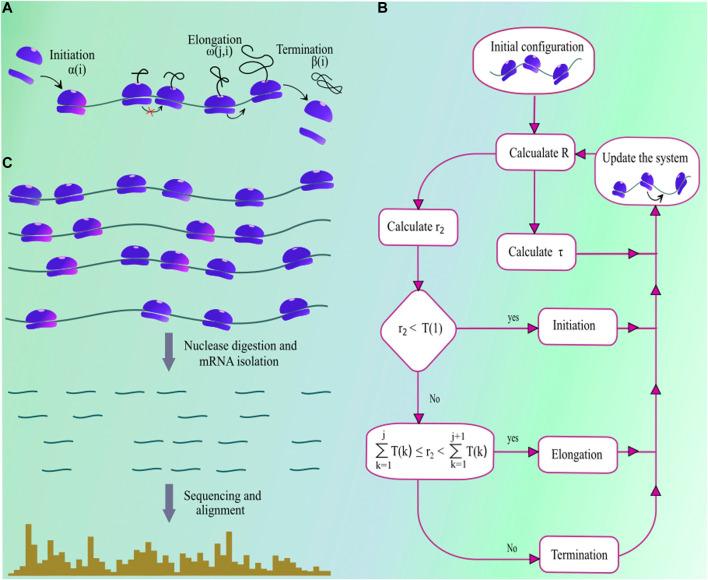
Quantitative prediction on protein synthesis requires accurate translation initiation and codon translation rates. Ribosome profiling data, which provide steady-state distribution of relative ribosome occupancies along a transcript, can be used to extract these rate parameters. Various methods have been developed in the past few years to measure translation-initiation and codon translation rates from ribosome profiling data. In the review, we provide a detailed analysis of the key methods employed to extract the translation rate parameters from ribosome profiling data. We further discuss how these approaches were used to decipher the role of various structural and sequence-based features of mRNA molecules in the regulation of gene expression. The utilization of these accurate rate parameters in computational modeling of protein synthesis may provide new insights into the kinetic control of the process of gene expression.
对蛋白质合成进行定量预测需要准确的翻译起始和密码子翻译速率。核糖体谱分析数据提供了沿转录本的相对核糖体占有率的稳态分布,可用于提取这些速率参数。在过去几年中,已经开发了各种方法来从核糖体谱分析数据中测量翻译起始和密码子翻译速率。在这篇综述中,我们对从核糖体谱分析数据中提取翻译速率参数所采用的关键方法进行了详细分析。我们进一步讨论了这些方法如何用于解读mRNA分子的各种基于结构和序列的特征在基因表达调控中的作用。在蛋白质合成的计算模型中利用这些准确的速率参数可能会为基因表达过程的动力学控制提供新的见解。

 Zotero 插件