Puri Reema, Adesina Simeon, Akala Emmanuel
Center for Drug Research and Development, Department of Pharmaceutical Sciences, College of Pharmacy, Howard University, 2300 4th Street, NW, Washington, D.C., 20059, USA.
J Nanosci Nanomed. 2018 Sep;2(1):3-18. Epub 2018 Apr 12.
A strategy in site-specific drug delivery is the use of pH-gradients that exist in diseased conditions such as cancer for the release of loaded drug(s) in the biophase. The objective of this work is to synthesize pH-responsive docetaxel-loaded nanoparticles with a bisacrylate acetal crosslinker, which can get internalized into cells, and which will be equivalent to or more cytotoxic than the free drug against cancer cells.
pH-responsive nanoparticles were synthesized by a dispersion polymerization technique. The nanoparticles were characterized for physicochemical properties. Cytotoxicity studies of the nanoparticles were performed on PC3 and LNCaP prostate cancer cell lines using a cell viability assay. Cellular uptake studies were performed using a confocal laser scanning microscope.
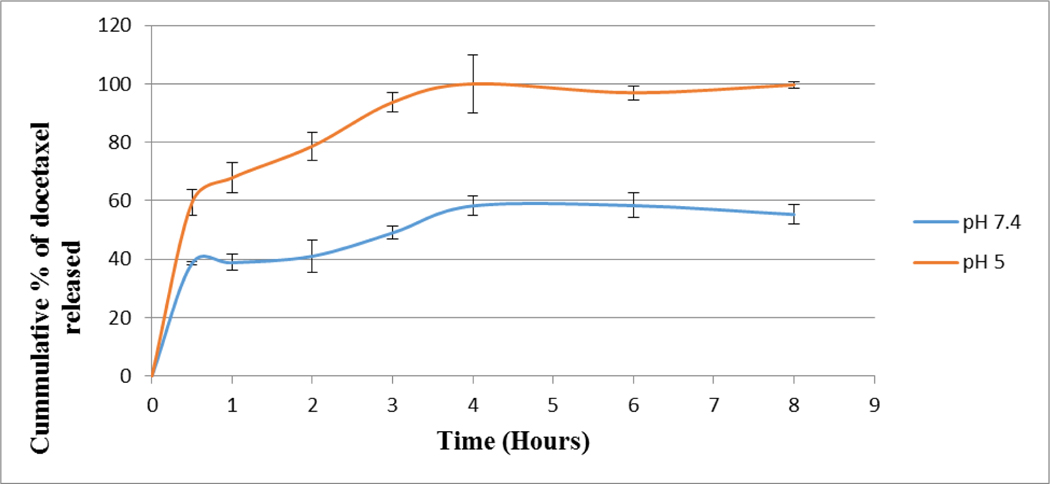
Smooth spherical nanoparticles were formed. drug release was faster at pH 5.0 than pH 7.4, which confirmed the pH-responsiveness of the nanoparticles. Cytotoxicity studies showed that the nanoparticles were more effective at the same molar amount than the free drug against cancer cells. Both dose exposure and incubation time affected the cytotoxicity of prostate cancer cells. Furthermore, LNCaP cells appeared to be the more sensitive to docetaxel than PC3 cells. The cellular uptake studies clearly showed the presence of discrete nanoparticles within the cells in as little as 2 hours.
pH-sensitive nanoparticles were developed; they degraded quickly in the mildly acidic environments similar to those found in endosomes and lysosomes of tumor tissues. These novel pH-sensitive nanoparticles would offer several advantages over conventional drug therapies.
在特定部位给药策略中,利用疾病状态(如癌症)中存在的pH梯度,使负载的药物在生物相中释放。本研究的目的是合成一种带有双丙烯酸酯缩醛交联剂的pH响应性载多西他赛纳米颗粒,该纳米颗粒能够内化进入细胞,并且对癌细胞的细胞毒性与游离药物相当或更强。
通过分散聚合技术合成pH响应性纳米颗粒。对纳米颗粒的物理化学性质进行表征。使用细胞活力测定法对PC3和LNCaP前列腺癌细胞系进行纳米颗粒的细胞毒性研究。使用共聚焦激光扫描显微镜进行细胞摄取研究。
形成了光滑的球形纳米颗粒。在pH 5.0时药物释放比pH 7.4时更快,这证实了纳米颗粒的pH响应性。细胞毒性研究表明,在相同摩尔量下,纳米颗粒对癌细胞的效果比游离药物更有效。剂量暴露和孵育时间均影响前列腺癌细胞的细胞毒性。此外,LNCaP细胞似乎比PC3细胞对多西他赛更敏感。细胞摄取研究清楚地表明,在短短2小时内细胞内就存在离散的纳米颗粒。
开发了pH敏感型纳米颗粒;它们在类似于肿瘤组织内体和溶酶体的微酸性环境中迅速降解。这些新型pH敏感型纳米颗粒相对于传统药物疗法具有多个优势。