Department of Hospitality Management, Tunghai University, Taichung, 407224, Taiwan.
Center for Teacher Education, Cheng Shiu University, Kaohsiung, 83347, Taiwan.
Soc Sci Med. 2021 Sep;284:114218. doi: 10.1016/j.socscimed.2021.114218. Epub 2021 Jul 10.
Social distance regulations have been suggested as one of the best ways to control and prevent the spread of COVID-19. Social connection and food are intertwined because both have played critical evolutionary roles in human survival. We tested whether the substitutability hypothesis in human motivation applies here in that cues signaling scarcity in one domain (e.g., social connection) might enhance the desire to acquire resources in another domain (e.g., food).
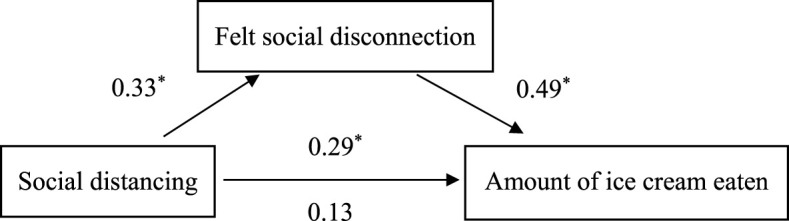
We recruited 140 adults from Kaohsiung City (the largest city in southern Taiwan) to participate in a laboratory experiment. Participants were randomly assigned to receive either social distancing or neutral primes via an emotional-event recollection technique. The amount of ice cream eaten during a taste test and the self-reported likelihood of binge eating served as the dependent measures.
We found that, compared with controls, participants primed with social distancing consumed more ice cream in a taste test and reported a greater likelihood that they would engage in binge eating if they were placed in home quarantine.
We may be the first to provide experimental evidence that social distancing can enhance the desire for food. The link between social distancing and the desire for food is pertinent to understanding how strongly social distance regulations may influence weight gain. Our findings have far-reaching implications for weight control under social distance regulations for prevention and control of COVID-19.
社会距离规定被认为是控制和预防 COVID-19 传播的最佳方法之一。社会联系和食物是相互交织的,因为两者在人类生存中都发挥了至关重要的作用。我们测试了人类动机中的替代假说是否适用于这里,即一个领域(例如社会联系)中信号稀缺的线索可能会增强另一个领域(例如食物)中获取资源的欲望。
我们从高雄市(台湾南部最大的城市)招募了 140 名成年人参加实验室实验。参与者通过情绪事件回忆技术被随机分配接受社交距离或中性提示。在味觉测试中吃的冰淇淋量和自我报告的暴饮暴食可能性作为因变量。
与对照组相比,接受社交距离提示的参与者在味觉测试中吃了更多的冰淇淋,并报告说如果他们被隔离在家中,他们更有可能暴饮暴食。
我们可能是第一个提供实验证据表明社交距离可以增强对食物的渴望的人。社交距离和对食物的渴望之间的联系对于理解社会距离规定可能对体重增加产生多大影响至关重要。我们的发现对 COVID-19 防控期间社会距离规定下的体重控制具有深远的意义。