Department of Critical Care Medicine, Guangdong Second Provincial General Hospital, No.466 Xingang Middle Road, Guangzhou, 510000, Guangdong, China.
BMC Infect Dis. 2021 Jul 15;21(1):684. doi: 10.1186/s12879-021-06383-2.
Mechanical ventilation (MV) is often applied in critically ill patients in intensive care unit (ICU) to protect the airway from aspiration, and supplement more oxygen. MV may result in ventilator-associated pneumonia (VAP) in ICU patients. This study was to estimate the 90-day and 180-day mortalities of ICU patients with VAP, and to explore the influence of VAP on the outcomes of ICU patients.
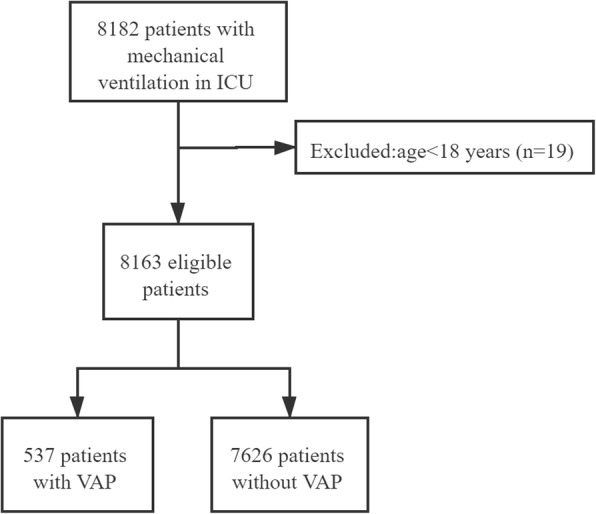
Totally, 8182 patients who aged ≥18 years and received mechanical ventilation (MV) in ICU from Medical Information Mart for Intensive Care III (MIMIC III) database were involved in this study. All subjects were divided into the VAP group (n = 537) and the non-VAP group (n = 7626) based on the occurrence of VAP. Clinical data of all participants were collected. The effect of VAP on the prognosis of ICU patients was explored by binary logistic regression analysis.
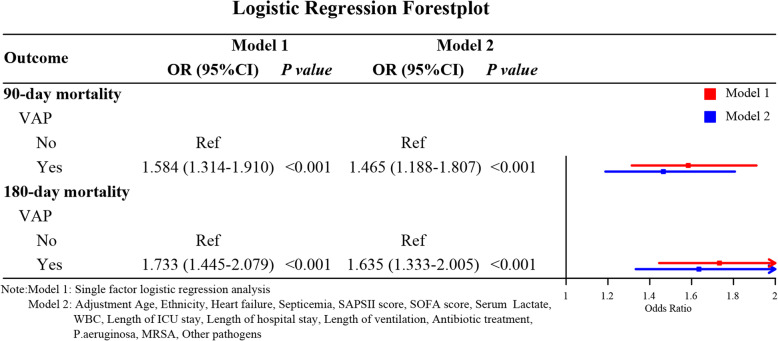
The results delineated that the 90-day mortality of VAP patients in ICU was 33.33% and 180-day mortality was 37.62%. The 90-day and 180-day mortality rates were higher in the VAP group than in the non-VAP group. After adjusting the confounders including age, ethnicity, heart failure, septicemia, simplified acute physiology score II (SAPSII) score, sequential organ failure assessment (SOFA) score, serum lactate, white blood cell (WBC), length of ICU stay, length of hospital stay, length of ventilation, antibiotic treatment, Pseudomonas aeruginosa (P.aeruginosa), methicillin-resistant Staphylococcus aureus (MRSA), other pathogens, the risk of 90-day and 180-day mortalities in VAP patients were 1.465 times (OR = 1.465, 95%CI: 1.188-1.807, P < 0.001) and 1.635 times (OR = 1.635, 95%CI: 1.333-2.005, P < 0.001) higher than those in non-VAP patients, respectively.
Our study revealed that ICU patients with VAP had poorer prognosis than those without VAP. The results of this study might offer a deeper insight into preventing the occurrence of VAP.
机械通气(MV)常用于重症监护病房(ICU)中的危重病患者,以保护气道免受吸入,并补充更多氧气。MV 可能导致 ICU 患者发生呼吸机相关性肺炎(VAP)。本研究旨在评估 VAP 患者的 90 天和 180 天死亡率,并探讨 VAP 对 ICU 患者结局的影响。
本研究共纳入了来自医疗信息学重症监护 III (MIMIC III)数据库中年龄≥18 岁且接受机械通气(MV)的 8182 名患者。所有患者均根据是否发生 VAP 分为 VAP 组(n=537)和非 VAP 组(n=7626)。收集所有参与者的临床数据。通过二元逻辑回归分析探讨 VAP 对 ICU 患者预后的影响。
研究结果表明,VAP 患者在 ICU 的 90 天死亡率为 33.33%,180 天死亡率为 37.62%。VAP 组的 90 天和 180 天死亡率均高于非 VAP 组。调整年龄、种族、心力衰竭、败血症、简化急性生理学评分 II(SAPSII)评分、序贯器官衰竭评估(SOFA)评分、血清乳酸、白细胞(WBC)、ICU 住院时间、住院时间、通气时间、抗生素治疗、铜绿假单胞菌(P. aeruginosa)、耐甲氧西林金黄色葡萄球菌(MRSA)、其他病原体等混杂因素后,VAP 患者 90 天和 180 天死亡率的风险分别为 1.465 倍(OR=1.465,95%CI:1.188-1.807,P<0.001)和 1.635 倍(OR=1.635,95%CI:1.333-2.005,P<0.001)。
本研究表明,VAP 患者的预后较非 VAP 患者差。本研究结果可能为预防 VAP 的发生提供更深入的见解。