Langman L, Paetkau V
J Virol. 1978 Feb;25(2):562-9. doi: 10.1128/JVI.25.2.562-569.1978.
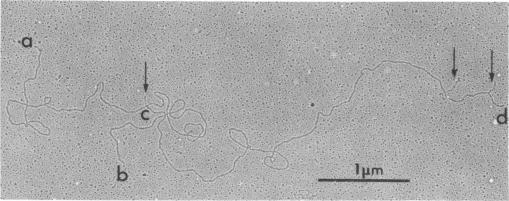
During the infection of Escherichia coli by bacteriophage T7, there is a gradual conversion of host DNA to T7 DNA. Recombination and replication occur during this time. We have devised a new way of examining the physical structures of the intermediates of these processes. It is based on the observation that there are no sites in T7 DNA susceptible to cleavage by the restriction endonuclease EcoRI. E. coli DNA, on the other hand, is susceptible to degradation by EcoRI. Thus, phage and host DNA can be separated by sucrose gradient centrifugation after treatment with EcoRI. Concatemeric T7 DNA contains a high proportion of branched, gapped, and whiskered structures. These appear to be intermediates of replication and recombination. This approach also monitors the conversion process from host to T7 DNA.
在噬菌体T7感染大肠杆菌的过程中,宿主DNA会逐渐转化为T7 DNA。在此期间会发生重组和复制。我们设计了一种新方法来研究这些过程中间体的物理结构。该方法基于这样的观察结果:T7 DNA中不存在易被限制性内切酶EcoRI切割的位点。另一方面,大肠杆菌DNA易被EcoRI降解。因此,在用EcoRI处理后,噬菌体和宿主DNA可以通过蔗糖梯度离心分离。串联的T7 DNA含有高比例的分支、缺口和须状结构。这些似乎是复制和重组的中间体。这种方法还监测了从宿主DNA到T7 DNA的转化过程。