Department of Biology, Wolkite University, Wolkite, Ethiopia.
Department of Plant Biology and Biodiversity Management, Addis Ababa University, Addis Ababa, Ethiopia.
J Ethnobiol Ethnomed. 2021 Jul 17;17(1):44. doi: 10.1186/s13002-021-00469-6.
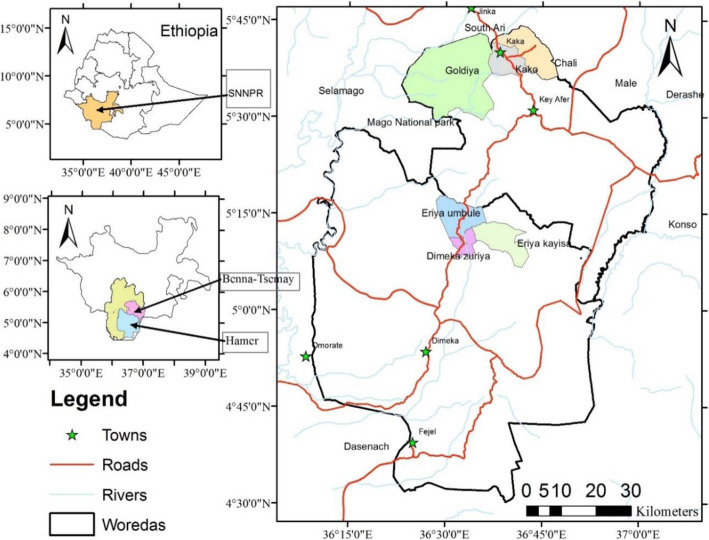
Trees are important components of terrestrial ecosystems; they provide ecological, economic, and cultural services to humans. There is an urgent need for undertaking ethnobotanical investigations and documentation on the indigenous botanical knowledge of the local communities of a given area. This study was conducted to assess and document the categoric ethnobotany of Piliostigma thonningii and the associated indigenous knowledge of the local people related to use, management practices, and the threatening factors in the South Omo Zone of southwestern Ethiopia.
Six Kebeles were purposively selected from two districts of the zone and a total of 84 respondents were sampled, with consideration of gender, age, and wealth status. Data were collected using structured and semi-structured interviews, field observations, and group discussions. Relevant descriptive statistical methods were used to analyze the data. Ethnobotanical knowledge held by informants were computed using Pearson's chi-square test and direct matrix ranking and pair-wise ranking was used to prioritize the uses according to community preferences and the level of the destructiveness of the reported threats.
The results showed that P. thonningii provides different functions to people's livelihoods as shade, food, fodder, soil fertility, fuelwood, medicine, rope, multipurpose materials (e.g., Borketa for sitting and head support), huts, beehives, farm implements, chairs, fences, and timber. The indigenous knowledge of local people on the uses of P. thonningii has shown significant (P < 0.05) relationship to age groups (being higher for elderly people). The consumption practice of respondents has significant (P < 0.05) association to the Kebeles, age, and income, with higher value for Hamer, lower aged groups, and low-income families. It provides nutritious animal feed to improve browse intake, survival, and productivity of domestic animals and also improve productivity of farm through amelioration of soil fertility. The status of P. thonningii has been decreasing due to agricultural expansion, collection of the species for firewood, dry fencing, and due to browsing. Respondents' attitude and interest to maintain and conserve the species has shown a significant (P< 0.05) association to gender, wealth, and level of education. Higher interest was observed in men than women, mid-high wealth class households than low income, and people with education than uneducated.
This study attempted to provide information on the multiple uses of P. thonningii. Given the key roles of P. thonningii for the people and the environment to improve household food security, agricultural productivity, and income sources and the threats to it, the need to protect it in natural forests and woodlands and optimize its uses in agroforestry systems is high. Serious consideration of this species will ultimately allow households to reap the benefits expected to accrue from it in the arid and semi-arid areas of Ethiopia where plants of this nature are usually rare.
树木是陆地生态系统的重要组成部分;它们为人类提供生态、经济和文化服务。迫切需要对特定地区当地社区的本土植物学知识进行民族植物学调查和记录。本研究旨在评估和记录 Piliostigma thonningii 的分类民族植物学以及与使用、管理实践相关的本土知识,以及埃塞俄比亚西南部南奥莫地区的威胁因素。
从该地区的两个区有目的地选择了六个 Kebeles,并对总共 84 名受访者进行了抽样调查,考虑了性别、年龄和财富状况。数据收集采用结构化和半结构化访谈、实地观察和小组讨论。使用相关的描述性统计方法分析数据。使用皮尔逊卡方检验和直接矩阵排名计算信息提供者持有的民族植物学知识,并使用成对排名和等级排序根据社区偏好和报告威胁的破坏性程度对用途进行优先级排序。
研究结果表明,P. thonningii 为人们的生计提供了不同的功能,例如遮荫、食物、饲料、土壤肥力、薪材、药物、绳索、多用途材料(例如用于坐和头部支撑的 Borketa)、小屋、蜂巢、农具、椅子、围栏和木材。当地人民对 P. thonningii 的使用的本土知识与年龄组(老年人更高)有显著(P < 0.05)关系。受访者的消费实践与 Kebeles、年龄和收入有显著(P < 0.05)的关联,哈默尔的价值更高,年龄较低的群体和低收入家庭的价值更高。它为改善牲畜的觅食、生存和生产力提供了有营养的动物饲料,并通过改善土壤肥力提高了农业生产力。由于农业扩张、物种采集用作薪材、干篱笆以及由于觅食,P. thonningii 的数量一直在减少。受访者维护和保护该物种的态度和兴趣与性别、财富和教育程度有显著(P < 0.05)的关联。与女性相比,男性表现出更高的兴趣,与低收入家庭相比,中高财富阶层的家庭表现出更高的兴趣,与未受过教育的人相比,受过教育的人表现出更高的兴趣。
本研究试图提供有关 P. thonningii 多种用途的信息。鉴于 P. thonningii 对改善家庭粮食安全、农业生产力和收入来源以及对它的威胁的关键作用,需要在自然森林和林地保护它,并优化其在农林系统中的利用。认真考虑这种物种最终将使家庭能够从埃塞俄比亚干旱和半干旱地区预期获得的收益中受益,在这些地区,这种性质的植物通常很少见。