Kasmi Sofien, Zouhal Hassane, Hammami Raouf, Clark Cain C T, Hackney Anthony C, Hammami Amri, Chtara Mokhtar, Chortane Sabri Gaied, Salah Fatma Zohra Ben, Granacher Urs, Ounis Omar Ben
Tunisian Research Laboratory "Sport Performance Optimization", National Center of Medicine and Science in Sports, Tunis, Tunisia.
Department of Physiotherapy, Posturology and Functional Rehabilitation, National Center of Medicine and Science in Sports, Tunis, Tunisia.
Front Physiol. 2021 Jul 2;12:688385. doi: 10.3389/fphys.2021.688385. eCollection 2021.
The standard method to treat physically active patients with anterior cruciate ligament (ACL) rupture is ligament reconstruction surgery. The rehabilitation training program is very important to improve functional performance in recreational athletes following ACL reconstruction.
The aims of this study were to compare the effects of three different training programs, eccentric training (ECC), plyometric training (PLYO), or combined eccentric and plyometric training (COMB), on dynamic balance (Y-BAL), the Lysholm Knee Scale (LKS), the return to sport index (RSI), and the leg symmetry index (LSI) for the single leg hop test for distance in elite female athletes after ACL surgery.
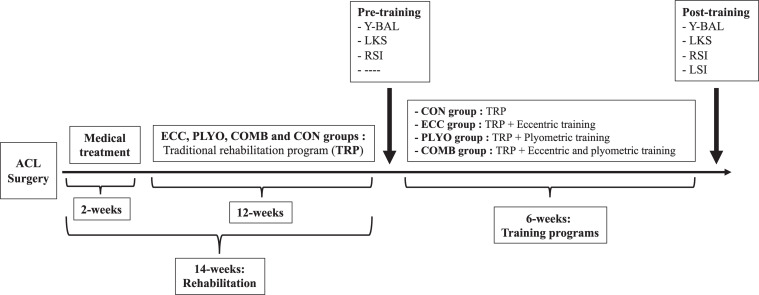
Fourteen weeks after rehabilitation from surgery, 40 elite female athletes (20.3 ± 3.2 years), who had undergone an ACL reconstruction, participated in a short-term (6 weeks; two times a week) training study. All participants received the same rehabilitation protocol prior to the training study. Athletes were randomly assigned to three experimental groups, ECC ( = 10), PLYO ( = 10), and COMB ( = 10), and to a control group (CON: = 10). Testing was conducted before and after the 6-week training programs and included the Y-BAL, LKS, and RSI. LSI was assessed after the 6-week training programs only.
Adherence rate was 100% across all groups and no training or test-related injuries were reported. No significant between-group baseline differences (pre-6-week training) were observed for any of the parameters. Significant group-by-time interactions were found for Y-BAL ( < 0.001, ES = 1.73), LKS ( < 0.001, ES = 0.76), and RSI ( < 0.001, ES = 1.39). Contrast analysis demonstrated that COMB yielded significantly greater improvements in Y-BAL, LKS, and RSI (all < 0.001), in addition to significantly better performances in LSI (all < 0.001), than CON, PLYO, and ECC, respectively.
In conclusion, combined (eccentric/plyometric) training seems to represent the most effective training method as it exerts positive effects on both stability and functional performance in the post-ACL-surgical rehabilitation period of elite female athletes.
治疗身体活跃的前交叉韧带(ACL)断裂患者的标准方法是韧带重建手术。康复训练计划对于提高ACL重建后娱乐性运动员的功能表现非常重要。
本研究的目的是比较三种不同训练计划,即离心训练(ECC)、增强式训练(PLYO)或离心与增强式联合训练(COMB),对精英女性运动员ACL手术后单腿跳远距离测试中的动态平衡(Y-BAL)、Lysholm膝关节评分(LKS)、恢复运动指数(RSI)和腿对称指数(LSI)的影响。
手术后康复14周后,40名接受ACL重建的精英女性运动员(20.3±3.2岁)参加了一项短期(6周;每周两次)训练研究。所有参与者在训练研究前接受相同的康复方案。运动员被随机分为三个实验组,ECC组(n = 10)、PLYO组(n = 10)和COMB组(n = 10),以及一个对照组(CON:n = 10)。在为期6周的训练计划前后进行测试,包括Y-BAL、LKS和RSI。仅在为期6周的训练计划后评估LSI。
所有组的依从率均为100%,且未报告与训练或测试相关的损伤。在任何参数上,均未观察到组间基线差异(训练前6周)显著。发现Y-BAL(P < 0.001,ES = 1.73)、LKS(P < 0.001,ES = 0.76)和RSI(P < 0.001,ES = 1.39)存在显著交互作用。对比分析表明,与CON组、PLYO组和ECC组相比,COMB组在Y-BAL、LKS和RSI方面的改善显著更大(均P < 0.001),在LSI方面的表现也显著更好(均P < 0.001)。
总之,联合(离心/增强式)训练似乎是最有效的训练方法,因为它对精英女性运动员ACL手术后康复期的稳定性和功能表现均有积极影响。