Deniskova Tatiana E, Dotsev Arsen V, Selionova Marina I, Reyer Henry, Sölkner Johann, Fornara Margaret S, Aybazov Ali-Magomed M, Wimmers Klaus, Brem Gottfried, Zinovieva Natalia A
L.K. Ernst Federal Science Center for Animal Husbandry, Podolsk, Russia.
Russian State Agrarian University - Moscow Timiryazev Agricultural Academy, Moscow, Russia.
Front Genet. 2021 Jul 1;12:708740. doi: 10.3389/fgene.2021.708740. eCollection 2021.
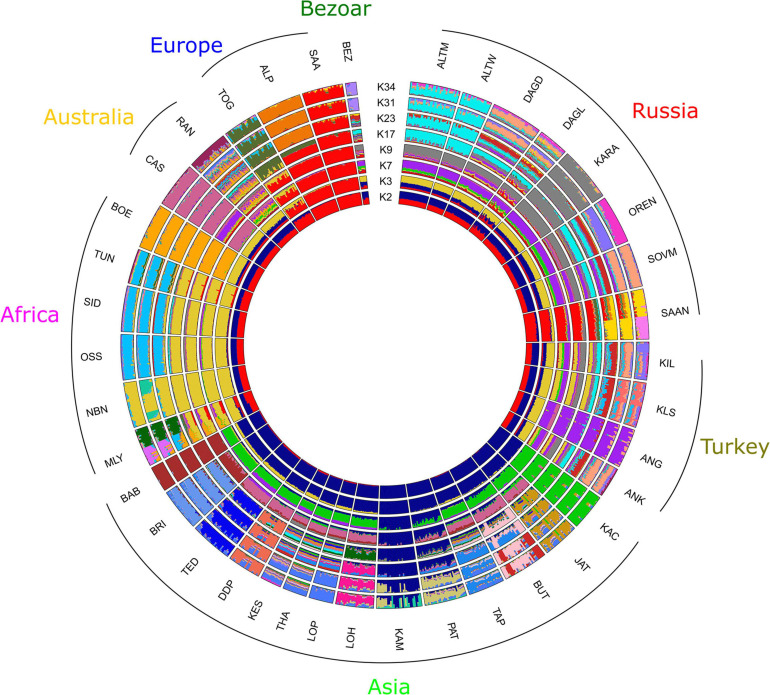
Specific local environmental and sociocultural conditions have led to the creation of various goat populations in Russia. National goat diversity includes breeds that have been selected for down and mohair production traits as well as versatile local breeds for which pastoralism is the main management system. Effective preservation and breeding programs for local goat breeds are missing due to the lack of DNA-based data. In this work, we analyzed the genetic diversity and population structure of Russian local goats, including Altai Mountain, Altai White Downy, Dagestan Downy, Dagestan Local, Karachaev, Orenburg, and Soviet Mohair goats, which were genotyped with the Illumina Goat SNP50 BeadChip. In addition, we addressed genetic relationships between local and global goat populations obtained from the AdaptMap project. Russian goats showed a high level of genetic diversity. Although a decrease in historical effective population sizes was revealed, the recent effective population sizes estimated for three generations ago were larger than 100 in all studied populations. The mean runs of homozygosity (ROH) lengths ranged from 79.42 to 183.94 Mb, and the average ROH number varied from 18 to 41. Short ROH segments (<2 Mb) were predominant in all breeds, while the longest ROH class (>16 Mb) was the least frequent. Principal component analysis, Neighbor-Net graph, and Admixture clustering revealed several patterns in Russian local goats. First, a separation of the Karachaev breed from other populations was observed. Moreover, genetic connections between the Orenburg and Altai Mountain breeds were suggested and the Dagestan breeds were found to be admixed with the Soviet Mohair breed. Neighbor-Net analysis and clustering of local and global breeds demonstrated the close genetic relations between Russian local and Turkish breeds that probably resulted from past admixture events through postdomestication routes. Our findings contribute to the understanding of the genetic relationships of goats originating in West Asia and Eurasia and may be used to design breeding programs for local goats to ensure their effective conservation and proper management.
俄罗斯特定的当地环境和社会文化条件导致了各种山羊种群的形成。俄罗斯的山羊多样性包括为产绒和马海毛生产性状而选育的品种,以及以游牧为主要管理方式的通用本地品种。由于缺乏基于DNA的数据,当地山羊品种的有效保存和育种计划缺失。在这项工作中,我们分析了俄罗斯当地山羊的遗传多样性和种群结构,包括阿尔泰山羊、阿尔泰白绒山羊、达吉斯坦绒山羊、达吉斯坦本地山羊、卡拉恰耶夫山羊、奥伦堡山羊和苏联马海毛山羊,这些山羊使用Illumina山羊SNP50芯片进行了基因分型。此外,我们研究了从AdaptMap项目获得的本地和全球山羊种群之间的遗传关系。俄罗斯山羊表现出高度的遗传多样性。虽然揭示了历史有效种群规模的下降,但三代前估计的近期有效种群规模在所有研究种群中都大于100。纯合子连续片段(ROH)的平均长度在79.42至183.94 Mb之间,平均ROH数量在18至41之间。短ROH片段(<2 Mb)在所有品种中占主导地位,而最长的ROH类别(>16 Mb)频率最低。主成分分析、邻接网图和混合聚类揭示了俄罗斯当地山羊的几种模式。首先,观察到卡拉恰耶夫品种与其他种群的分离。此外,有人提出奥伦堡品种和阿尔泰山羊品种之间存在遗传联系,并且发现达吉斯坦品种与苏联马海毛品种混合。本地和全球品种的邻接网分析和聚类表明,俄罗斯本地品种和土耳其品种之间存在密切的遗传关系,这可能是由于驯化后通过后驯化路线发生的过去混合事件导致的。我们的研究结果有助于理解起源于西亚和欧亚大陆的山羊的遗传关系,并可用于设计当地山羊的育种计划,以确保它们的有效保护和合理管理。