L.K. Ernst Federal Science Center for Animal Husbandry, Dubrovitzy Estate 60, Podolia, Russia, 142132.
All-Russian Research Institute of Sheep and Goat Breeding, Zootechnichesky Lane 15, Stavropol, Russia, 355017.
Genet Sel Evol. 2018 May 24;50(1):29. doi: 10.1186/s12711-018-0399-5.
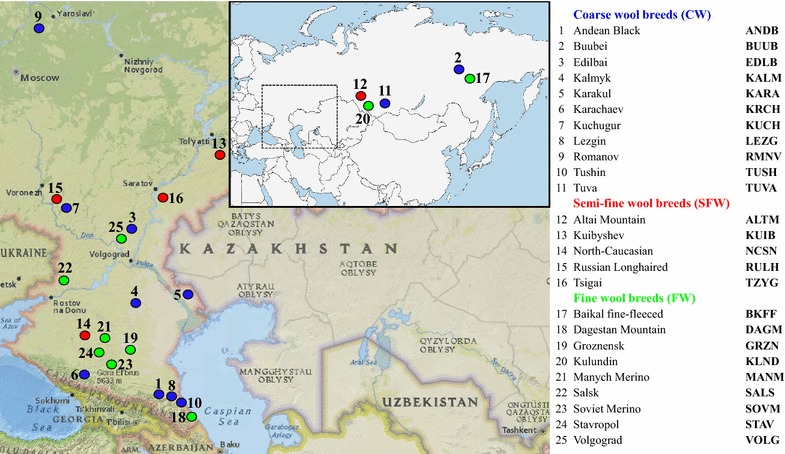
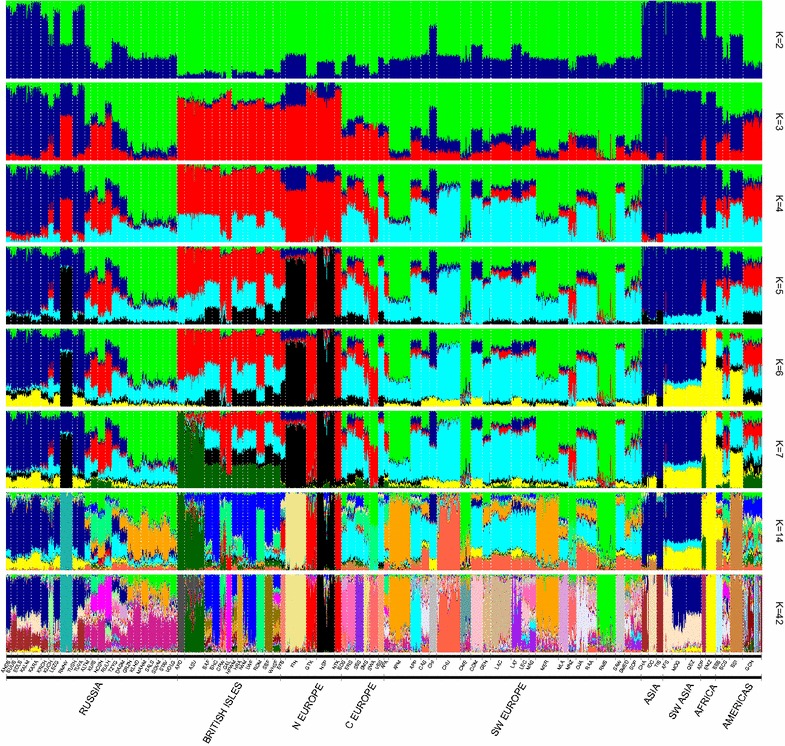
Russia has a diverse variety of native and locally developed sheep breeds with coarse, fine, and semi-fine wool, which inhabit different climate zones and landscapes that range from hot deserts to harsh northern areas. To date, no genome-wide information has been used to investigate the history and genetic characteristics of the extant local Russian sheep populations. To infer the population structure and genome-wide diversity of Russian sheep, 25 local breeds were genotyped with the OvineSNP50 BeadChip. Furthermore, to evaluate admixture contributions from foreign breeds in Russian sheep, a set of 58 worldwide breeds from publicly available genotypes was added to our data.
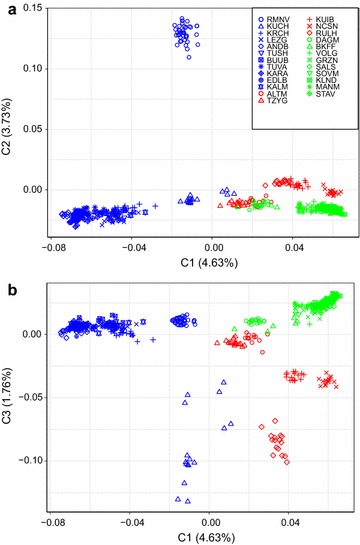
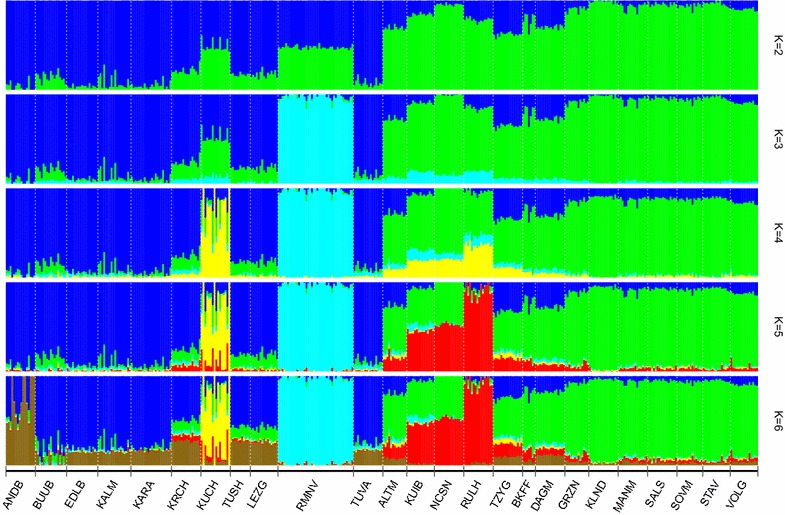
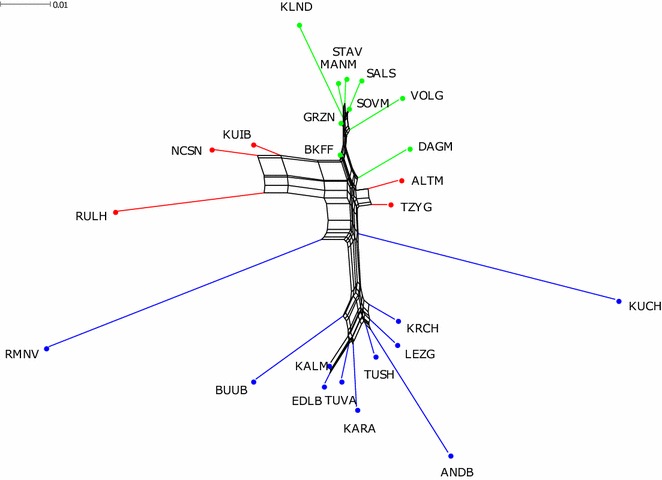
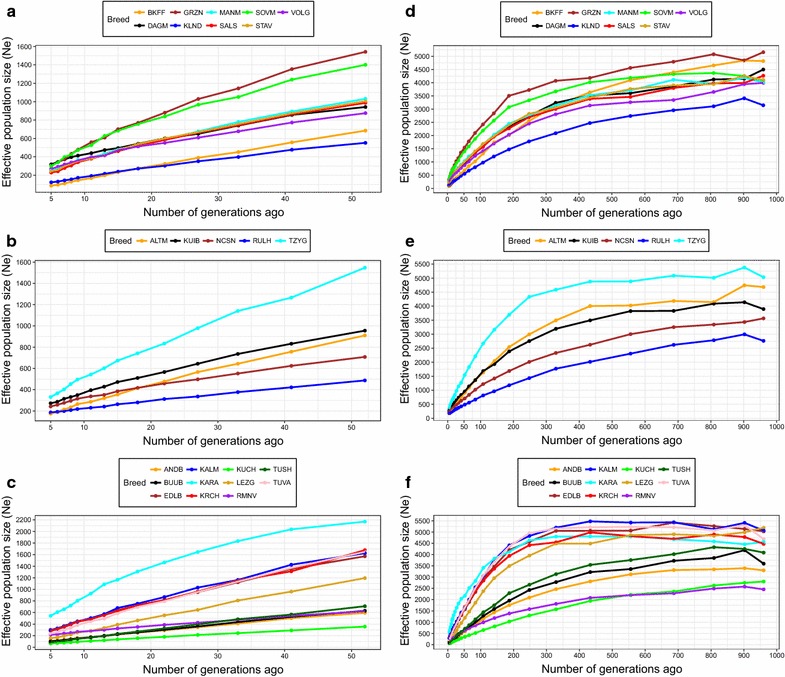
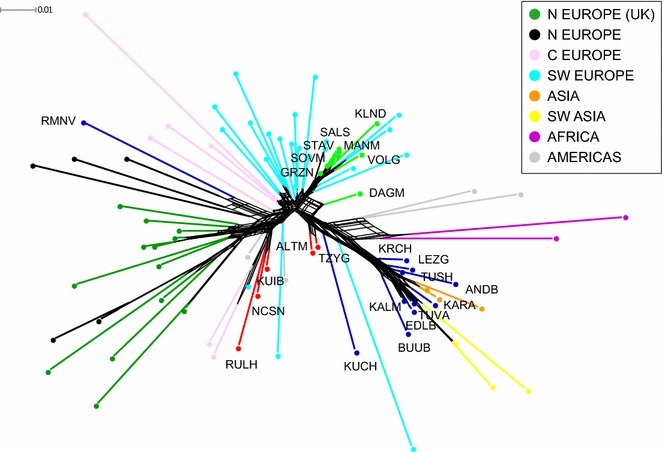
We recorded similar observed heterozygosity (0.354-0.395) and allelic richness (1.890-1.955) levels across the analyzed breeds and they are comparable with those observed in the worldwide breeds. Recent effective population sizes estimated from linkage disequilibrium five generations ago ranged from 65 to 543. Multi-dimensional scaling, admixture, and neighbor-net analyses consistently identified a two-step subdivision of the Russian local sheep breeds. A first split clustered the Russian sheep populations according to their wool type (fine wool, semi-fine wool and coarse wool). The Dagestan Mountain and Baikal fine-fleeced breeds differ from the other Merino-derived local breeds. The semi-fine wool cluster combined a breed of Romanian origin, Tsigai, with its derivative Altai Mountain, the two Romney-introgressed breeds Kuibyshev and North Caucasian, and the Lincoln-introgressed Russian longhaired breed. The coarse-wool group comprised the Nordic short-tailed Romanov, the long-fat-tailed outlier Kuchugur and two clusters of fat-tailed sheep: the Caucasian Mountain breeds and the Buubei, Karakul, Edilbai, Kalmyk and Tuva breeds. The Russian fat-tailed breeds shared co-ancestry with sheep from China and Southwestern Asia (Iran).
In this study, we derived the genetic characteristics of the major Russian local sheep breeds, which are moderately diverse and have a strong population structure. Pooling our data with a worldwide genotyping set gave deeper insight into the history and origin of the Russian sheep populations.
俄罗斯拥有丰富多样的本土和本地开发的绵羊品种,具有粗毛、细毛和半细毛,栖息在从炎热的沙漠到恶劣的北部地区等不同的气候带和景观中。迄今为止,尚无全基因组信息用于研究现存俄罗斯本地绵羊种群的历史和遗传特征。为了推断俄罗斯绵羊的种群结构和全基因组多样性,我们使用 OvineSNP50 BeadChip 对 25 个本地品种进行了基因分型。此外,为了评估外国品种在俄罗斯绵羊中的混合贡献,我们还将一组来自公开基因型的 58 个全球品种添加到我们的数据中。
我们记录了分析品种之间相似的观察杂合度(0.354-0.395)和等位基因丰富度(1.890-1.955)水平,与全球品种观察到的水平相当。从五代前的连锁不平衡估计的近期有效种群大小从 65 到 543 不等。多维尺度分析、混合和邻居网络分析一致地将俄罗斯本地绵羊品种分为两步进行细分。第一次分裂根据羊毛类型(细毛、半细毛和粗毛)对俄罗斯绵羊种群进行聚类。达吉斯坦山脉和贝加尔湖细毛品种与其他美利奴衍生的本地品种不同。半细毛聚类组合了一种罗马尼亚起源的品种 Tsigai,以及它的衍生品种阿尔泰山脉、两个罗姆尼血统的库比雪夫和北高加索品种,以及林肯血统的俄罗斯长毛品种。粗毛组包括北欧短尾罗曼诺夫、长尾长耳的异常品种库丘古尔和两个脂肪尾巴羊的聚类:高加索山脉品种和布贝、卡拉库尔、埃迪尔拜、卡尔梅克和图瓦品种。俄罗斯脂肪尾巴品种与来自中国和西南亚(伊朗)的绵羊共享共同祖先。
在这项研究中,我们得出了俄罗斯主要本地绵羊品种的遗传特征,这些品种具有中等程度的多样性和强烈的种群结构。将我们的数据与全球基因分型集进行合并,使我们更深入地了解了俄罗斯绵羊种群的历史和起源。