Division of Biological Science, Department of Science and Technology, Nara Institute of Science & Technology, Ikoma, Nara, Japan.
PLoS Genet. 2021 Jul 19;17(7):e1009682. doi: 10.1371/journal.pgen.1009682. eCollection 2021 Jul.
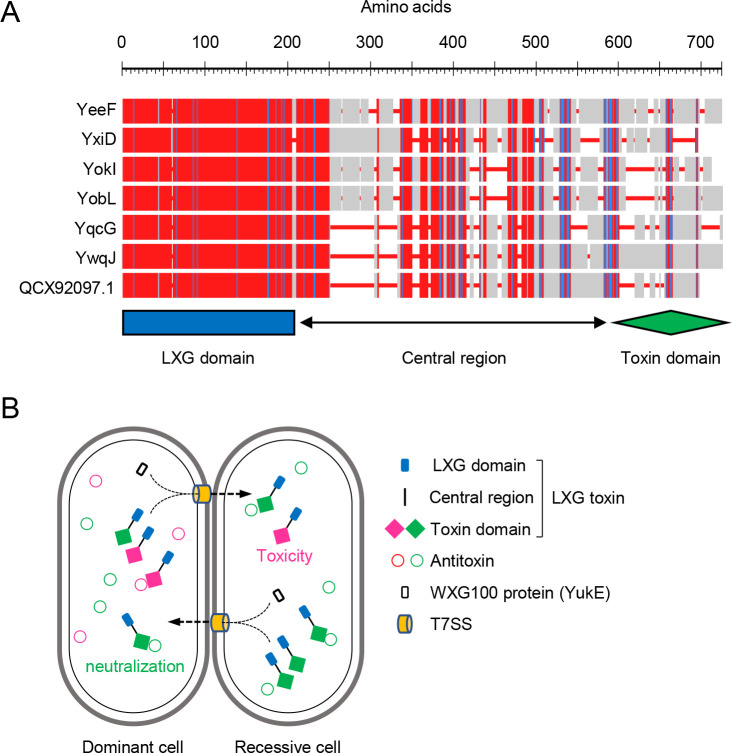
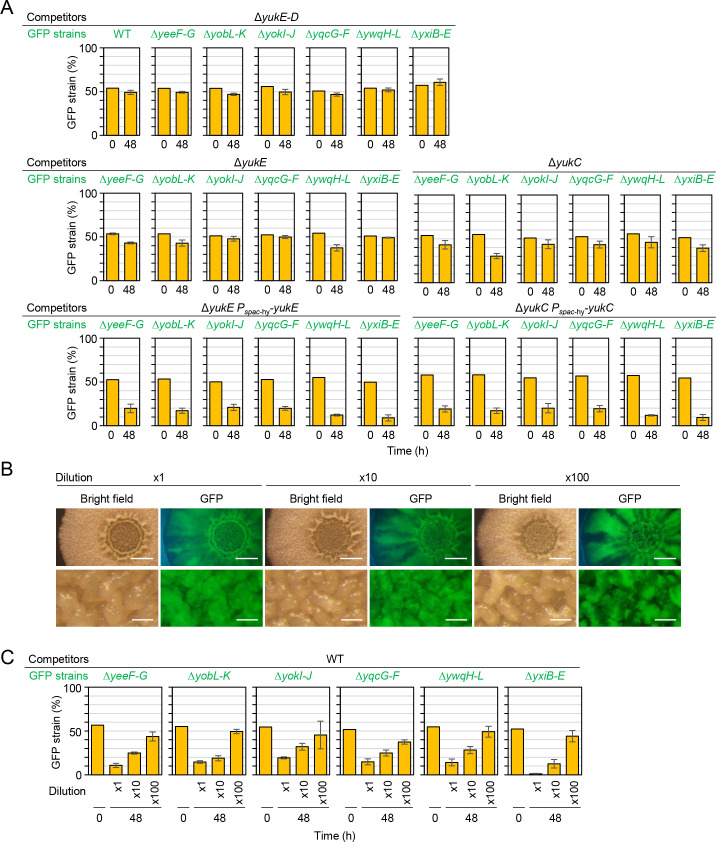
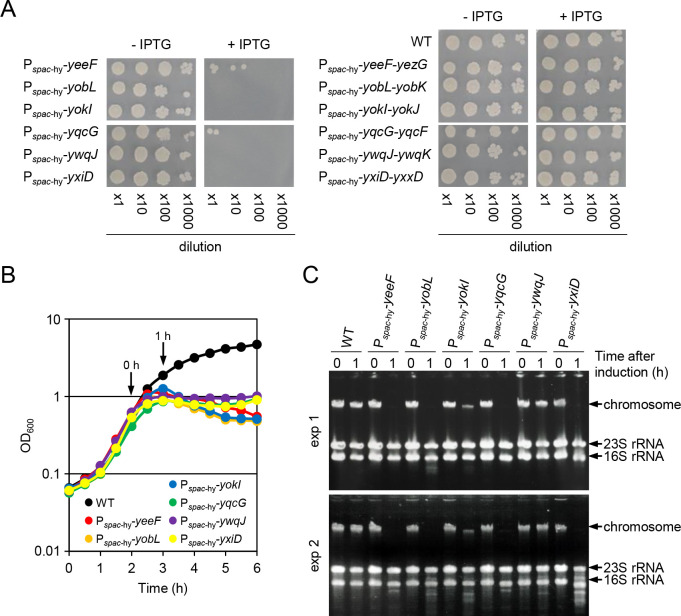
Biofilms are multispecies communities, in which bacteria constantly compete with one another for resources and niches. Bacteria produce many antibiotics and toxins for competition. However, since biofilm cells exhibit increased tolerance to antimicrobials, their roles in biofilms remain controversial. Here, we showed that Bacillus subtilis produces multiple diverse polymorphic toxins, called LXG toxins, that contain N-terminal LXG delivery domains and diverse C-terminal toxin domains. Each B. subtilis strain possesses a distinct set of LXG toxin-antitoxin genes, the number and variation of which is sufficient to distinguish each strain. The B. subtilis strain NCIB3610 possesses six LXG toxin-antitoxin operons on its chromosome, and five of the toxins functioned as DNase. In competition assays, deletion mutants of any of the six LXG toxin-antitoxin operons were outcompeted by the wild-type strain. This phenotype was suppressed when the antitoxins were ectopically expressed in the deletion mutants. The fitness defect of the mutants was only observed in solid media that supported biofilm formation. Biofilm matrix polymers, exopolysaccharides and TasA protein polymers were required for LXG toxin function. These results indicate that LXG toxin-antitoxin systems specifically mediate intercellular competition between B. subtilis strains in biofilms. Mutual antagonism between some LXG toxin producers drove the spatial segregation of two strains in a biofilm, indicating that LXG toxins not only mediate competition in biofilms, but may also help to avoid warfare between strains in biofilms. LXG toxins from strain NCIB3610 were effective against some natural isolates, and thus LXG toxin-antitoxin systems have ecological impact. B. subtilis possesses another polymorphic toxin, WapA. WapA had toxic effects under planktonic growth conditions but not under biofilm conditions because exopolysaccharides and TasA protein polymers inhibited WapA function. These results indicate that B. subtilis uses two types of polymorphic toxins for competition, depending on the growth mode.
生物膜是多菌种群落,其中细菌不断相互竞争资源和生态位。细菌产生许多抗生素和毒素进行竞争。然而,由于生物膜细胞对抗生素表现出更高的耐受性,它们在生物膜中的作用仍存在争议。在这里,我们表明枯草芽孢杆菌产生多种不同的多态性毒素,称为 LXG 毒素,它包含 N 端 LXG 输送结构域和不同的 C 端毒素结构域。每个枯草芽孢杆菌菌株都拥有一套独特的 LXG 毒素-抗毒素基因,其数量和变化足以区分每个菌株。枯草芽孢杆菌菌株 NCIB3610 在其染色体上拥有六个 LXG 毒素-抗毒素操纵子,其中五个毒素作为 DNA 酶发挥作用。在竞争测定中,任何六个 LXG 毒素-抗毒素操纵子的缺失突变体都被野生型菌株所淘汰。当抗毒素在缺失突变体中外源表达时,这种表型被抑制。只有在支持生物膜形成的固体培养基中才能观察到突变体的适应性缺陷。生物膜基质聚合物、胞外多糖和 TasA 蛋白聚合物是 LXG 毒素功能所必需的。这些结果表明,LXG 毒素-抗毒素系统专门介导枯草芽孢杆菌菌株在生物膜中的细胞间竞争。一些 LXG 毒素产生菌之间的相互拮抗作用导致生物膜中两个菌株的空间分离,表明 LXG 毒素不仅介导生物膜中的竞争,而且可能有助于避免生物膜中菌株之间的战争。来自菌株 NCIB3610 的 LXG 毒素对一些天然分离株有效,因此 LXG 毒素-抗毒素系统具有生态影响。枯草芽孢杆菌还拥有另一种多态性毒素 WapA。WapA 在浮游生长条件下具有毒性作用,但在生物膜条件下没有,因为胞外多糖和 TasA 蛋白聚合物抑制了 WapA 的功能。这些结果表明,枯草芽孢杆菌根据生长模式使用两种类型的多态性毒素进行竞争。