Department of Psychiatry, University of Pittsburgh School of Medicine, University of Pittsburgh, Pittsburgh, PA, USA.
Magnetic Resonance Research Center, Department of Radiology, University of Pittsburgh Medical Center, University of Pittsburgh, Pittsburgh, PA, USA.
Neuropsychopharmacology. 2021 Nov;46(12):2207-2216. doi: 10.1038/s41386-021-01088-1. Epub 2021 Jul 20.
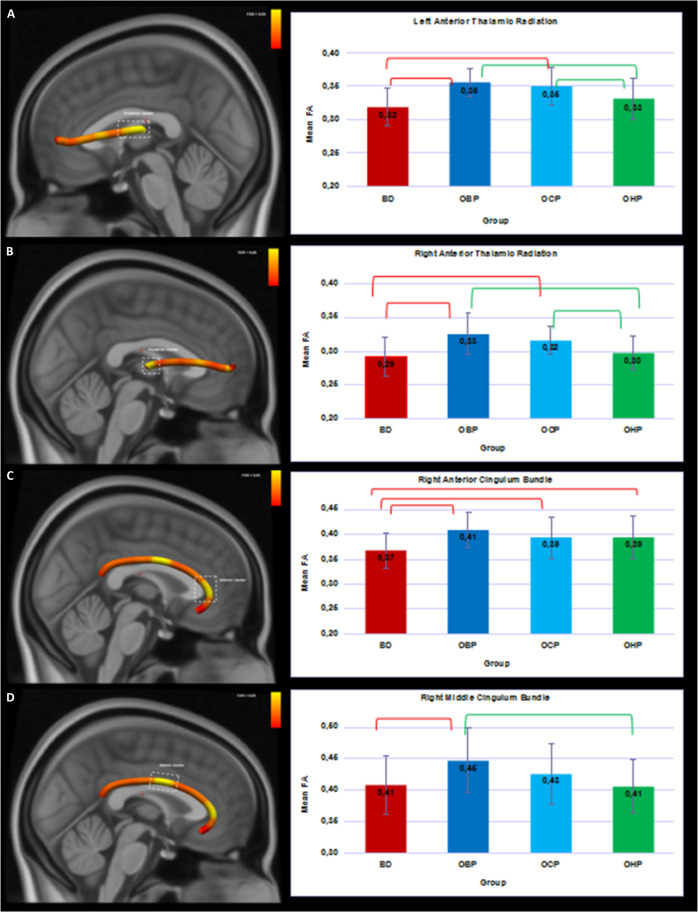
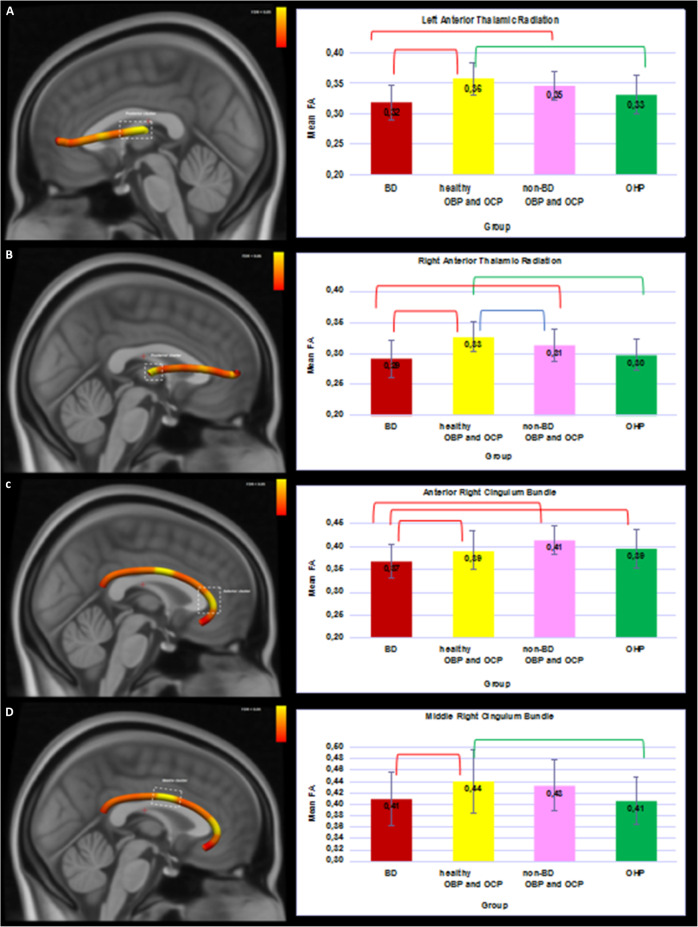
Bipolar disorder (BD) is highly heritable. Identifying objective biomarkers reflecting pathophysiological processes predisposing to, versus protecting against BD, can help identify BD risk in offspring of BD parents. We recruited 21 BD participants with a first-degree relative with BD, 25 offspring of BD parents, 27 offspring of comparison parents with non-BD psychiatric disorders, and 32 healthy offspring of healthy parents. In at-risk groups, 23 had non-BD diagnoses and 29, no Axis-I diagnoses(healthy). Five at-risk offspring who developed BD post scan(Converters) were included. Diffusion imaging(dMRI) analysis with tract segmentation identified between-group differences in the microstructure of prefrontal tracts supporting emotional regulation relevant to BD: forceps minor, anterior thalamic radiation(ATR), cingulum bundle(CB), and uncinate fasciculus(UF). BD participants showed lower fractional anisotropy (FA) in the right CB (anterior portion) than other groups (q < 0.05); and in bilateral ATR (posterior portion) versus at-risk groups (q < 0.001). Healthy, but not non-BD, at-risk participants showed significantly higher FA in bilateral ATR clusters than healthy controls (qs < 0.05). At-risk groups showed higher FA in these clusters than BD participants (qs < 0.05). Non-BD versus healthy at-risk participants, and Converters versus offspring of BD parents, showed lower FA in the right ATR cluster (qs < 0.05). Low anterior right CB FA in BD participants versus other groups might result from having BD. High bilateral ATR FA in at-risk groups, and in healthy at-risk participants, versus healthy controls might protect against BD/other psychiatric disorders. Absence of elevated right ATR FA in non-BD versus healthy at-risk participants, and in Converters versus non-converter offspring of BD parents, might lower protection against BD in at-risk groups.
双相障碍 (BD) 具有高度遗传性。识别反映易患 BD 与保护 BD 发病的客观生物标志物,有助于识别 BD 父母后代的 BD 风险。我们招募了 21 名有一级亲属患有 BD 的 BD 参与者、25 名 BD 父母的后代、27 名非 BD 精神障碍父母的后代和 32 名健康父母的健康后代。在高危组中,23 人有非 BD 诊断,29 人没有轴 I 诊断(健康)。5 名扫描后出现 BD 的高危后代(转化者)被纳入。通过束分割的弥散张量成像(dMRI)分析,确定了与 BD 相关的情绪调节前额叶束微观结构的组间差异:钩束小束、前丘脑辐射(ATR)、扣带束(CB)和钩束(UF)。BD 参与者的右侧 CB(前部)的分数各向异性(FA)低于其他组(q<0.05);双侧 ATR(后部)与高危组相比(q<0.001)。健康但非非 BD 的高危参与者双侧 ATR 簇的 FA 显著高于健康对照组(qs<0.05)。高危组在这些簇中的 FA 高于 BD 参与者(qs<0.05)。非 BD 与健康高危参与者,以及转化者与 BD 父母的后代相比,右侧 ATR 簇的 FA 较低(qs<0.05)。BD 参与者的右侧 CB FA 低于其他组,可能是因为他们患有 BD。高危组的双侧 ATR FA 较高,而健康高危组和健康对照组的 FA 较高,可能会保护他们免受 BD/其他精神障碍的影响。非 BD 与健康高危参与者,以及转化者与非转化者的 BD 父母后代的右侧 ATR FA 升高,可能会降低高危组对 BD 的保护作用。