Wilairatana Polrat, Mala Wanida, Rattaprasert Pongruj, Kotepui Kwuntida Uthaisar, Kotepui Manas
Department of Clinical Tropical Medicine, Faculty of Tropical Medicine, Mahidol University, Bangkok 10400, Thailand.
Medical Technology, School of Allied Health Sciences, Walailak University, Tha Sala, Nakhon Si Thammarat 80161, Thailand.
Trop Med Infect Dis. 2021 Jul 3;6(3):122. doi: 10.3390/tropicalmed6030122.
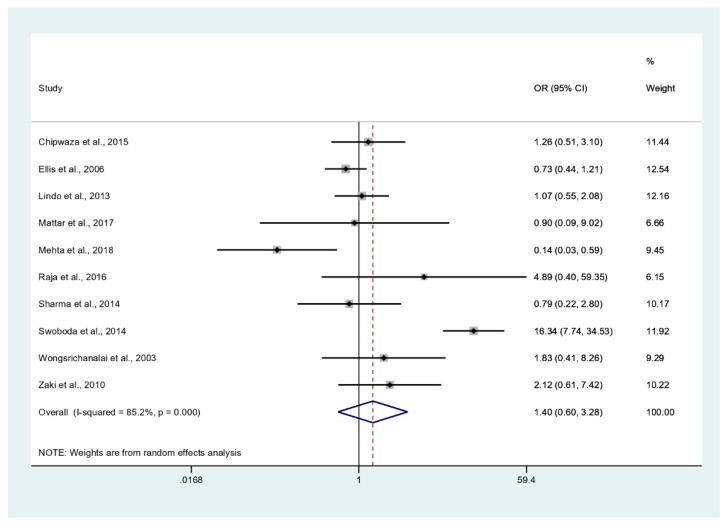
Malaria and leptospirosis are important cosmopolitan infections that have emerged with overlapping geographic distribution, especially in tropical and subtropical regions. Therefore, co-infection with malaria and leptospirosis may occur in overlapping areas. The present study aimed to quantify the prevalence of malaria and leptospirosis co-infection among febrile patients. The association between malaria and leptospirosis infections was also investigated. Relevant studies that had reported malaria and leptospirosis co-infection were identified from PubMed, Scopus, and Web of Science. The risk of bias of the studies was assessed using the Joanna Briggs Institute (JBI) Critical Appraisal Tool. The pooled prevalence of malaria and leptospirosis co-infections among febrile patients and the pooled prevalence of leptospirosis infection among malaria patients were estimated using random effect models. The association between malaria and leptospirosis infection among febrile patients was estimated using random effect models. The outcomes of each study were shown in a forest plot in point estimate and 95% confidence interval (CI). Heterogeneity among the included studies was assessed using Cochran's Q and quantified using I-squared statistics. For leptospirosis, subgroup analyses of countries, diagnostic tests, and participants' age groups were performed to specify prevalence in each subgroup. Publication bias was assessed by funnel-plot visualization. Of the 2370 articles identified from the databases, 15 studies met the eligibility criteria and were included for qualitative and quantitative syntheses. Most of the included studies were conducted in India (5/15, 33.3%), Thailand (3/15, 20%), and Cambodia (2/15, 13.3%). Most of the enrolled cases were febrile patients (5838 cases) and malaria-positive patients (421 cases). The meta-analysis showed that the pooled prevalence of malaria and leptospirosis co-infection (86 cases) among febrile patients was 1% (95% CI: 1-2%, I: 83.3%), while the pooled prevalence of leptospirosis infection (186 cases) among malaria patients was 13% (95% CI: 9-18%, I: 90.3%). The meta-analysis showed that malaria and leptospirosis co-infections occurred by chance (p: 0.434, OR: 1.4, 95% CI: 0.6-3.28, I: 85.2%). The prevalence of malaria in leptospirosis co-infection among febrile patients in the included studies was low. Co-infection was likely to occur by chance. However, as clinical symptoms of leptospirosis patients were non-specific and not distinguishable from symptoms of malaria patients, clinicians caring for febrile patients in an area where those two diseases are endemic should maintain a high index of suspicion for both diseases and whether mono-infections or co-infections are likely. Recognition of this co-infection may play an important role in reducing disease severity and treatment duration.

疟疾和钩端螺旋体病是重要的世界性感染疾病,它们在地理分布上有重叠,尤其是在热带和亚热带地区。因此,疟疾和钩端螺旋体病的合并感染可能发生在重叠区域。本研究旨在量化发热患者中疟疾和钩端螺旋体病合并感染的患病率。同时还调查了疟疾和钩端螺旋体病感染之间的关联。从PubMed、Scopus和Web of Science中检索出报告了疟疾和钩端螺旋体病合并感染的相关研究。使用乔安娜·布里格斯研究所(JBI)的批判性评价工具评估这些研究的偏倚风险。采用随机效应模型估计发热患者中疟疾和钩端螺旋体病合并感染的合并患病率以及疟疾患者中钩端螺旋体病感染的合并患病率。采用随机效应模型估计发热患者中疟疾和钩端螺旋体病感染之间的关联。每项研究的结果以点估计值和95%置信区间(CI)的森林图形式呈现。使用Cochran's Q评估纳入研究之间的异质性,并使用I²统计量进行量化。对于钩端螺旋体病,对国家、诊断测试和参与者年龄组进行亚组分析,以明确每个亚组中的患病率。通过漏斗图可视化评估发表偏倚。从数据库中识别出的2370篇文章中,有15项研究符合纳入标准,并被纳入定性和定量综合分析。大多数纳入研究在印度(5/15,33.3%)、泰国(3/15,20%)和柬埔寨(2/