Department of Neonatology, Faculty of Medicine, Eberhard-Karls-University, Calwer Straße 7, 72076, Tübingen, Germany.
Center for Pediatric Clinical Studies, Faculty of Medicine, Eberhard-Karls-University, Calwer Straße 7, 72076, Tübingen, Germany.
Eur J Nutr. 2022 Feb;61(1):219-230. doi: 10.1007/s00394-021-02637-6. Epub 2021 Jul 21.
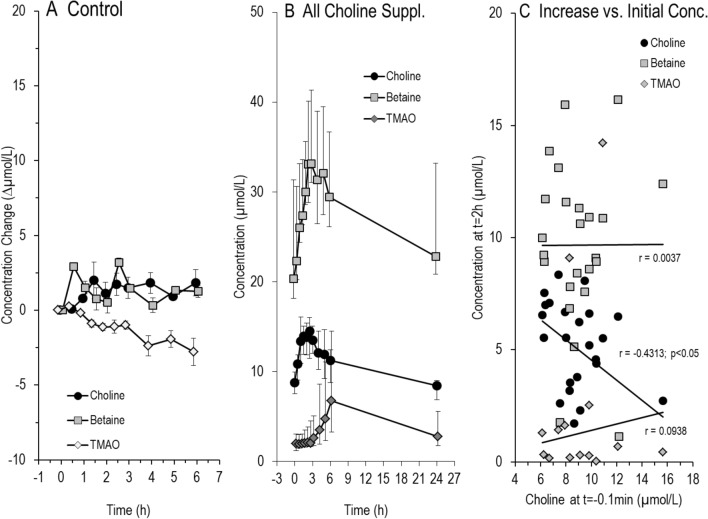
Adequate intake of choline is essential for growth and homeostasis, but its supply does often not meet requirements. Choline deficiency decreases phosphatidylcholine (PC) and betaine synthesis, resulting in organ pathology, especially of liver, lung, and brain. This is of particular clinical importance in preterm infants and cystic fibrosis patients. We compared four different choline supplements for their impact on plasma concentration and kinetics of choline, betaine as a methyl donor and trimethylamine oxide (TMAO) as a marker of bacterial degradation prior to absorption.
Prospective randomized cross-over study (1/2020-4/2020) in six healthy adult men. Participants received a single dose of 550 mg/d choline equivalent in the form of choline chloride, choline bitartrate, α-glycerophosphocholine (GPC), and egg-PC in randomized sequence at least 1 week apart. Blood was taken from t = - 0.1-6 h after supplement intake. Choline, betaine, TMAO, and total PC concentrations were analyzed by tandem mass spectrometry. Results are shown as medians and interquartile range.
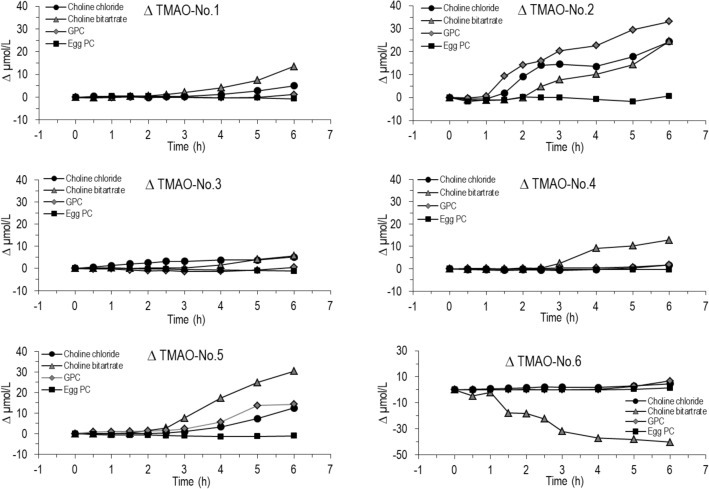
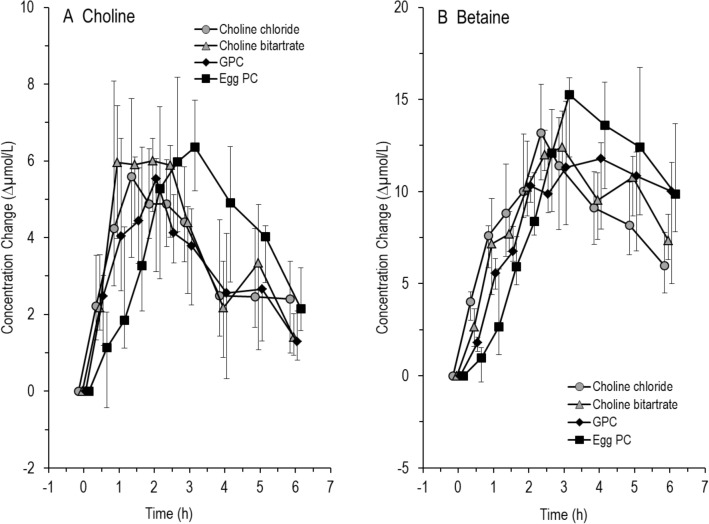
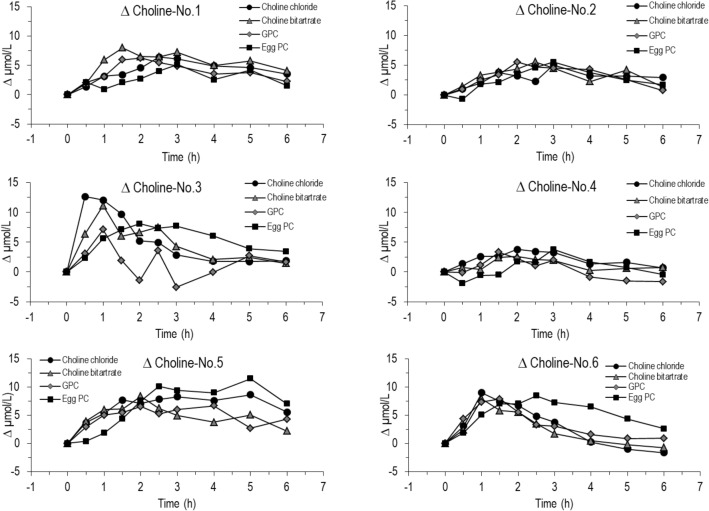
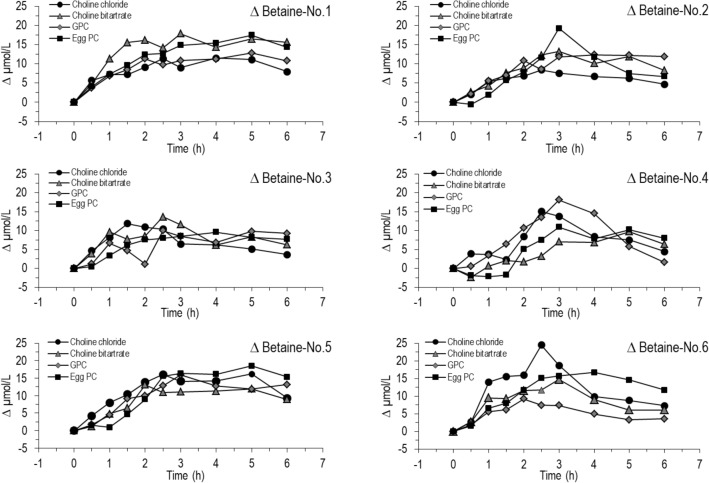
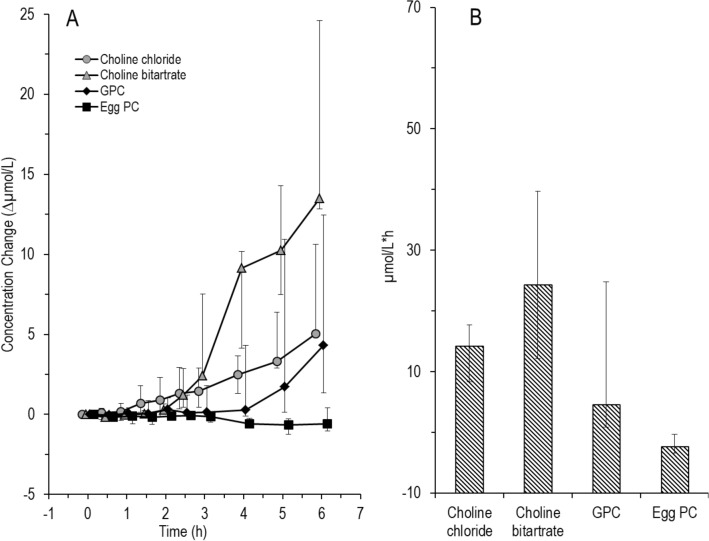
There was no difference in the AUC of choline plasma concentrations after intake of the different supplements. Individual plasma kinetics of choline and betaine differed and concentrations peaked latest for PC (at ≈3 h). All supplements similarly increased plasma betaine. All water-soluble supplements rapidly increased TMAO, whereas egg-PC did not.
All supplements tested rapidly increased choline and betaine levels to a similar extent, with egg-PC showing the latest peak. Assuming that TMAO may have undesirable effects, egg-PC might be best suited for choline supplementation in adults.
This study was registered at "Deutsches Register Klinischer Studien" (DRKS) (German Register for Clinical Studies), 17.01.2020, DRKS00020454.
足够的胆碱摄入对于生长和内稳态至关重要,但它的供应往往不能满足需求。胆碱缺乏会降低磷脂酰胆碱(PC)和甜菜碱的合成,导致器官病变,尤其是肝脏、肺和大脑。这在早产儿和囊性纤维化患者中具有特别重要的临床意义。我们比较了四种不同的胆碱补充剂对其对血浆中胆碱浓度和动力学的影响,甜菜碱作为甲基供体,三甲胺氧化物(TMAO)作为吸收前细菌降解的标志物。
2020 年 1 月至 2020 年 4 月,在 6 名健康成年男性中进行了前瞻性随机交叉研究。参与者以随机顺序至少相隔 1 周接受 550mg/d 胆碱当量的胆碱氯化物、酒石酸胆碱、α-甘油磷酸胆碱(GPC)和卵磷酯(PC)单一剂量。在补充摄入后 t = -0.1-6h 采血。通过串联质谱法分析胆碱、甜菜碱、TMAO 和总 PC 浓度。结果表示为中位数和四分位间距。
不同补充剂摄入后,胆碱血浆浓度的 AUC 没有差异。胆碱和甜菜碱的个体血浆动力学不同,PC 的浓度峰值最晚(约 3 小时)。所有补充剂均以相似的方式增加了血浆甜菜碱。所有水溶性补充剂均迅速增加了 TMAO,而卵磷酯则没有。
所有测试的补充剂均能迅速增加胆碱和甜菜碱的水平,达到相似的程度,而卵磷酯的峰值最晚。假设 TMAO 可能产生不良影响,卵磷酯可能最适合成人补充胆碱。
该研究在“德国临床研究注册处”(DRKS)(德国临床研究注册)进行注册,注册日期为 2020 年 1 月 17 日,DRKS00020454。