University Research Priority Program "Dynamics of Healthy Aging", University of Zurich, Zurich, Switzerland.
Institute of Biometry and Clinical Epidemiology, Charité - Universitätsmedizin Berlin, Corporate Member of Freie Universität Berlin, Humboldt-Universität zu Berlin, and Berlin Institute of Health, Berlin, Germany.
J Oral Rehabil. 2021 Oct;48(10):1160-1172. doi: 10.1111/joor.13231. Epub 2021 Aug 14.
To date, no study has investigated the association between chewing function and related parameters as a function of the degree of dementia using a finer subdivision of the values of the Mini-Mental State Examination (MMSE).
This study aimed to investigate the differences in chewing function and related parameters as a function of the degree of dementia.
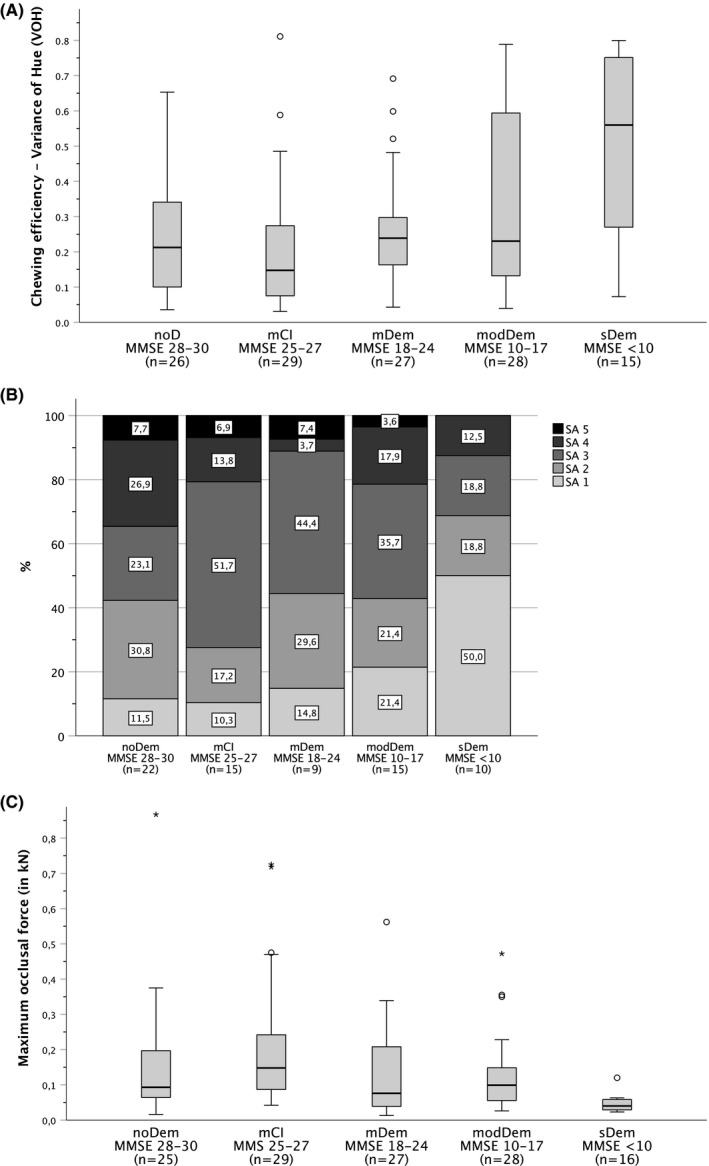
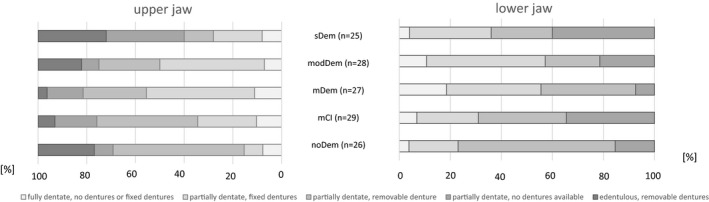
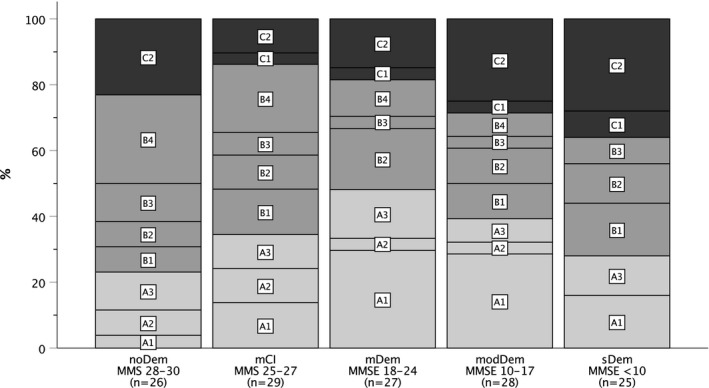
An analysis of cross-sectional data obtained from the OrBiD (Oral Health, Bite Force, and Dementia) pilot study was performed. The participants were stratified into five groups based on the outcomes of the MMSE (no dementia, MMSE 28-30; mild cognitive impairment, MMSE 25-27; mild dementia, MMSE 18-24; moderate dementia, MMSE 10-17; severe dementia, MMSE <10). The chewing efficiency, maximum occlusal force and related parameters (number of supporting zones, number of teeth, Eichner index, tooth/denture status, denture quality, and dental treatment needs) were recorded.
The MMSE groups showed significantly different chewing efficiencies (p = .003, Jonckheere-Terpstra test) and maximum occlusal forces (p = .003, Jonckheere-Terpstra test), but the number of supporting zones (p = .055, chi-square test) and the number of natural teeth (p = .126, chi-square test) were not different. The Eichner index, tooth/denture status, denture quality and dental treatment need showed no significant associations with the degree of dementia.
An improvement in the usability of the measurement methods for assessing chewing function in people with dementia is needed. Research involving people with dementia is necessary because the nutritional situation often deteriorates rapidly within a multifactorial system, which includes chewing ability and oral health.
迄今为止,尚无研究使用更精细的 Mini-Mental State Examination(MMSE)值细分来研究咀嚼功能及其相关参数与痴呆程度之间的关系。
本研究旨在探讨咀嚼功能及其相关参数与痴呆程度的关系。
对 OrBiD(口腔健康、咬合力和痴呆)试点研究的横断面数据进行分析。根据 MMSE 的结果(无痴呆、MMSE 28-30 分;轻度认知障碍、MMSE 25-27 分;轻度痴呆、MMSE 18-24 分;中度痴呆、MMSE 10-17 分;重度痴呆、MMSE<10 分),将参与者分为五组。记录咀嚼效率、最大牙合力及相关参数(支持区数量、牙齿数量、Eichner 指数、牙/义齿状况、义齿质量和牙齿治疗需求)。
MMSE 组的咀嚼效率(p=.003,Jonckheere-Terpstra 检验)和最大牙合力(p=.003,Jonckheere-Terpstra 检验)差异有统计学意义,但支持区数量(p=.055,卡方检验)和天然牙数量(p=.126,卡方检验)无差异。Eichner 指数、牙/义齿状况、义齿质量和牙齿治疗需求与痴呆程度无显著相关性。
需要改进评估痴呆患者咀嚼功能的测量方法的可用性。需要对痴呆患者进行研究,因为在包括咀嚼能力和口腔健康在内的多因素系统中,营养状况通常会迅速恶化。