Department of Prosthodontics and Materials Science, Gerodontology Section, University of Leipzig, 04103 Leipzig, Germany.
University Research Priority Program "Dynamics of Healthy Aging", University of Zurich, Andreasstrasse 15/Box 2, 8050 Zurich, Switzerland.
Int J Environ Res Public Health. 2022 Mar 22;19(7):3778. doi: 10.3390/ijerph19073778.
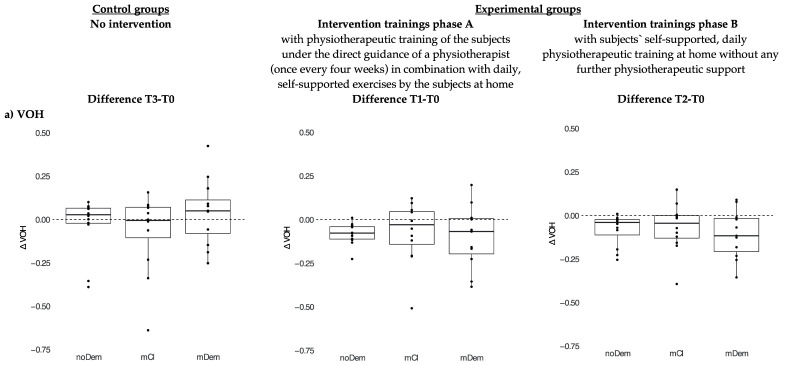
Until now, no study has investigated the effects of masticatory muscle training on chewing function in people with dementia. This study aimed to investigate whether physiotherapeutic exercises for the masticatory muscles have an influence on chewing efficiency and bite force in people with dementia. In a clinical trial with stratified randomization subjects were assigned to three groups based on the Mini Mental State Examination (MMSE: group 1-28-30, group 2-25-27, group 3-18-24). Each group was divided into an experimental (ExpG, intervention) and control group (ConG, no intervention). As intervention a Masticatory Muscle Training (MaMuT) (part 1: three physiotherapeutic treatments and daily home exercises, part 2: daily home exercises only) was carried out. Chewing efficiency and bite force were recorded. The MaMuT influenced the masticatory performance regardless of the cognitive state. Bite force increased in ExpG 1 and 2. Without further training, however, the effect disappeared. Chewing efficiency increased in all ExpG. After completion of the training, the ExpG 2 and 3 showed a decrease to initial values. Subjects of ExpG 1 showed a training effect at the final examination, but a tendency toward the initial values was observed. ExpG 3 seemed to benefit most from the physiotherapeutic exercises in terms of improving chewing efficiency by the end of the intervention phase. ExpG 1 showed the greatest gain in bite force. The MaMuT program is a potential method of improving masticatory performance in people with cognitive impairment or dementia when used on a daily basis.
到目前为止,还没有研究调查咀嚼肌训练对痴呆患者咀嚼功能的影响。本研究旨在探讨口腔咀嚼肌物理治疗运动对痴呆患者咀嚼效率和咬合力的影响。在一项临床随机分组试验中,受试者根据 Mini Mental State Examination (MMSE) 分为三组 (组 1-28-30、组 2-25-27、组 3-18-24)。每组分为实验组 (ExpG,干预组) 和对照组 (ConG,无干预组)。干预措施为口腔咀嚼肌训练 (MaMuT) (第 1 部分:3 次物理治疗和每日家庭锻炼,第 2 部分:仅每日家庭锻炼)。记录咀嚼效率和咬合力。MaMuT 影响咀嚼性能,与认知状态无关。ExpG1 和 2 的咬合力增加。然而,没有进一步的训练,效果消失了。所有 ExpG 的咀嚼效率都增加了。训练完成后,ExpG2 和 3 的咀嚼效率恢复到初始值。ExpG1 的咀嚼效率在最终检查时表现出训练效果,但观察到向初始值的趋势。ExpG3 似乎从物理治疗运动中获益最多,在干预阶段结束时,咀嚼效率提高。ExpG1 的咬合力增益最大。MaMuT 方案是一种潜在的改善认知障碍或痴呆患者咀嚼性能的方法,当每天使用时。