Laboratory of Zoology, Research Institute for Biosciences, University of Mons, Place du Parc 20, Mons, 7000, Belgium.
Department of Zoology, Division of Functional Morphology, INSECT Lab, Stockholm University, Svante Arrhenius väg 18b, Stockholm, 11418, Sweden.
Biol Rev Camb Philos Soc. 2021 Dec;96(6):2755-2770. doi: 10.1111/brv.12777. Epub 2021 Jul 21.
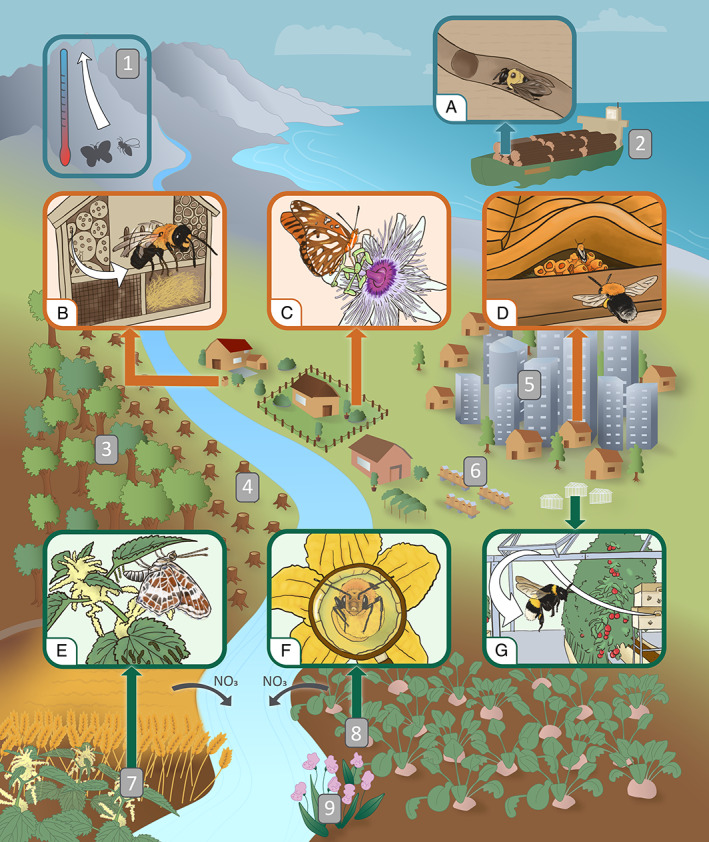
Global changes are severely affecting pollinator insect communities worldwide, resulting in repeated patterns of species extirpations and extinctions. Whilst negative population trends within this functional group have understandably received much attention in recent decades, another facet of global changes has been overshadowed: species undergoing expansion. Here, we review the factors and traits that have allowed a fraction of the pollinating entomofauna to take advantage of global environmental change. Sufficient mobility, high resistance to acute heat stress, and inherent adaptation to warmer climates appear to be key traits that allow pollinators to persist and even expand in the face of climate change. An overall flexibility in dietary and nesting requirements is common in expanding species, although niche specialization can also drive expansion under specific contexts. The numerous consequences of wild and domesticated pollinator expansions, including competition for resources, pathogen spread, and hybridization with native wildlife, are also discussed. Overall, we show that the traits and factors involved in the success stories of expanding pollinators are mostly species specific and context dependent, rendering generalizations of 'winning traits' complicated. This work illustrates the increasing need to consider expansion and its numerous consequences as significant facets of global changes and encourages efforts to monitor the impacts of expanding insect pollinators, particularly exotic species, on natural ecosystems.
全球变化正在严重影响世界各地的传粉昆虫群落,导致物种灭绝和灭绝的反复出现。虽然该功能组的负面种群趋势在最近几十年得到了广泛关注,但全球变化的另一个方面却被忽视了:物种在扩张。在这里,我们回顾了使一部分传粉昆虫能够利用全球环境变化的因素和特征。足够的流动性、对急性热应激的高抵抗力以及对温暖气候的固有适应似乎是使传粉者在面对气候变化时能够生存甚至扩张的关键特征。在扩张物种中,饮食和筑巢要求的总体灵活性很常见,尽管在特定情况下,生态位特化也可以推动扩张。我们还讨论了野生和家养传粉者扩张的许多后果,包括对资源的竞争、病原体传播和与本地野生动物的杂交。总的来说,我们表明,扩张传粉者成功案例中涉及的特征和因素大多是特定于物种和依赖于环境的,这使得概括“成功特征”变得复杂。这项工作说明了考虑扩张及其众多后果作为全球变化的重要方面的必要性日益增加,并鼓励努力监测扩张昆虫传粉者(特别是外来物种)对自然生态系统的影响。