United States Army Research Institute for Environmental Medicine, Natick, MA, USA.
Oak Ridge Institute for Science and Education, Belcamp, MD, USA.
Physiol Rep. 2021 Jul;9(14):e14947. doi: 10.14814/phy2.14947.
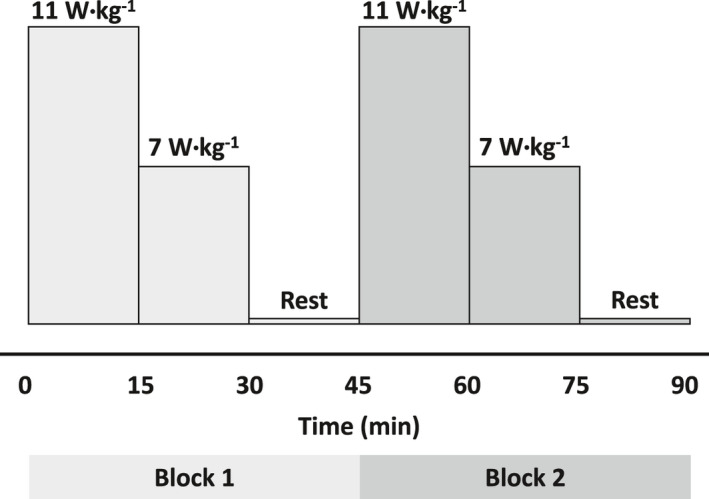
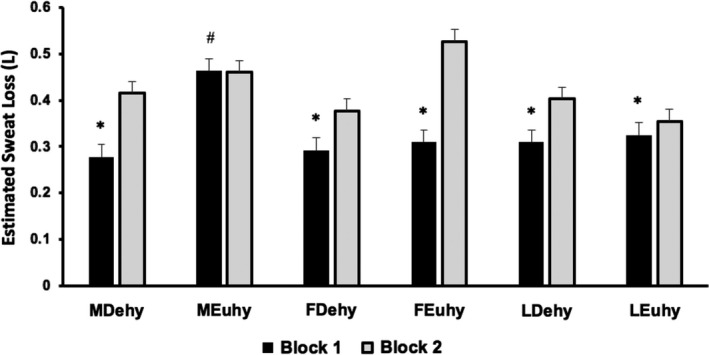
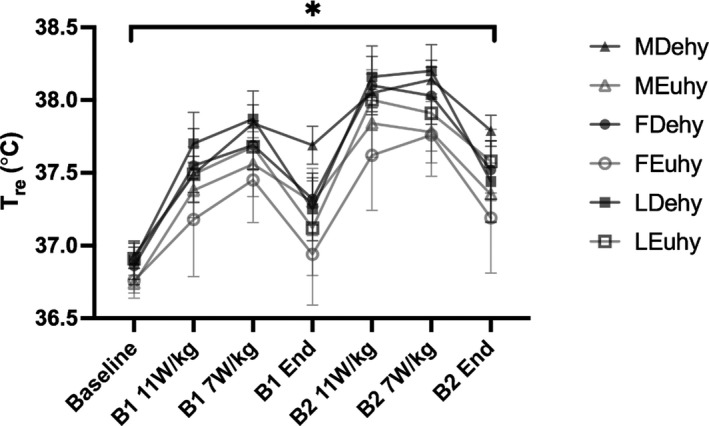
Although it is well established that dehydration has a negative impact on thermoregulation during exercise in the heat, it is unclear whether this effect of dehydration is different between men and women, or across the phases of the menstrual cycle (MC). Twelve men and seven women (men: 20 ± 2 years, 70.13 ± 10.5 kg, 173.4 ± 6.0 cm, 54.2 ± 8.6 ml kg min ; women: 20 ± 2 years, 57.21 ± 7.58 kg, 161 ± 5 cm, 40.39 ± 3.26 ml kg min ) completed trials either euhydrated (urine specific gravity, USG ≤ 1.020, Euhy) or dehydrated (USG > 1.020, Dehy). Trial order was randomized and counterbalanced; men completed two trials (MEuhy and MDehy) and women completed four over two MC phases (late follicular: days 10-13, FDehy, FEuhy; midluteal: days 18-22, LDehy, LEuhy). Each trial consisted of 1.5 h, split into two 30 min blocks of exercise (B1 and B2, 15 min at 11 W/kg & 15 min at 7 W/kg) separated by 15 min rest in between and after. Rectal temperature (T ) was measured continuously and estimated sweat loss was calculated from the body mass measured before and after each block of exercise. When dehydrated, the rate of rise in T was greater in women in the first block of exercise compared to men, independently of the MC phase (MDehy: 0.03 ± 0.03°C/min, FDehy: 0.06 ± 0.02, LDehy: 0.06 ± 0.02, p = 0.03). Estimated sweat loss was lower in all groups in B1 compared to B2 when dehydrated (p < 0.05), with no difference between sexes for either hydration condition. These data suggest that women may be more sensitive to the negative thermoregulatory effects of dehydration during the early stages of exercise in the heat.
尽管已经证实脱水会对热环境下运动时的体温调节产生负面影响,但目前尚不清楚这种脱水的影响在男性和女性之间是否存在差异,或者在月经周期(MC)的不同阶段是否存在差异。12 名男性和 7 名女性(男性:20±2 岁,70.13±10.5kg,173.4±6.0cm,54.2±8.6ml·kg-1·min-1;女性:20±2 岁,57.21±7.58kg,161±5cm,40.39±3.26ml·kg-1·min-1)分别在水合状态(尿比重,USG≤1.020,Euhy)或脱水状态(USG>1.020,Dehy)下完成了试验。试验顺序是随机和平衡的;男性完成了两项试验(MEuhy 和 MDehy),女性在两个 MC 阶段完成了四项试验(晚期卵泡期:第 10-13 天,FDehy,FEuhy;中期黄体期:第 18-22 天,LDehy,LEuhy)。每项试验持续 1.5 小时,分为两个 30 分钟的运动阶段(B1 和 B2,第 15 分钟 11W/kg 和第 15 分钟 7W/kg),中间和之后各休息 15 分钟。直肠温度(T)连续测量,根据运动前后的体重计算估计的出汗量。脱水时,女性在第一阶段运动中的 T 上升率高于男性,与 MC 阶段无关(MDehy:0.03±0.03°C/min,FDehy:0.06±0.02,LDehy:0.06±0.02,p=0.03)。脱水时,所有组在 B1 时的估计出汗量均低于 B2(p<0.05),但在水合状态下,男女之间没有差异。这些数据表明,女性在热环境下运动的早期阶段可能对脱水的负面体温调节效应更为敏感。