Universidad Científica del Sur, Lima, Peru.
Vicerrectorado de Investigación, Centro de Excelencia en Investigaciones Económicas y Sociales en Salud, Universidad San Ignacio de Loyola, Lima, Peru.
PLoS One. 2021 Jul 21;16(7):e0254365. doi: 10.1371/journal.pone.0254365. eCollection 2021.
Abdominal obesity (AO) has become a public health issue due to its impact on health, society and the economy. The relationship between socioeconomic disparities and the prevalence of AO has yet to be studied in Peru. Thus, our aim was to analyze the socioeconomic inequalities in AO distribution defined using the International Diabetes Federation (IDF) cut-off points in Peruvian adults in 2018-2019.
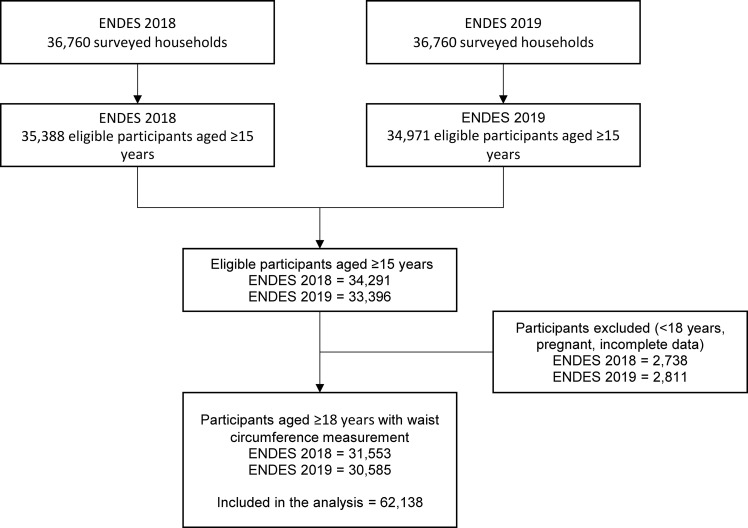
This was a cross-sectional study using data from the 2018-2019 Demographic and Family Health Survey (ENDES) of Peru. We analyzed a representative sample of 62,138 adults over 18 years of age of both sexes from urban and rural areas. Subjects were grouped into quintiles of the wealth to calculate a concentration curve and the Erreygers Concentration Index (ECI) in order to measure the inequality of AO distribution. Finally, we performed a decomposition analysis to evaluate the major determinants of inequalities.
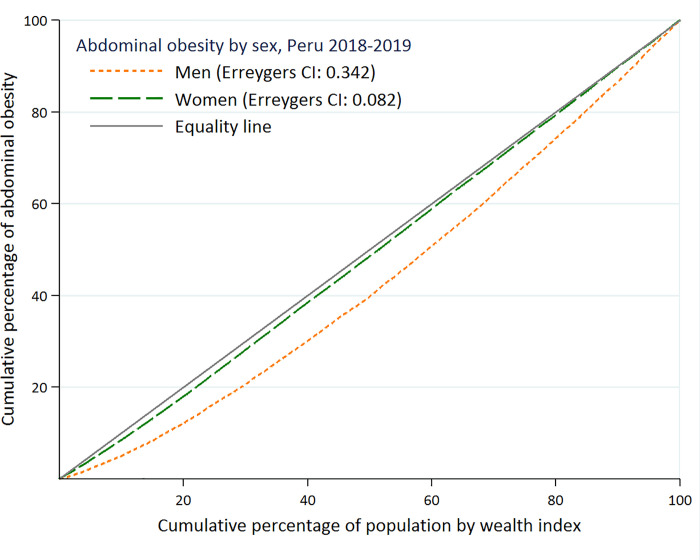
The prevalence of AO among Peruvian adults was 73.8%, being higher among women than men (85.1% and 61.1% respectively, p < 0.001). Socioeconomic inequality in AO was more prominent among men (ECI = 0.342, standard error (SE) = 0.0065 vs. ECI = 0.082, SE = 0.0043). The factors that contributed most to inequality in the prevalence of AO for both sexes were having the highest wealth index (men 37.2%, women 45.6%, p < 0.001), a higher education (men 34.4%, women 41.4%, p < 0.001) and living in an urban setting (men 22.0%, women 57.5%, p < 0.001).
In Peru the wealthy concentrate a greater percentage of AO. The inequality gap is greater among men, although AO is more prevalent among women. The variables that most contributed to inequality were the wealth index, educational level and area of residence. There is a need for effective individual and community interventions to reduce these inequalities.
由于腹型肥胖对健康、社会和经济的影响,它已成为一个公共卫生问题。在秘鲁,社会经济差异与腹型肥胖患病率之间的关系尚未得到研究。因此,我们的目的是分析 2018-2019 年秘鲁成年人中使用国际糖尿病联合会(IDF)切点定义的腹型肥胖分布的社会经济不平等。
这是一项使用秘鲁 2018-2019 年人口与家庭健康调查(ENDES)数据的横断面研究。我们分析了来自城市和农村地区的 62138 名 18 岁以上男女的代表性样本。将受试者分为财富五分位数组,以计算集中曲线和 Erreygers 集中指数(ECI),以衡量腹型肥胖分布的不平等程度。最后,我们进行了分解分析,以评估不平等的主要决定因素。
秘鲁成年人腹型肥胖的患病率为 73.8%,女性高于男性(分别为 85.1%和 61.1%,p<0.001)。男性腹型肥胖的社会经济不平等更为明显(ECI=0.342,标准误(SE)=0.0065 与 ECI=0.082,SE=0.0043)。对两性腹型肥胖患病率不平等贡献最大的因素是拥有最高的财富指数(男性 37.2%,女性 45.6%,p<0.001)、较高的教育水平(男性 34.4%,女性 41.4%,p<0.001)和居住在城市环境中(男性 22.0%,女性 57.5%,p<0.001)。
在秘鲁,富人集中了更大比例的腹型肥胖。男性的不平等差距更大,尽管女性的腹型肥胖更为普遍。对不平等贡献最大的变量是财富指数、教育水平和居住地区。需要采取有效的个人和社区干预措施来减少这些不平等。