Department of Electrical Engineering and Computer Science, Lassonde School of Engineering, York University, Toronto, ON, Canada.
Department of Medical Biophysics, University of Toronto, Toronto, ON, Canada.
Sci Rep. 2021 Jul 21;11(1):14865. doi: 10.1038/s41598-021-94004-y.
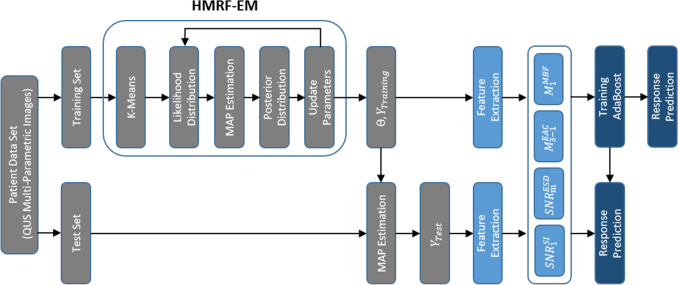
The efficacy of quantitative ultrasound (QUS) multi-parametric imaging in conjunction with unsupervised classification algorithms was investigated for the first time in characterizing intra-tumor regions to predict breast tumor response to chemotherapy before the start of treatment. QUS multi-parametric images of breast tumors were generated using the ultrasound radiofrequency data acquired from 181 patients diagnosed with locally advanced breast cancer and planned for neo-adjuvant chemotherapy followed by surgery. A hidden Markov random field (HMRF) expectation maximization (EM) algorithm was applied to identify distinct intra-tumor regions on QUS multi-parametric images. Several features were extracted from the segmented intra-tumor regions and tumor margin on different parametric images. A multi-step feature selection procedure was applied to construct a QUS biomarker consisting of four features for response prediction. Evaluation results on an independent test set indicated that the developed biomarker coupled with a decision tree model with adaptive boosting (AdaBoost) as the classifier could predict the treatment response of patient at pre-treatment with an accuracy of 85.4% and an area under the receiver operating characteristic (ROC) curve (AUC) of 0.89. In comparison, the biomarkers consisted of the features derived from the entire tumor core (without consideration of the intra-tumor regions), and the entire tumor core and the tumor margin could predict the treatment response of patients with an accuracy of 74.5% and 76.4%, and an AUC of 0.79 and 0.76, respectively. Standard clinical features could predict the therapy response with an accuracy of 69.1% and an AUC of 0.6. Long-term survival analyses indicated that the patients predicted by the developed model as responders had a significantly better survival compared to the non-responders. Similar findings were observed for the two response cohorts identified at post-treatment based on standard clinical and pathological criteria. The results obtained in this study demonstrated the potential of QUS multi-parametric imaging integrated with unsupervised learning methods in identifying distinct intra-tumor regions in breast cancer to characterize its responsiveness to chemotherapy prior to the start of treatment.
首次研究了定量超声(QUS)多参数成像与无监督分类算法相结合,以在开始治疗前对肿瘤内区域进行特征描述,从而预测乳腺癌对化疗的反应。从 181 名被诊断为局部晚期乳腺癌并计划接受新辅助化疗然后手术的患者中获取超声射频数据,生成 QUS 多参数乳腺肿瘤图像。应用隐马尔可夫随机场(HMRF)期望最大化(EM)算法在 QUS 多参数图像上识别不同的肿瘤内区域。从不同参数图像的分割肿瘤内区域和肿瘤边界提取了多个特征。应用多步特征选择过程构建由四个特征组成的 QUS 生物标志物用于反应预测。在独立测试集上的评估结果表明,所开发的生物标志物与具有自适应增强(AdaBoost)作为分类器的决策树模型相结合,可以在治疗前以 85.4%的准确性和 0.89 的接收者操作特征(ROC)曲线下面积(AUC)预测患者的治疗反应。相比之下,由整个肿瘤核心(不考虑肿瘤内区域)和整个肿瘤核心和肿瘤边界导出的特征组成的生物标志物可以预测患者的治疗反应,其准确性分别为 74.5%和 76.4%,AUC 分别为 0.79 和 0.76。标准临床特征可以以 69.1%的准确性和 0.6 的 AUC 预测治疗反应。长期生存分析表明,根据标准临床和病理标准在治疗后确定的两个反应队列中,被开发模型预测为应答者的患者的生存情况明显好于无应答者。基于标准临床和病理标准在治疗后确定的两个反应队列中,被开发模型预测为应答者的患者的生存情况明显好于无应答者。基于标准临床和病理标准在治疗后确定的两个反应队列中,被开发模型预测为应答者的患者的生存情况明显好于无应答者。基于标准临床和病理标准在治疗后确定的两个反应队列中,被开发模型预测为应答者的患者的生存情况明显好于无应答者。相似的发现观察到。研究结果表明,QUS 多参数成像与无监督学习方法相结合,在开始治疗前识别乳腺癌中的不同肿瘤内区域,从而对其对化疗的反应进行特征描述,具有潜在的应用前景。