Sharma Deepa, Osapoetra Laurentius Oscar, Czarnota Gregory J
Imaging Research and Physical Sciences, Sunnybrook Health Sciences Centre, Toronto, ON M4N 3M5, Canada.
Department of Radiation Oncology, Sunnybrook Health Sciences Centre, Toronto, ON M4N 3M5, Canada.
Cancers (Basel). 2022 Dec 16;14(24):6217. doi: 10.3390/cancers14246217.
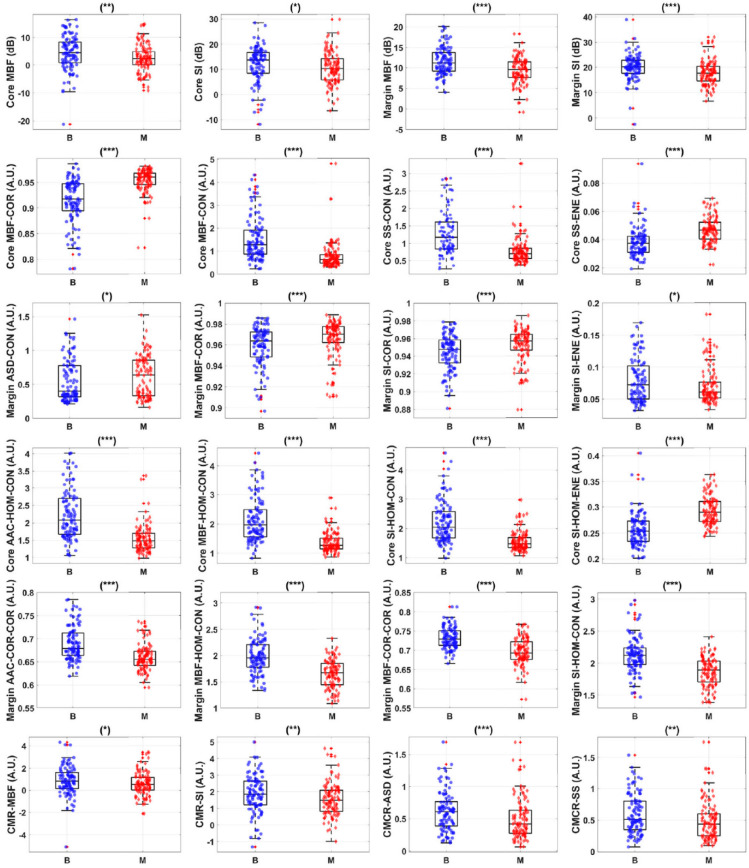
Quantitative ultrasound (QUS) is a non-invasive novel technique that allows treatment response monitoring. Studies have shown that QUS backscatter variables strongly correlate with changes observed microscopically. Increases in cell death result in significant alterations in ultrasound backscatter parameters. In particular, the parameters related to scatterer size and scatterer concentration tend to increase in relation to cell death. The use of QUS in monitoring tumor response has been discussed in several preclinical and clinical studies. Most of the preclinical studies have utilized QUS for evaluating cell death response by differentiating between viable cells and dead cells. In addition, clinical studies have incorporated QUS mostly for tissue characterization, including classifying benign versus malignant breast lesions, as well as responder versus non-responder patients. In this review, we highlight some of the important findings of previous preclinical and clinical studies and expand the applicability and therapeutic benefits of QUS in clinical settings. We summarized some recent clinical research advances in ultrasound-based radiomics analysis for monitoring and predicting treatment response and characterizing benign and malignant breast lesions. We also discuss current challenges, limitations, and future prospects of QUS-radiomics.
定量超声(QUS)是一种可用于监测治疗反应的非侵入性新技术。研究表明,QUS背向散射变量与显微镜下观察到的变化密切相关。细胞死亡增加会导致超声背向散射参数发生显著改变。特别是,与散射体大小和散射体浓度相关的参数往往会随着细胞死亡而增加。在多项临床前和临床研究中都讨论了QUS在监测肿瘤反应中的应用。大多数临床前研究利用QUS通过区分活细胞和死细胞来评估细胞死亡反应。此外,临床研究大多将QUS用于组织特征分析,包括对乳腺良性病变与恶性病变进行分类,以及区分有反应患者与无反应患者。在本综述中,我们重点介绍了以往临床前和临床研究的一些重要发现,并扩展了QUS在临床环境中的适用性和治疗益处。我们总结了基于超声的放射组学分析在监测和预测治疗反应以及表征乳腺良性和恶性病变方面的一些最新临床研究进展。我们还讨论了QUS放射组学当前面临的挑战、局限性以及未来前景。