Laboratory of Clinical Investigation/Diabetes Section, National Institute on Aging, National Institutes of Health, Baltimore, MD, United States.
Front Endocrinol (Lausanne). 2021 Jul 5;12:699661. doi: 10.3389/fendo.2021.699661. eCollection 2021.
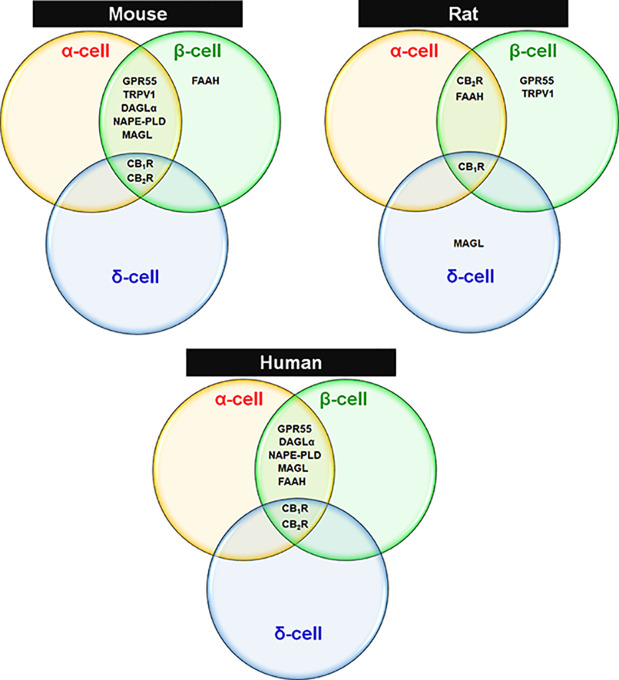
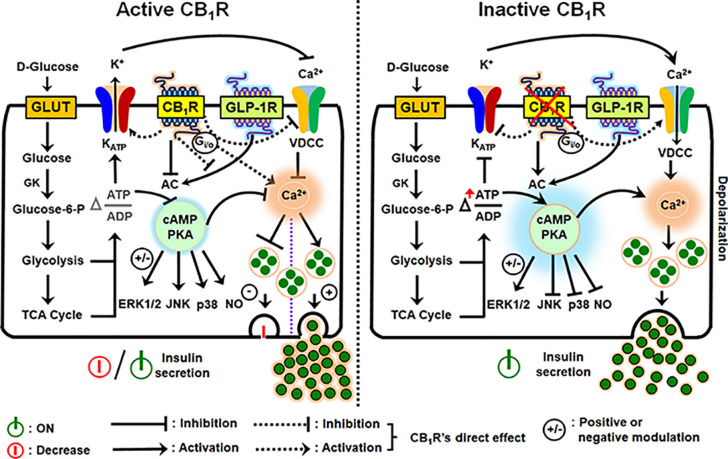
While endocannabinoids (ECs) and cannabis were primarily studied for their nervous system effects, it is now clear that ECs are also produced in the periphery where they regulate several physiological processes, including energy storage, glucose and lipid metabolism, insulin secretion and synthesis, and hepatocyte function. Within islet of Langerhans there is an autonomous EC system (ECS). Beta (β)-cells contain all the enzymes necessary for EC synthesis and degradation; ECs are generated in response to cellular depolarization; their paracrine influence on β-cells is mostly through the cannabinoid 1 receptor (CBR) that is present on all β-cells; they modulate basal and glucose- and incretin-induced insulin secretion, and β-cell responses to various stressors. Furthermore, there is now accumulating evidence from preclinical studies that the autonomous islet ECS is a key player in obesity-induced inflammation in islets, and β-cell damage and apoptosis from many causes can be mitigated by CBR blockers. We will thoroughly review the literature relevant to the effects of ECs and their receptors on β-cells and the other cell types within islets. Therapeutic potential of agents targeting EC/CBR and CBR is highly relevant because the receptors belong to the druggable G protein-coupled receptor superfamily. Present research in the ECS must be considered preliminary, especially with regards to human islet physiology, and further research is needed in order to translate basic cellular findings into clinical practice and the use of safe, clinically approved CBR modulators with and without glucose lowering combinations presently in therapeutic use for diabetes and obesity needs to be studied.
虽然内源性大麻素(ECs)和大麻主要是因其对神经系统的影响而被研究,但现在很清楚,ECs 也在身体外周产生,它们调节着几种生理过程,包括能量储存、葡萄糖和脂质代谢、胰岛素分泌和合成以及肝细胞功能。胰岛中存在自主 EC 系统(ECS)。β(β)-细胞包含 EC 合成和降解所需的所有酶;ECs 是响应细胞去极化而产生的;它们对β-细胞的旁分泌影响主要通过存在于所有β-细胞上的大麻素 1 受体(CBR)进行;它们调节基础和葡萄糖和肠促胰岛素诱导的胰岛素分泌,以及β-细胞对各种应激源的反应。此外,目前越来越多的临床前研究证据表明,自主胰岛 ECS 是肥胖引起胰岛炎症、β-细胞损伤和凋亡的关键因素,许多原因引起的β-细胞损伤和凋亡都可以通过 CBR 阻滞剂来缓解。我们将全面审查与 ECs 及其受体对β-细胞和胰岛内其他细胞类型的影响相关的文献。针对 EC/CBR 和 CBR 的药物的治疗潜力非常相关,因为这些受体属于可成药的 G 蛋白偶联受体超家族。目前的 ECS 研究必须被认为是初步的,特别是关于人类胰岛生理学,为了将基础细胞发现转化为临床实践,需要进一步研究,并且需要研究使用安全、临床批准的 CBR 调节剂与目前用于糖尿病和肥胖症的降血糖组合的无降血糖组合。