Karatas Ahmet, Canakci Ebru, Arici Yeliz Kasko, Kaya Mervegul, Sayim Beyza
Dr. Ahmet Karatas, MD. Nephrologist, Associated Professor, Department of Internal Medicine, Division of Neprology, Education and Research Hospital, Ordu University School of Medicine, Ordu, Turkey.
Dr. Ebru Canakci, MD, Anesthesiologist, Associate Professor, Department of Anesthesiology and Reanimation, Education and Research Hospital, Ordu University School of Medicine, Ordu, Turkey.
Pak J Med Sci. 2021 Jul-Aug;37(4):972-978. doi: 10.12669/pjms.37.4.3661.
Examine the effect of fasting during Ramadan on kidney functions in patients with chronic kidney disease.
The study was conducted on 130 patients with stage III-IV chronic kidney disease (CKD), who were admitted to the Ordu University nephrology polyclinic during the month before Ramadan and one month after Ramadan in 2019. Blood samples were taken in the morning after 12 hours of fasting.
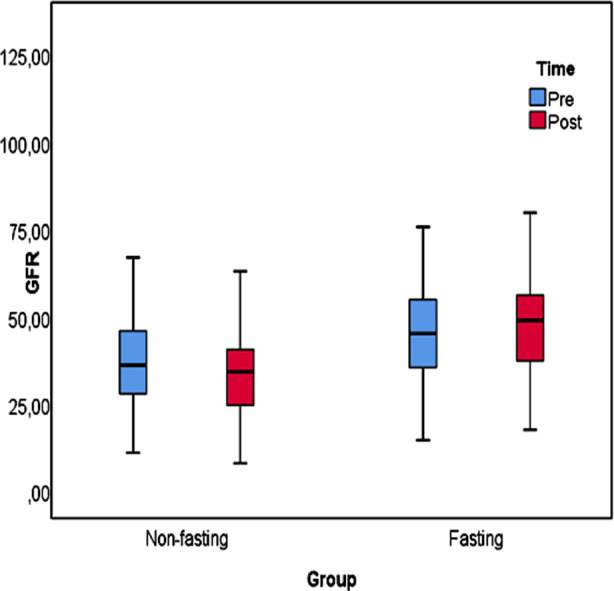
There was a statistically significant difference between BUN in the fasting group before and after the month of Ramadan. The median BUN before Ramadan was 26.65 mg/dl, the median after Ramadan was 24.05 mg/dl (p=0.004).There was a statistically significant difference between the nonfasting groups before and after Ramadan with respect to creatinine level. Median creatinine before Ramadan was 1.69 mg/dl,and the median after Ramadan was 1.86 mg/dl (p <0.001).There was a statistically significant difference between the fasting groups before and after Ramadan with respect to creatinine levels. Fasting group ,the median before Ramadan was 1.5 mg/dl, and the median after Ramadan was 1.42 mg/dl (p = 0.038).The impact of independent variable of fasting, using linear regression was found to be statistically significant (p<0.001). The eGFR was 14.826 points higher in those who fasted after Ramadan than in those who did not.
Fasting during the month of Ramadan does not deteriorate kidney functions and even leads to a moderate improvement in kidney functions. Taking these results into consideration, fasting may be advised for patients with stage III-IV CKD who want to fast and remain in stable condition.
研究斋月期间禁食对慢性肾脏病患者肾功能的影响。
该研究针对130例III - IV期慢性肾脏病(CKD)患者开展,这些患者于2019年斋月前一个月及斋月后一个月入住ordu大学肾脏病专科门诊。在禁食12小时后的早晨采集血样。
斋月前和斋月后禁食组的血尿素氮(BUN)存在统计学显著差异。斋月前BUN中位数为26.65mg/dl,斋月后为24.05mg/dl(p = 0.004)。斋月前后非禁食组的肌酐水平存在统计学显著差异。斋月前肌酐中位数为1.69mg/dl,斋月后为1.86mg/dl(p <0.001)。斋月前后禁食组的肌酐水平也存在统计学显著差异。禁食组中,斋月前中位数为1.5mg/dl,斋月后为1.42mg/dl(p = 0.038)。通过线性回归发现禁食自变量的影响具有统计学显著性(p<0.001)。斋月后禁食者的估算肾小球滤过率(eGFR)比未禁食者高14.826个单位。
斋月期间禁食不会使肾功能恶化,甚至会使肾功能得到适度改善。考虑到这些结果,对于想要禁食且病情稳定的III - IV期CKD患者,建议可以进行禁食。