González-Castro José Luis, Ubillos-Landa Silvia, Puente-Martínez Alicia, Gracia-Leiva Marcela
Educational Science Department, University of Burgos, Burgos, Spain.
Health Science Department, University of Burgos, Burgos, Spain.
Front Psychol. 2021 Jul 6;12:674032. doi: 10.3389/fpsyg.2021.674032. eCollection 2021.
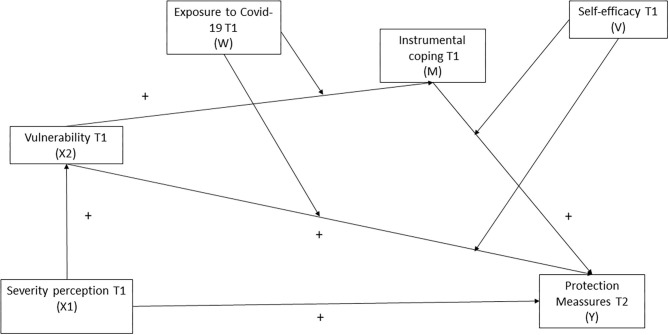
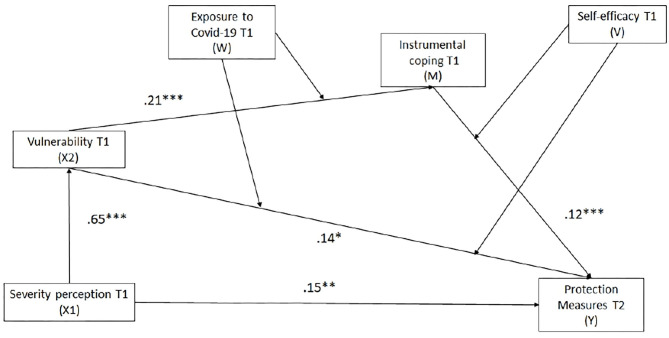
The COVID-19 disease has caused thousands of deaths worldwide and required the rapid and drastic adoption of various protective measures as main resources in the fight to reduce the spread of the disease. In the present study we aimed to identify socio cognitive factors that may influence adherence to protective measures toward COVID-19 in a Spanish sample. This longitudinal study analyzes the predictive value of perceived severity and vulnerability of infection, self-efficacy, direct exposure to the virus, and instrumental focused coping style for adhering to infection protection behaviors during the first months of the COVID-19 pandemic. It also tests sex and age differences in these factors and changes over time. A two-wave longitudinal study ( = 757) was conducted in March and April 2020 starting the day after a strict national lockdown was decreed in Spain. A path analysis was used to test direct and indirect effects between vulnerability and the adherence to protective behaviors. Results suggest that individuals' perceived severity and vulnerability to COVID-19 and instrumental coping strategies are related to the use of more protective behaviors. This coping strategy mediates the effect of perceived vulnerability on engaging in protective behaviors, and this effect depends on direct exposure to COVID-19 and perceived self-efficacy moderators. Results suggest that recognizing one's own abilities to engage in instrumental actions may facilitate adherence to protective measures in people who had not been directly exposed to COVID-19. Therefore, adopting instrumental coping strategies to manage an individual's perceived vulnerability to infection may positively impact the adherence to protective behaviors, especially during the onset of an unexpected threat and when there is no prior direct experience with the situation.
新冠疫情已在全球造成数千人死亡,并要求迅速且大幅采取各种防护措施,将其作为抗击疫情传播的主要手段。在本研究中,我们旨在确定可能影响西班牙样本中对新冠疫情防护措施依从性的社会认知因素。这项纵向研究分析了在新冠疫情大流行的头几个月里,感知到的感染严重性和易感性、自我效能感、直接接触病毒以及工具性聚焦应对方式对坚持感染防护行为的预测价值。它还测试了这些因素在性别和年龄上的差异以及随时间的变化。2020年3月和4月,在西班牙颁布严格的全国封锁令后的第二天,开展了一项两波次的纵向研究(n = 757)。采用路径分析来测试易感性与坚持防护行为之间的直接和间接影响。结果表明,个体对新冠疫情的感知严重性和易感性以及工具性应对策略与更多防护行为的使用有关。这种应对策略介导了感知易感性对采取防护行为的影响,并且这种影响取决于直接接触新冠疫情以及感知到的自我效能调节因素。结果表明,认识到自己采取工具性行动的能力可能会促进未直接接触过新冠疫情的人坚持防护措施。因此,采用工具性应对策略来管理个体感知到的感染易感性可能会对坚持防护行为产生积极影响,尤其是在意外威胁出现之初且此前没有该情况的直接经验时。