Lin Boyu, Wang Rui, Chen Liang, Gu Zhitao, Ji Chunyu, Fang Wentao
Department of Thoracic Surgery, Shanghai Chest Hospital, Shanghai Jiao Tong University, Shanghai, China.
Transl Lung Cancer Res. 2021 Jun;10(6):2487-2499. doi: 10.21037/tlcr-21-132.
Indication for sublobar resections in early-stage lung adenocarcinomas has been controversial. The purpose of this study was to find appropriate selection criteria for sublobar resections in ground glass opacity (GGO)-containing early-stage lung adenocarcinomas.
We retrospectively studied 985 consecutive patients with clinical stage IA, peripheral GGO-containing lung adenocarcinomas ≤3 cm in size. According to their radiological appearance, they were divided into a pure GGO group and a part-solid nodule (PSN) group. The PSN group was further divided into a GGO-predominant subgroup and a solid-predominant subgroup. Propensity-score matching (PSM) was conducted first in PSNs with similar total lesion size and then in those with similar solid component size to eliminate potential confounders. Histological characteristics and prognosis were compared between matched patients to investigate the prognostic value of total lesion size and solid component size. Then solid component size was chosen as the selection criterion to compare the prognosis of patients receiving lobectomy or sublobar resections.
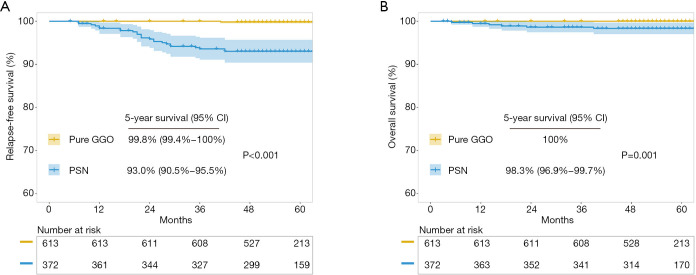
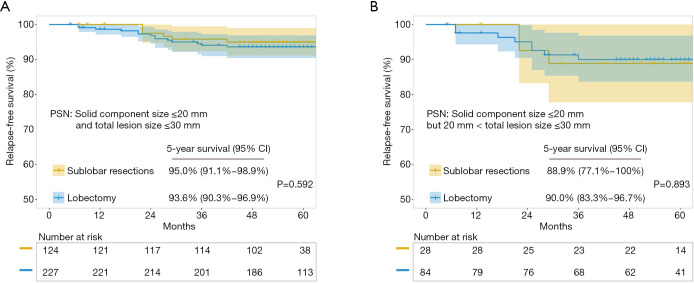
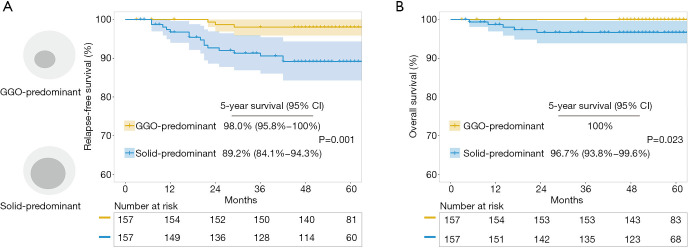
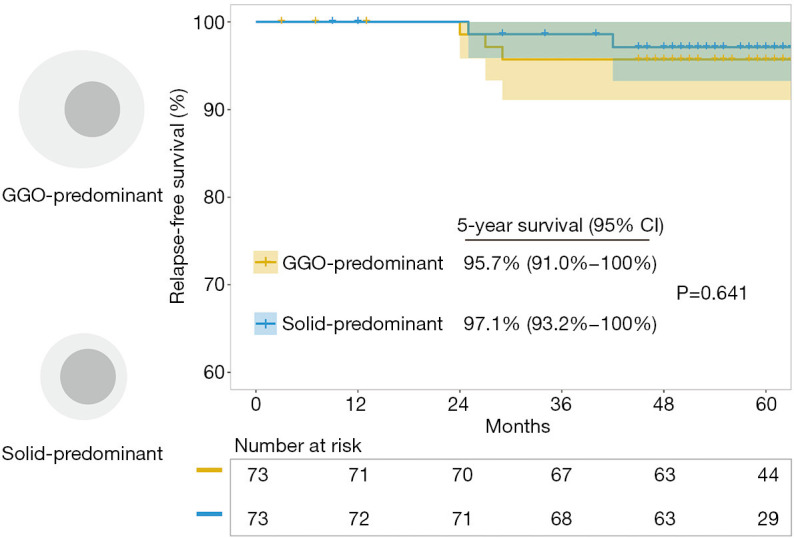
Comparing to PSNs, pure GGO lesions had significantly more favorable histological characteristics and prognosis, with 100% 5-year overall survival (OS), even though 33.3% of patients with pure GGO lesions >20 mm in total lesion size received sublobar resections. For 157 pairs of PSNs with similar total lesion size but different solid component size after the first PSM, the solid-predominant subgroup had significantly worse histological characteristics and prognosis than the GGO-predominant subgroup. After the second PSM, histological characteristics and prognosis were comparable between 73 pairs of PSNs with similar solid component size but different total lesion size. Multivariable analysis showed that solid component size, rather than total lesion size or consolidation-to-tumor ratio (CTR), was an independent prognostic factor. For PSNs containing solid component size ≤2 cm, relapse-free survival (RFS) was similar after sublobar resections or lobectomy (95.0% 93.6%, P=0.592). The results remained similar for PSNs of total lesion size >2 cm but solid component size ≤2 cm (88.9% 90.0%, P=0.893).
Solid component size better predicts histological characteristics and prognosis than total lesion size in early-stage GGO-containing lung adenocarcinomas. Instead of total lesion size, solid component size ≤2 cm may be a more appropriate selection criterion for sublobar resections in such patients.
早期肺腺癌亚肺叶切除的指征一直存在争议。本研究的目的是为含磨玻璃影(GGO)的早期肺腺癌寻找合适的亚肺叶切除选择标准。
我们回顾性研究了985例连续的临床IA期、周边型、大小≤3 cm且含GGO的肺腺癌患者。根据其影像学表现,将他们分为纯GGO组和部分实性结节(PSN)组。PSN组进一步分为以GGO为主的亚组和以实性为主的亚组。首先对总病灶大小相似的PSN进行倾向评分匹配(PSM),然后对实性成分大小相似的PSN进行匹配,以消除潜在的混杂因素。比较匹配患者的组织学特征和预后,以研究总病灶大小和实性成分大小的预后价值。然后选择实性成分大小作为选择标准,比较接受肺叶切除或亚肺叶切除患者的预后。
与PSN相比,纯GGO病灶具有明显更有利的组织学特征和预后,5年总生存率(OS)为100%,尽管33.3%总病灶大小>20 mm的纯GGO病灶患者接受了亚肺叶切除。在首次PSM后,对于157对总病灶大小相似但实性成分大小不同的PSN,以实性为主的亚组的组织学特征和预后明显比以GGO为主的亚组差。在第二次PSM后,73对实性成分大小相似但总病灶大小不同的PSN之间的组织学特征和预后相当。多变量分析显示,实性成分大小而非总病灶大小或实变与肿瘤比值(CTR)是独立的预后因素。对于实性成分大小≤2 cm的PSN,亚肺叶切除或肺叶切除后的无复发生存率(RFS)相似(95.0%对93.6%,P = 0.592)。对于总病灶大小>2 cm但实性成分大小≤2 cm的PSN,结果仍然相似(88.9%对90.0%,P = 0.893)。
在含GGO的早期肺腺癌中,实性成分大小比总病灶大小能更好地预测组织学特征和预后。对于此类患者,实性成分大小≤2 cm而非总病灶大小可能是亚肺叶切除更合适的选择标准。