Burns Lindsay H, Wang Hoau-Yan
Pain Therapeutics Inc., Austin, TX 78731, USA.
Department of Physiology, Pharmacology and Neuroscience, City University of New York School of Medicine, New York, NY 10031, USA.
Neuroimmunol Neuroinflamm. 2017;4(12):263-271. doi: 10.20517/2347-8659.2017.50. Epub 2017 Dec 8.
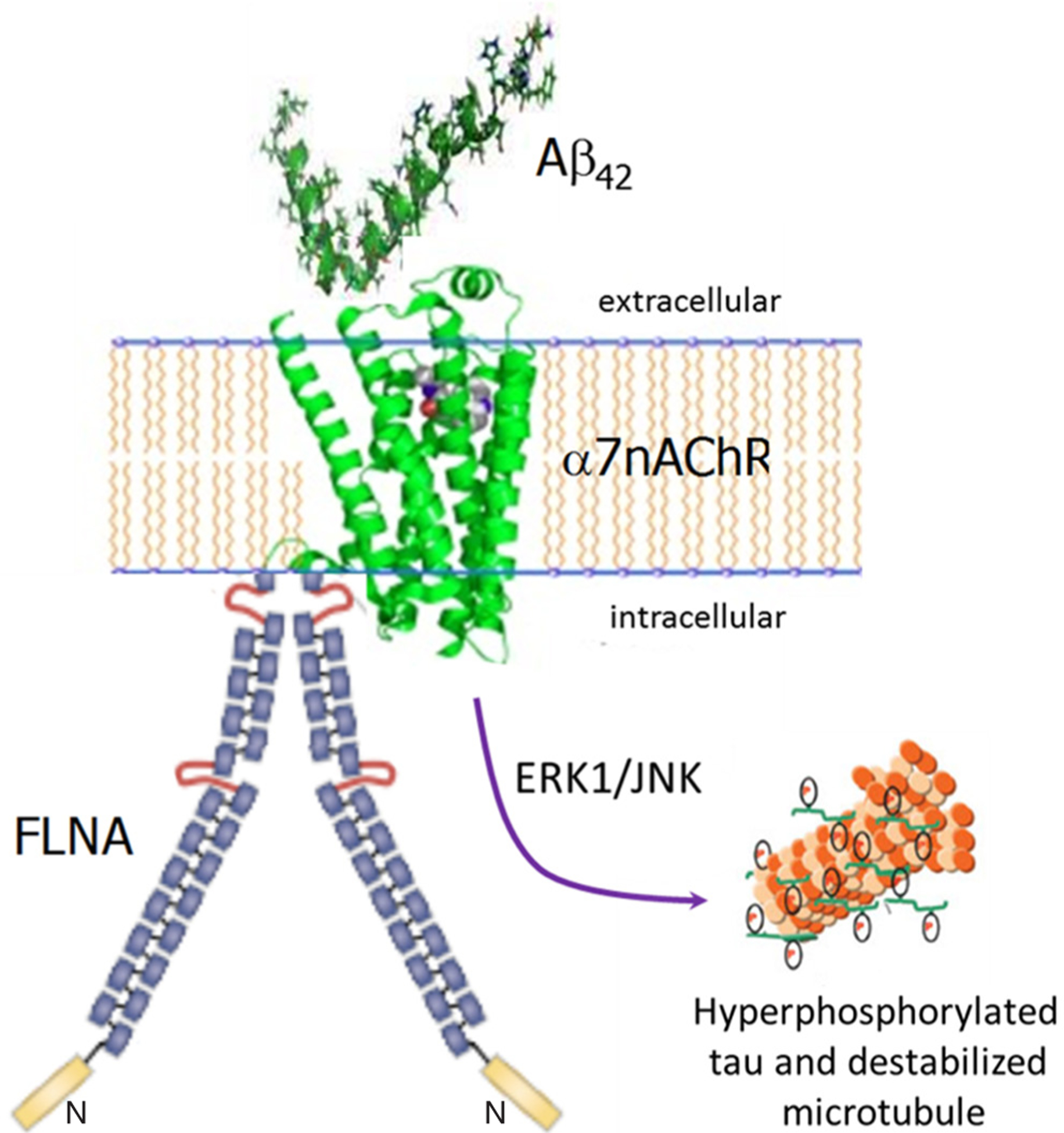
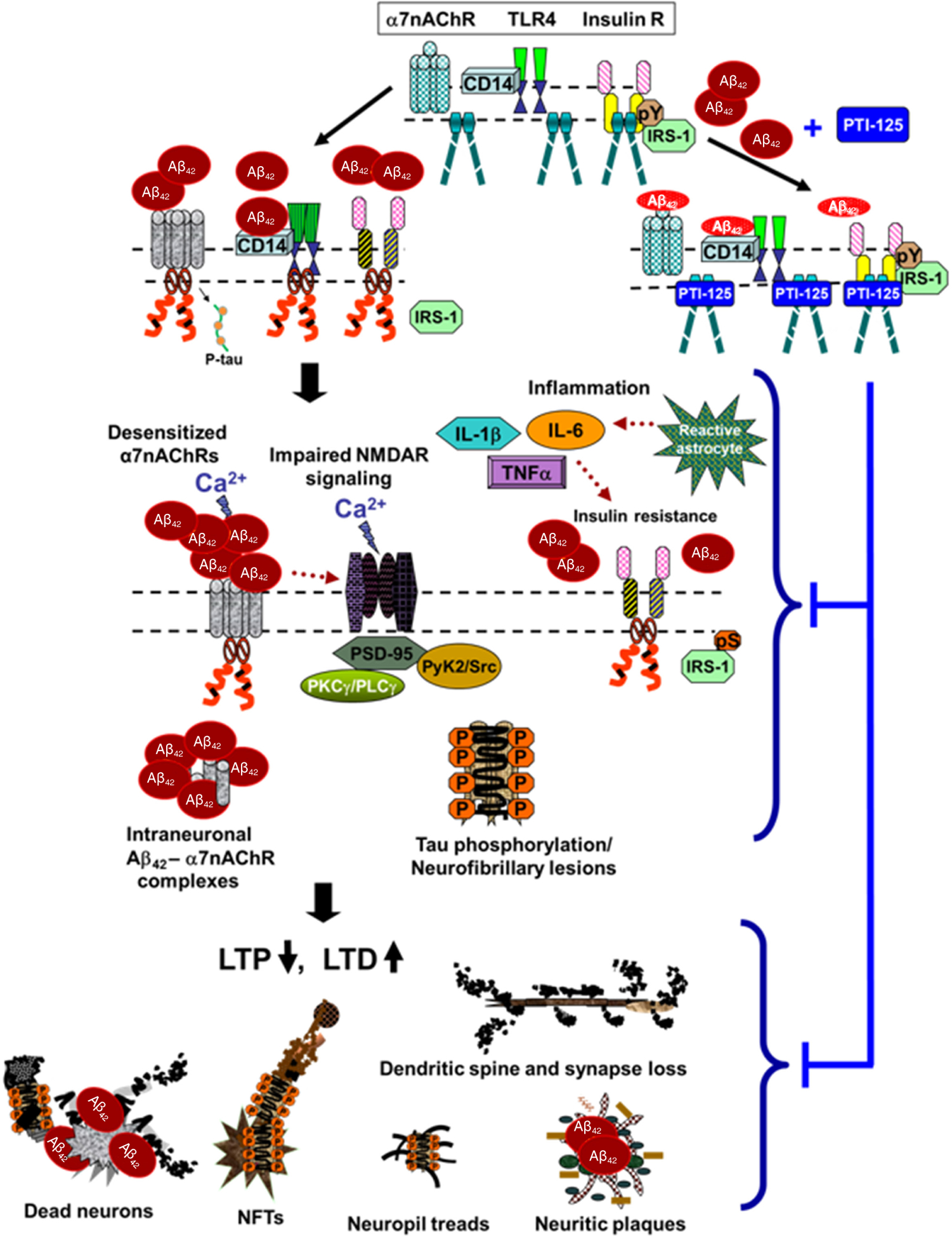
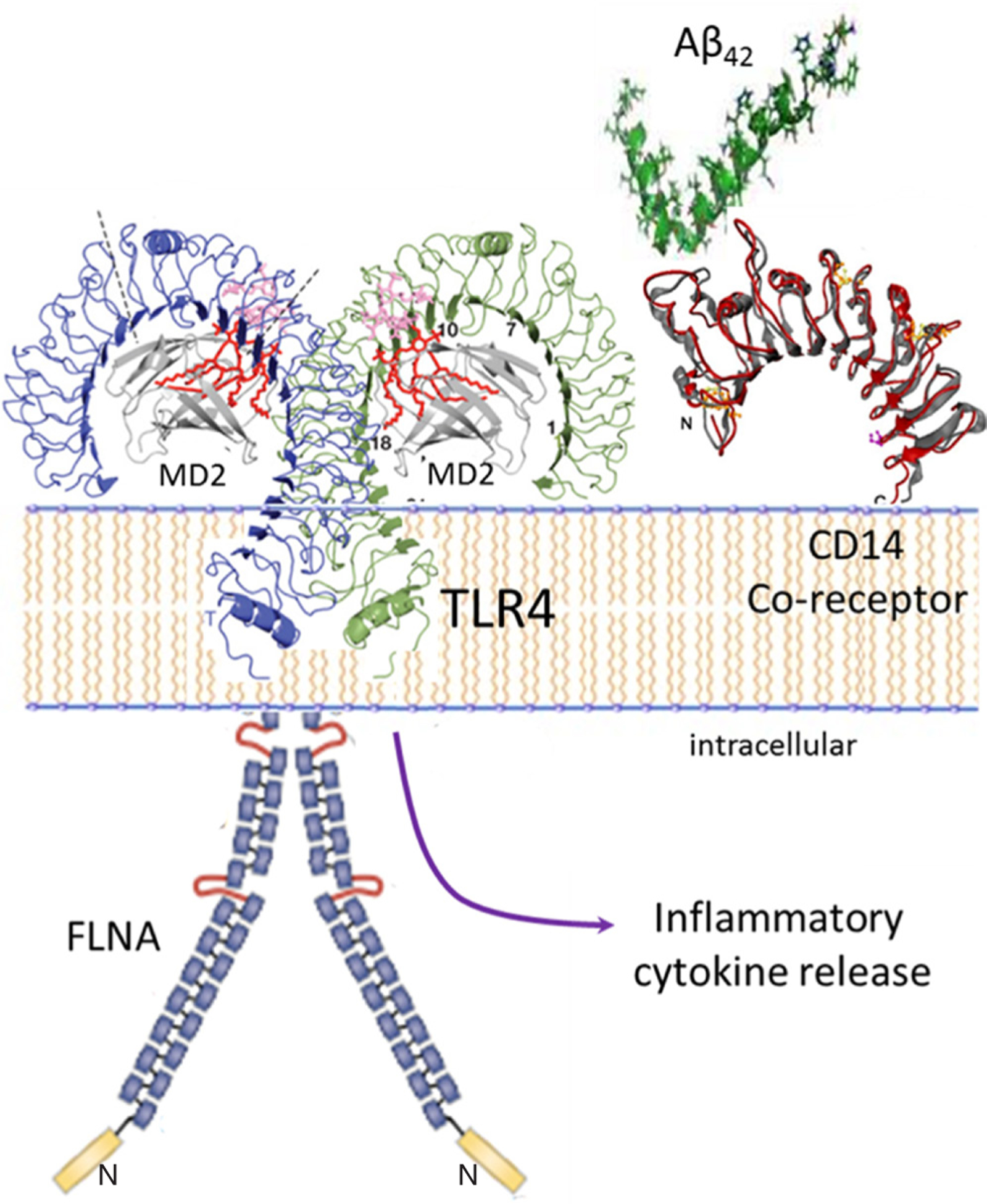
Alzheimer's disease (AD) is a neurodegenerative disease with proteopathy characterized by abnormalities in amyloid beta (Aβ) and tau proteins. Defective amyloid and tau propagate and aggregate, leading to eventual amyloid plaques and neurofibrillary tangles. New data show that a third proteopathy, an altered conformation of the scaffolding protein filamin A (FLNA), is critically linked to the amyloid and tau pathologies in AD. Altered FLNA is pervasive in AD brain and without apparent aggregation. In a striking interdependence, altered FLNA is both induced by Aβ and required for two prominent pathogenic signaling pathways of Aβ. Aβ monomers or small oligomers signal via the α7 nicotinic acetylcholine receptor (α7nAChR) to activate kinases that hyperphosphorylate tau to cause neurofibrillary lesions and formation of neurofibrillary tangles. Altered FLNA also enables a persistent activation of toll-like-receptor 4 (TLR4) by Aβ, leading to excessive inflammatory cytokine release and neuroinflammation. The novel AD therapeutic candidate PTI-125 binds and reverses the altered FLNA conformation to prevent Aβ's signaling via α7nAChR and aberrant activation of TLR4, thus reducing multiple AD-related neuropathologies. As a regulator of Aβ's signaling via α7nAChR and TLR4, altered FLNA represents a novel AD therapeutic target.
阿尔茨海默病(AD)是一种具有蛋白质病特征的神经退行性疾病,其特点是β淀粉样蛋白(Aβ)和tau蛋白异常。有缺陷的淀粉样蛋白和tau蛋白会传播并聚集,最终导致淀粉样斑块和神经原纤维缠结。新数据表明,第三种蛋白质病,即支架蛋白细丝蛋白A(FLNA)的构象改变,与AD中的淀粉样蛋白和tau蛋白病变密切相关。改变后的FLNA在AD大脑中普遍存在且无明显聚集。在一种显著的相互依存关系中,改变后的FLNA既由Aβ诱导产生,又是Aβ两条重要致病信号通路所必需的。Aβ单体或小寡聚体通过α7烟碱型乙酰胆碱受体(α7nAChR)发出信号,激活激酶,使tau蛋白过度磷酸化,导致神经原纤维病变和神经原纤维缠结的形成。改变后的FLNA还能使Aβ持续激活Toll样受体4(TLR4),导致炎症细胞因子过度释放和神经炎症。新型AD治疗候选药物PTI-125结合并逆转改变后的FLNA构象,以阻止Aβ通过α7nAChR发出信号以及TLR4的异常激活,从而减少多种与AD相关的神经病理变化。作为Aβ通过α7nAChR和TLR4发出信号的调节因子,改变后的FLNA代表了一个新的AD治疗靶点。