La Statale, University of Milan, Milan, Italy.
Department of Sociology, Sciences Po, Paris, France.
PLoS One. 2021 Jul 23;16(7):e0255156. doi: 10.1371/journal.pone.0255156. eCollection 2021.
The Covid-19 pandemic is hitting societies hard, and people living in disadvantaged circumstances are among the most affected. We investigate the combined effects of the Covid-19 crisis and living in a deprived neighbourhood on two dimensions of subjective well-being: hedonic (i.e. mental health) and evaluative (i.e. life satisfaction) subjective well-being.
We use longitudinal data from the Understanding Society UK panel. We combine data gathered in the main survey between 2015 and 2019 with very recent data from the Covid-19 online survey between April and July 2020. Leveraging a sample of nearly 9,600 English individuals, we first run a set of cross-sectional OLS regressions to analyse changes over time in the relationship between neighbourhood deprivation and subjective well-being. Then, as our main model of interest, we use a fixed effect difference-in-differences model to provide more robust evidence.
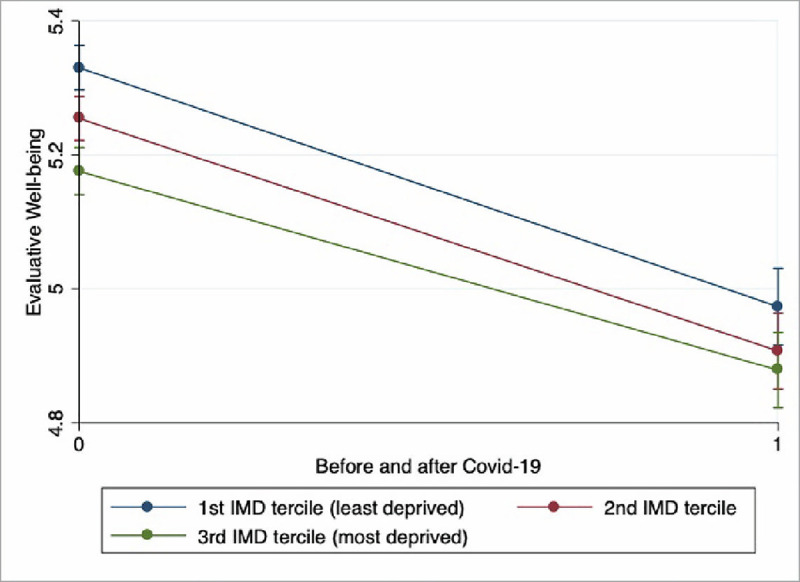
Since the beginning of the crisis, both levels of hedonic and evaluative well-being have decreased as a result of the pandemic and lockdown. However, for those living in more deprived neighbourhoods the level of hedonic well-being decreased more than for those living in better areas. We found no such difference for evaluative well-being.
Our results highlight the importance of reducing neighbourhood inequalities as the spatial clustering of disadvantages has increased by the pandemic.
新冠疫情严重冲击社会,处境不利的人群受到的影响尤为严重。本研究调查了新冠危机和居住在贫困社区这两个因素对幸福感的两个维度(享乐维度,即心理健康;评价维度,即生活满意度)的综合影响。
我们使用了英国“社会理解”面板的纵向数据。我们将 2015 年至 2019 年间的主要调查数据与 2020 年 4 月至 7 月期间新冠在线调查的最新数据相结合。利用近 9600 名英国个体的样本,我们首先进行了一系列横截面 OLS 回归,以分析随着时间的推移,社区贫困与主观幸福感之间的关系变化。然后,作为我们感兴趣的主要模型,我们使用固定效应差分模型提供更有力的证据。
自危机开始以来,由于疫情和封锁,享乐和评价两个维度的幸福感水平都有所下降。然而,对于那些居住在贫困社区的人来说,他们的享乐幸福感水平下降幅度大于那些居住在较好地区的人。我们没有发现评价幸福感方面有这种差异。
我们的研究结果强调了减少邻里不平等的重要性,因为疫情加剧了劣势的空间集聚。