Exercise Physiology Lab at Toledo, Sports Science Department, University of Castilla-La Mancha, Toledo 45004, Spain.
Exercise Physiology Lab at Toledo, Sports Science Department, University of Castilla-La Mancha, Toledo 45004, Spain.
J Sport Health Sci. 2022 Sep;11(5):567-577. doi: 10.1016/j.jshs.2021.07.006. Epub 2021 Jul 21.
Individuals at risk of suffering cardiovascular disease (CVD) present with larger increases in blood triglyceride (TG) concentration after a high-fat meal than do healthy individuals. These postprandial hypertriglyceride levels are an independent risk factor for CVD. Prescription of statins and a bout of prolonged exercise are both effective in lowering postprandial hypertriglyceride levels. We aimed to evaluate the comparative effectiveness of statins vs. a bout of aerobic exercise in reducing fasting and postprandial TG (PPTG) concentrations in individuals at high risk of developing CVD.
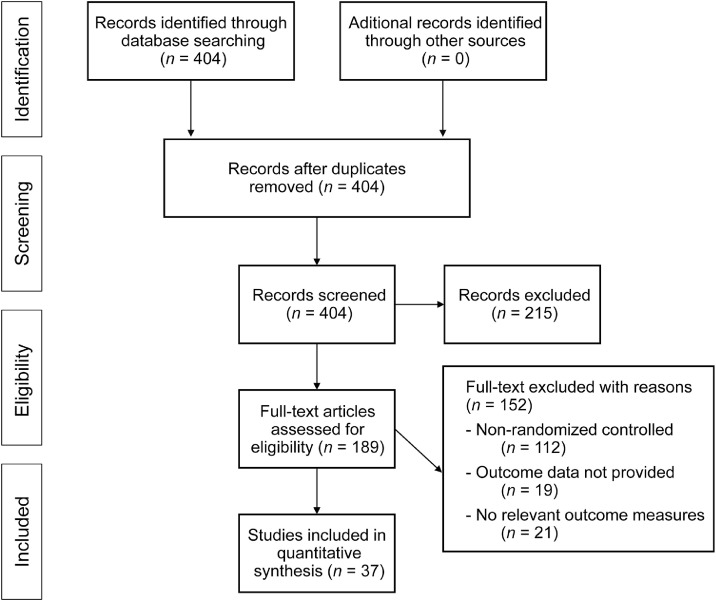
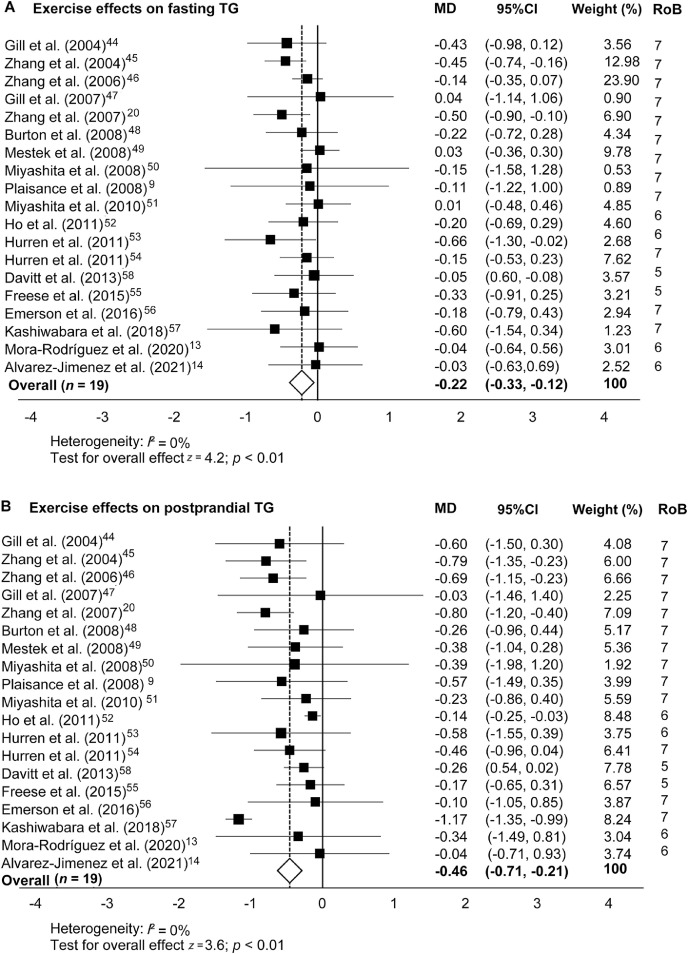
Thirty-seven studies from a systematic literature search of the PubMed, EMBASE, and Cochrane databases were included in this review. The selected studies conducted trials involving statin therapy (n = 20) or a bout of aerobic exercise (n = 19) and measured their impact on PPTG levels as the outcome. Two studies analyzed both treatments and were included in duplicate. The meta-analysis was constructed using a random-effects model to calculate the mean difference (MD). The Student t test was used to compare the data sets for statins vs. exercise.
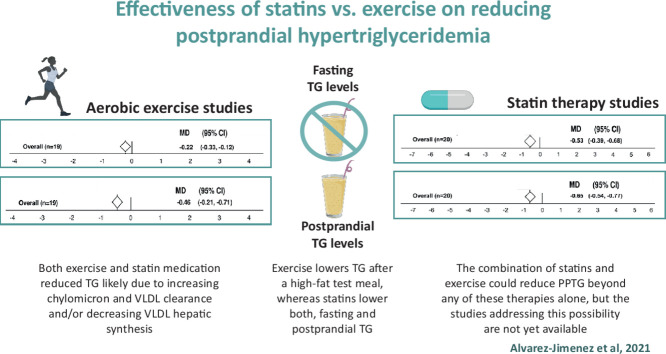
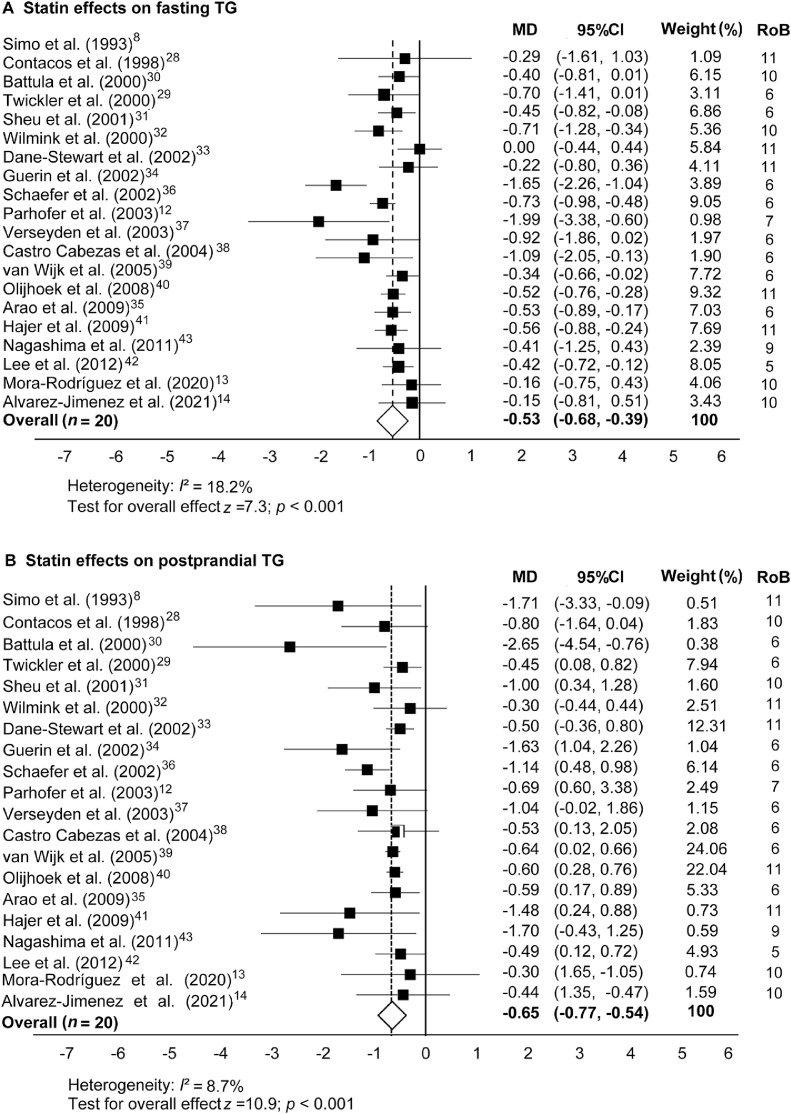
Overall, statin and exercise interventions showed similar reductions in PPTG levels, with an MD of -0.65 mmol/L for statins (95% confidence interval (95%CI): -0.54 to -0.77; p < 0.001) and -0.46 mmol/L for exercise (95%CI: -0.21 to -0.71; p < 0.01). However, statins lowered fasting TG levels more than exercise (MD = -1.54 mmol/L, 95%CI: -2.25 to -0.83; p = 0.009).
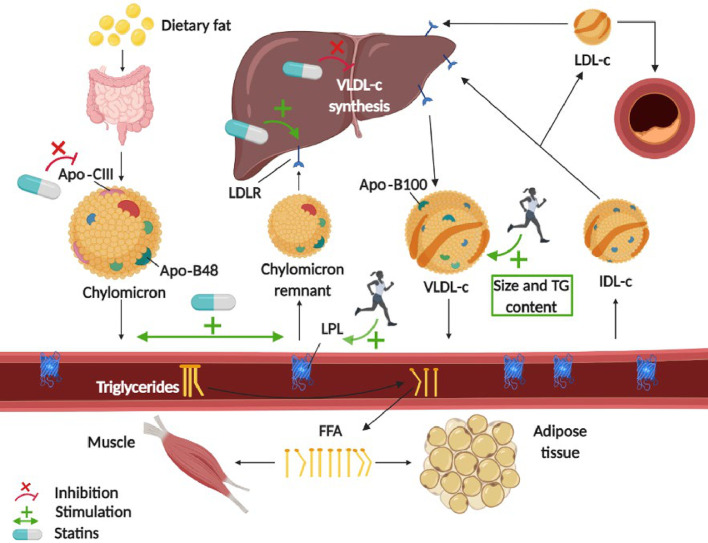
Although aerobic exercise is effective in lowering blood TG levels, statins seem to be more efficient, especially in the fasted state. A combination of exercise and statins might reveal a valuable approach to the treatment and prevention of CVD. More studies are required to determine the underlying mechanisms and the possible additive effects of these interventions.
与健康个体相比,有心血管疾病(CVD)风险的个体在高脂餐后血液甘油三酯(TG)浓度升高幅度更大。这些餐后高甘油三酯水平是 CVD 的独立危险因素。他汀类药物的处方和一段时间的有氧运动都能有效降低餐后高甘油三酯水平。我们旨在评估他汀类药物与有氧运动在降低 CVD 高危个体的空腹和餐后甘油三酯(PPTG)浓度方面的相对有效性。
从PubMed、EMBASE 和 Cochrane 数据库的系统文献检索中纳入了 37 项研究。纳入的研究进行了他汀类药物治疗(n=20)或一段时间的有氧运动(n=19)试验,并测量了它们对 PPTG 水平的影响作为结果。有两项研究分析了两种治疗方法,并进行了重复分析。使用随机效应模型构建荟萃分析以计算均值差(MD)。使用 Student t 检验比较他汀类药物与运动的数据组。
总体而言,他汀类药物和运动干预措施在降低 PPTG 水平方面效果相似,他汀类药物的 MD 为-0.65mmol/L(95%置信区间(95%CI):-0.54 至-0.77;p<0.001),运动的 MD 为-0.46mmol/L(95%CI:-0.21 至-0.71;p<0.01)。然而,他汀类药物降低空腹 TG 水平的效果优于运动(MD=-1.54mmol/L,95%CI:-2.25 至-0.83;p=0.009)。
虽然有氧运动能有效降低血液 TG 水平,但他汀类药物似乎更有效,尤其是在空腹状态下。运动和他汀类药物的联合可能揭示了一种治疗和预防 CVD 的有价值方法。需要更多的研究来确定这些干预措施的潜在机制和可能的附加作用。