Smolarz Mateusz, Kurczyk Agata, Jelonek Karol, Żyła Joanna, Mielańczyk Łukasz, Sitkiewicz Magdalena, Pietrowska Monika, Polańska Joanna, Rzyman Witold, Widłak Piotr
Maria Sklodowska-Curie National Research Institute of Oncology, Gliwice Branch, 44-102 Gliwice, Poland.
Department of Data Science and Engineering, Silesian University of Technology, 44-100 Gliwice, Poland.
Cancers (Basel). 2021 Jul 8;13(14):3414. doi: 10.3390/cancers13143414.
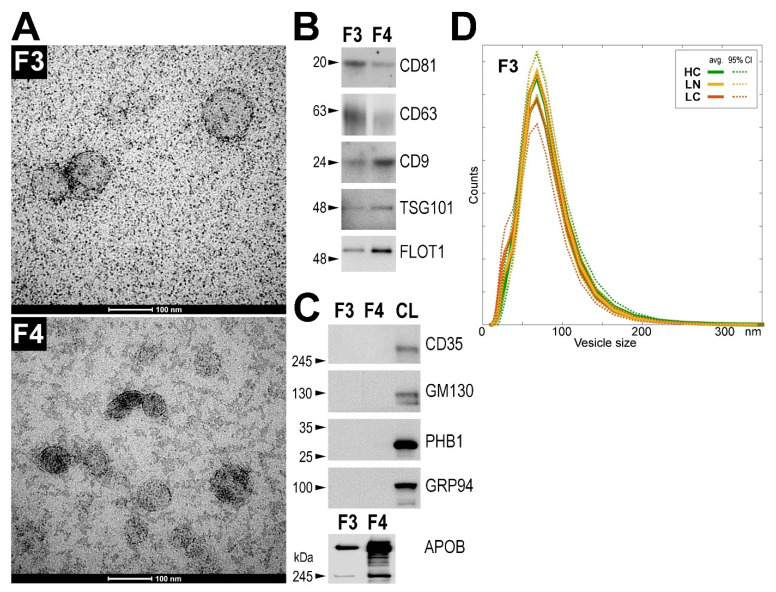
Molecular components of exosomes and other classes of small extracellular vesicles (sEV) present in human biofluids are potential biomarkers with possible applicability in the early detection of lung cancer. Here, we compared the lipid profiles of serum-derived sEV from three groups of lung cancer screening participants: individuals without pulmonary alterations, individuals with benign lung nodules, and patients with screening-detected lung cancer (81 individuals in each group). Extracellular vesicles and particles were purified from serum by size-exclusion chromatography, and a fraction enriched in sEV and depleted of low-density lipoproteins (LDLs) was selected (similar sized vesicles was observed in all groups: 70-100 nm). The targeted mass-spectrometry-based approach enabled the detection of 352 lipids, including 201 compounds used in quantitative analyses. A few compounds, exemplified by Cer(42:1), i.e., a ceramide whose increased plasma/serum level was reported in different pathological conditions, were upregulated in vesicles from cancer patients. On the other hand, the contribution of phosphatidylcholines with poly-unsaturated acyl chains was reduced in vesicles from lung cancer patients. Cancer-related features detected in serum-derived sEV were different than those of the corresponding whole serum. A high heterogeneity of lipid profiles of sEV was observed, which markedly impaired the performance of classification models based on specific compounds (the three-state classifiers showed an average AUC = 0.65 and 0.58 in the training and test subsets, respectively).
人生物流体中存在的外泌体和其他几类小细胞外囊泡(sEV)的分子成分是潜在的生物标志物,可能适用于肺癌的早期检测。在此,我们比较了三组肺癌筛查参与者血清来源的sEV的脂质谱:无肺部病变的个体、有良性肺结节的个体以及筛查发现肺癌的患者(每组81人)。通过尺寸排阻色谱法从血清中纯化细胞外囊泡和颗粒,并选择了富含sEV且低密度脂蛋白(LDL)耗尽的部分(所有组中观察到大小相似的囊泡:70 - 100 nm)。基于靶向质谱的方法能够检测到352种脂质,包括用于定量分析的201种化合物。一些化合物,如Cer(42:1),即在不同病理条件下血浆/血清水平升高的一种神经酰胺,在癌症患者的囊泡中上调。另一方面,肺癌患者囊泡中具有多不饱和酰基链的磷脂酰胆碱的含量降低。血清来源的sEV中检测到的癌症相关特征与相应全血清的不同。观察到sEV脂质谱的高度异质性,这显著损害了基于特定化合物的分类模型的性能(三态分类器在训练子集和测试子集中的平均AUC分别为0.65和0.58)。