Institut für Chemie und Biochemie, Freie Universität Berlin, Takustr. 3, 14195 Berlin, Germany.
Institut für Physikalische Chemie, Universität Freiburg, Albertstr. 21, 79104 Freiburg im Breisgau, Germany.
Molecules. 2021 Jul 20;26(14):4373. doi: 10.3390/molecules26144373.
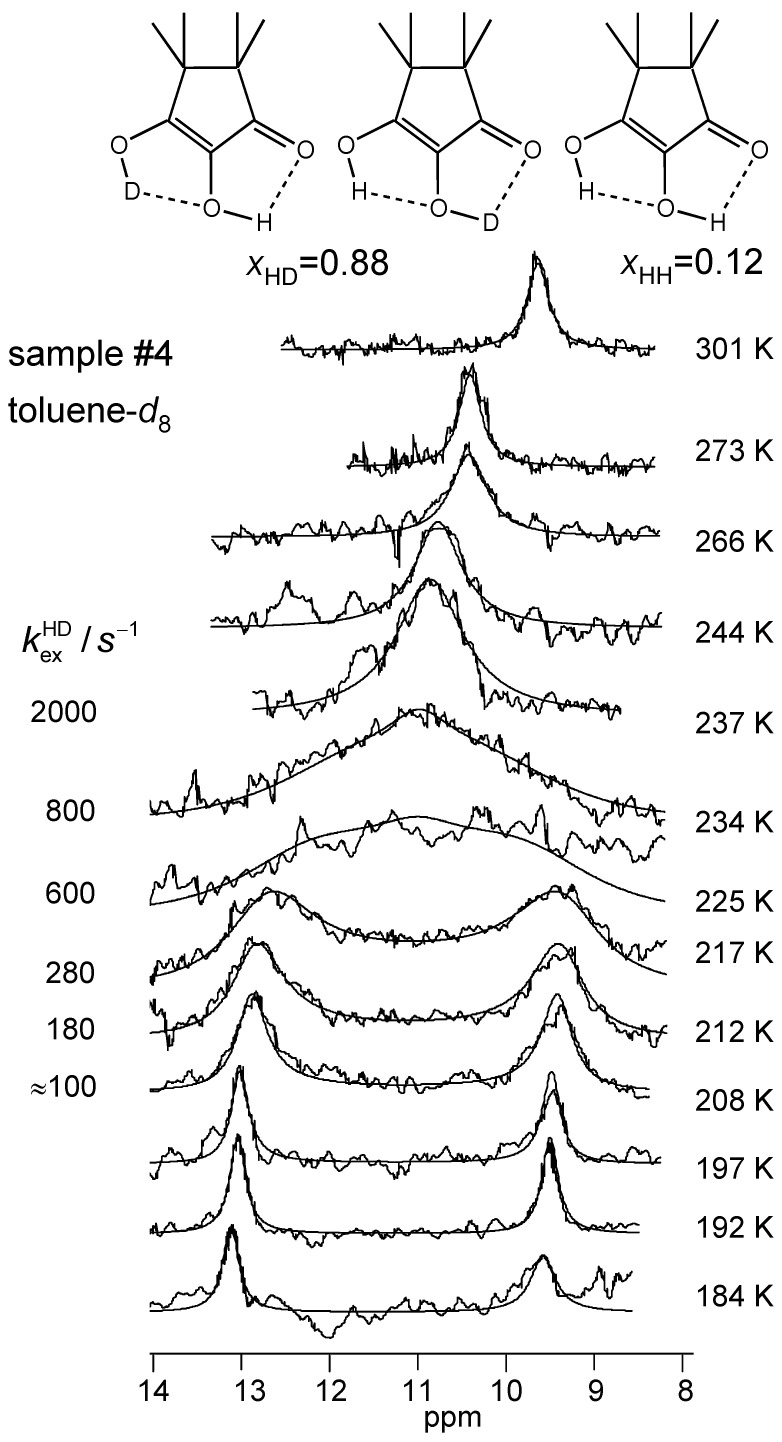
Using dynamic liquid-state NMR spectroscopy a degenerate double proton tautomerism was detected in tetramethyl reductic acid (TMRA) dissolved in toluene- and in CDCl. Similar to vitamin C, TMRA belongs to the class of reductones of biologically important compounds. The tautomerism involves an intramolecular HH transfer that interconverts the peripheric and the central positions of the two OH groups. It is slow in the NMR time scale around 200 K and fast at room temperature. Pseudo-first-order rate constants of the HH transfer and of the HD transfer after suitable deuteration were obtained by line shape analyses. Interestingly, the chemical shifts were found to be temperature dependent carrying information about an equilibrium between a hydrogen bonded dimer and a monomer forming two weak intramolecular hydrogen bonds. The structures of the monomer and the dimer are discussed. The latter may consist of several rapidly interconverting hydrogen-bonded associates. A way was found to obtain the enthalpies and entropies of dissociation, which allowed us to convert the pseudo-first-order rate constants of the reaction mixture into first-order rate constants of the tautomerization of the monomer. Surprisingly, these intrinsic rate constants were the same for toluene- and CDCl, but in the latter solvent more monomer is formed. This finding is attributed to the dipole moment of the TMRA monomer, compensated in the dimer, and to the larger dielectric constant of CDCl. Within the margin of error, the kinetic HH/HD isotope effects were found to be of the order of 3 but independent of temperature. That finding indicates a stepwise HH transfer involving a tunnel mechanism along a double barrier pathway. The Arrhenius curves were described in terms of the Bell-Limbach tunneling model.
利用动态液态核磁共振光谱法,在溶解于甲苯和 CDCl 的四甲基还原酸(TMRA)中检测到了简并的双质子互变异构现象。与维生素 C 类似,TMRA 属于生物重要化合物的还原酮类。互变异构涉及到一个分子内 HH 转移,它使两个 OH 基团的外围和中心位置相互转换。在 200 K 左右的 NMR 时间尺度上,它的速度较慢,而在室温下则较快。通过线形分析得到了 HH 转移和适当氘化后的 HD 转移的准一级速率常数。有趣的是,化学位移被发现与温度有关,这提供了关于氢键二聚体和形成两个弱分子内氢键的单体之间平衡的信息。讨论了单体和二聚体的结构。后者可能由几个快速相互转化的氢键缔合组成。找到了一种获得离解焓和熵的方法,这使我们能够将反应混合物的准一级速率常数转化为单体互变异构的一级速率常数。令人惊讶的是,这些本征速率常数在甲苯和 CDCl 中是相同的,但在后者溶剂中形成了更多的单体。这一发现归因于 TMRA 单体的偶极矩,在二聚体中得到补偿,以及 CDCl 的较大介电常数。在误差范围内,动力学 HH/HD 同位素效应被发现为 3 的数量级,但与温度无关。这一发现表明,涉及双势垒途径的隧道机制的逐步 HH 转移。阿仑尼乌斯曲线根据贝尔-林巴赫隧道模型进行了描述。