Department of Interdisciplinary Disability Studies, The Maria Grzegorzewska University in Warsaw, Szczesliwicka 40, 02-353 Warsaw, Poland.
Institute of Psychiatry and Neurology in Warsaw, Department of Neuroses, Personality Disorders and Eating Disorders, Sobieskiego 9, 02-957 Warsaw, Poland.
Int J Environ Res Public Health. 2021 Jul 6;18(14):7213. doi: 10.3390/ijerph18147213.
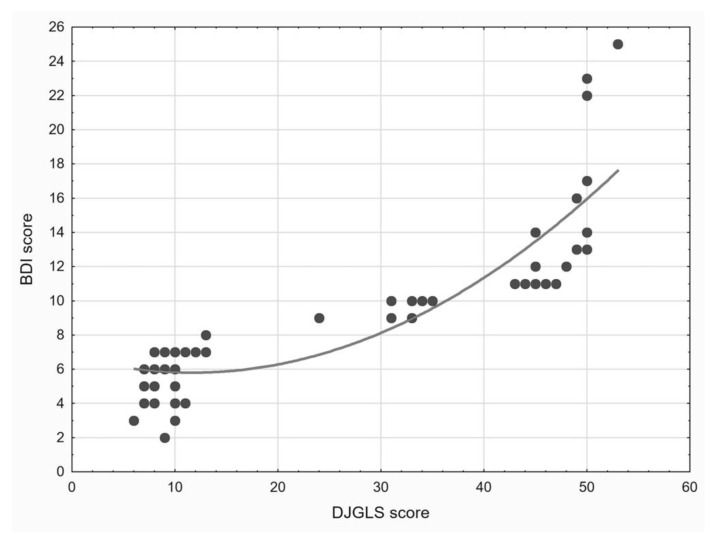
Up to a third of the population of older adults has been estimated to suffer from feelings of loneliness, which is considered a risk factor of depression. The aim of this paper is to compare the perceived level of loneliness and depression in seniors living in the country and in the cities and assess somatic morbidity and sociodemographic status as predictors of loneliness and depressiveness. = 92 older adults in primary care units filled out a set of questionnaires: authors' survey on sociodemographic data and morbidities, Beck Depression Inventory II (BDI, to measure depressiveness) and De Jong Gierveld Loneliness Scale (DJGLS, to assess loneliness). There was a strong, positive and statistically significant correlation between the BDI and DJGLS scores (R = 0.855, < 0.001). City residents had on average higher BDI and DJGLS scores. Linear regression models were constructed to predict BDI and DJGLS scores. The set of statistically significant predictors were similar for BDI and DJGLS. Sociodemographic status and somatic morbidities accounted for around 90% of variance of depressiveness and loneliness scores in the studied group. Living alone was found to be the strongest relative predictor of both loneliness and depressiveness in the studied sample of the older adults. Our current results suggest that there might be a need to improve social support in the late adulthood as an intervention to diminish the sense of loneliness and depressiveness.
据估计,多达三分之一的老年人感到孤独,而孤独被认为是抑郁的一个风险因素。本文旨在比较农村和城市老年人的孤独感和抑郁程度,并评估躯体发病率和社会人口统计学状况作为孤独感和抑郁的预测因素。
在初级保健单位的 92 名老年人填写了一套问卷:作者关于社会人口统计学数据和发病率的调查、贝克抑郁量表第二版(BDI,用于衡量抑郁程度)和德容·吉尔维尔德孤独量表(DJGLS,用于评估孤独感)。BDI 和 DJGLS 评分之间存在强烈、正相关且具有统计学意义(R = 0.855,<0.001)。城市居民的 BDI 和 DJGLS 评分平均较高。建立了线性回归模型来预测 BDI 和 DJGLS 评分。对 BDI 和 DJGLS 评分有统计学意义的预测因子集相似。社会人口统计学状况和躯体发病率解释了研究组中抑郁和孤独评分变化的 90%左右。研究样本中发现,独居是孤独和抑郁的最强相对预测因素。我们目前的结果表明,可能需要在晚年改善社会支持,以减少孤独感和抑郁感。