Department of Social Work, National Distance Education University (UNED), C/ Obispo Trejo, 2, 28040 Madrid, Spain.
Department of Administrative Sciences, Université du Québec en Outaouais (UQO), Bureau, B-2072, Pavillon Lucien-Brault, 101, rue Saint-Jean-Bosco, Gatineau, QC K1C 5J7, Canada.
Int J Environ Res Public Health. 2020 Aug 19;17(17):6023. doi: 10.3390/ijerph17176023.
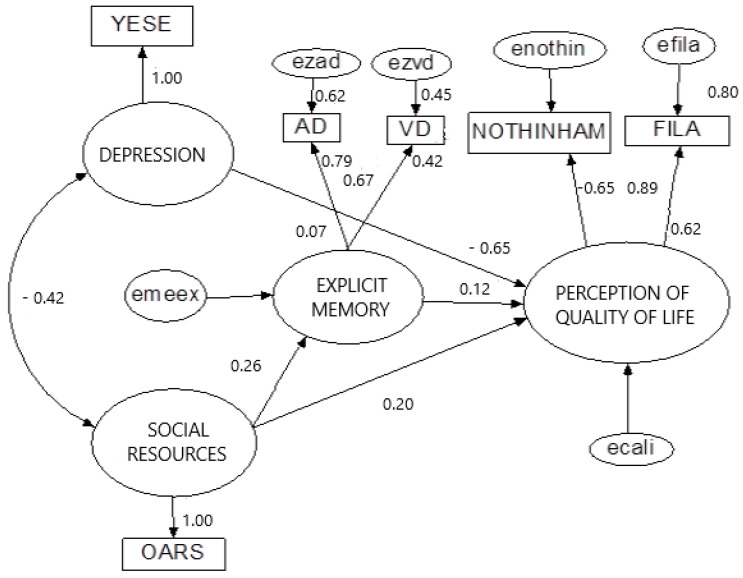
Population aging is the 21st century's predominant demographic event. The old-age dependency ratio is projected to rise sharply in the next decades. Variables of health-related quality of life can be useful in designing interventions for promoting active aging to prevent dependency and save governments' budgets. This study aims to find a model capable of explaining how psychosocial variables are related to improved quality of life during active aging, and if this relationship varies with age. Structural equation modelling (SEM) was used to examine the relationships among the availability of social resources, memory, depression, and perception of quality of life from three community senior centers in Madrid (Spain) in a sample of 128 older adult volunteers. The results suggest a psychosocial model where the availability of social support improves quality of life and explicit memory, reduces depression in active older adults, and where there are two main elements for understanding quality of life: perception of health and satisfaction. Importantly, age does not modify the interactions between variables, suggesting that their behavior is constant across aging. We concluded that the availability of social resources, understood not only as the people we interact with daily but also other family members, close friends, or institutions that could help in case of an emergency, allows people to avoid isolation and loneliness, increasing satisfaction and well-being in older adults. Professionals and policymakers should promote well-being by incorporating psychosocial variables related to personal satisfaction in the existential project, not only health, functional activity, or a friendly environment. Older adults need to feel that they are not alone, and in this sense, the availability of social resources is key.
人口老龄化是 21 世纪的主要人口事件。预计在未来几十年,老年抚养比将大幅上升。与健康相关的生活质量变量在设计促进积极老龄化的干预措施以防止依赖和节省政府预算方面可能很有用。本研究旨在寻找一个能够解释心理社会变量如何与积极老龄化期间生活质量的提高相关的模型,以及这种关系是否随年龄而变化。结构方程模型(SEM)用于检验马德里三个社区老年人中心的 128 名老年志愿者的社会资源可用性、记忆力、抑郁和生活质量感知之间的关系。结果表明,存在一个心理社会模型,其中社会支持的可用性可以改善生活质量和外显记忆,降低积极老龄化人群的抑郁程度,并且有两个理解生活质量的主要因素:对健康的感知和满意度。重要的是,年龄不会改变变量之间的相互作用,这表明它们的行为在整个衰老过程中是一致的。我们得出结论,社会资源的可用性,不仅理解为我们每天与之互动的人,还包括其他家庭成员、亲密朋友或在紧急情况下可以提供帮助的机构,可以防止人们孤立无援,增加老年人的满意度和幸福感。专业人士和决策者应该通过将与个人满意度相关的心理社会变量纳入存在主义项目(不仅是健康、功能活动或友好的环境)来促进幸福感。老年人需要感到自己并不孤单,在这方面,社会资源的可用性是关键。