Department of Oral Pathology, Peshawar Medical College, Warsak Road, Peshawar 25160, Pakistan.
Department of Oral Pathology, Riphah International University, Islamabad 46000, Pakistan.
Int J Environ Res Public Health. 2021 Jul 6;18(14):7230. doi: 10.3390/ijerph18147230.
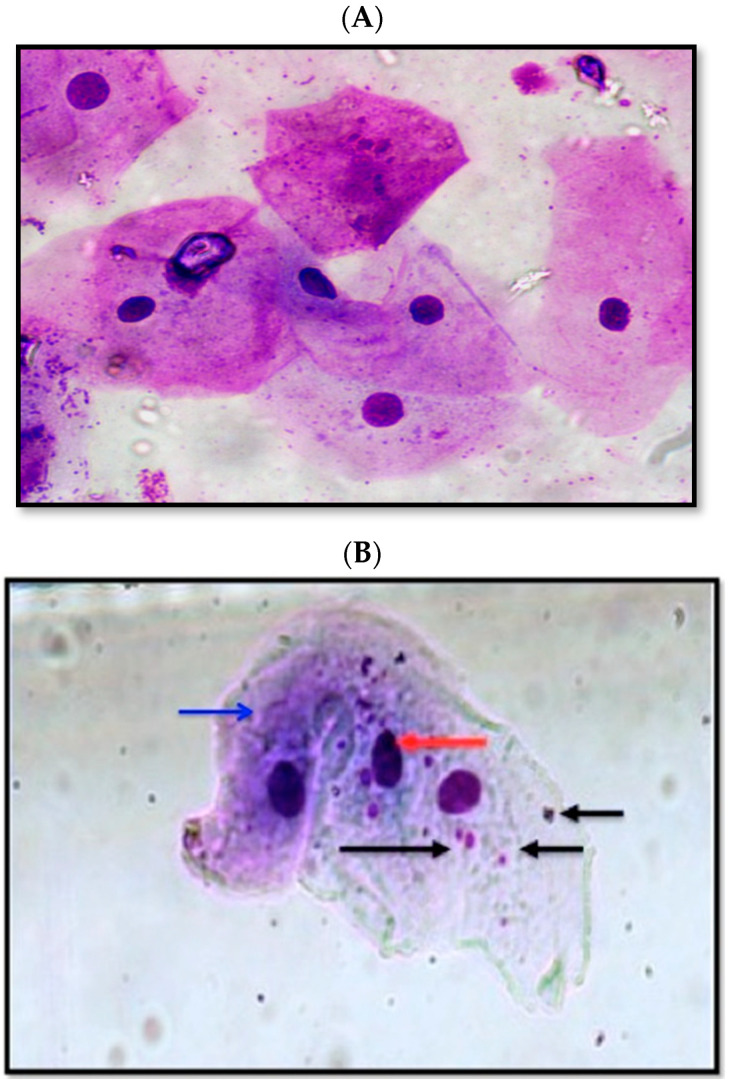
The aim of the study was to investigate the unstimulated whole saliva (UWS) tumor necrosis factor alpha (TNF-α) and cellular micronuclei in snuff dippers (Naswar) compared to healthy control subjects. The case control study was conducted over 9 months at a tertiary care center. Sixty patients were divided into two groups: Snuff dippers (SD) (Naswar) and non-snuff dippers (NSD) (control subjects). The included self-reported SD used Snuff twice daily for more than 12 months. UWS was collected and salivary TNF-α assessment was performed using enzyme-linked immunosorbent assay (ELISA). For cellular micronuclei, buccal mucosa was brushed to obtain cells in Naswar users, fixed with a dibutylphthalate polystyrene xylene (DPX) mounting to view micronuclei. Means and standard deviations were compared using the t-test and outcomes were related using Pearson correlation, considering ≤ 0.05 as significant. The mean age of participants was 38.85 ± 11.56 years. The mean duration of snuff use was 20.43 ± 12.79 years and the common site for Naswar placement was the lower vestibule ( = 19, 63.3%). TNF-α levels among SD were 9.6 ± 3.3 pg/mL, which were significantly higher than levels in NSD, 5.2 ± 3 pg/mL ( < 0.05). The number of cellular micronuclei in SD was 30.7 ± 7.8, which was comparatively higher than in NSD, which was 9.2 ± 3.3 ( < 0.05). The duration of snuff use was positively correlated to TNF-α levels ( = 0.048) rather than the micronuclei number ( = 0.97). SD showed higher levels of TNF-α and cellular micronuclei compared with NSD (control subjects); a positive correlation was shown with the duration of snuff use. We conclude that TNF-α and micronuclei are potential salivary biomarkers for an oral biological effect in snuff (Naswar) users.
本研究旨在比较鼻烟(Naswar)使用者与健康对照者的非刺激全唾液(UWS)肿瘤坏死因子-α(TNF-α)和细胞微核。这是一项在三级护理中心进行的为期 9 个月的病例对照研究。将 60 名患者分为两组:鼻烟使用者(SD)(鼻烟)和非鼻烟使用者(NSD)(对照组)。纳入的自报 SD 每天使用鼻烟两次,持续时间超过 12 个月。收集 UWS,并使用酶联免疫吸附试验(ELISA)进行唾液 TNF-α评估。对于细胞微核,用二甲苯(DPX)固定颊黏膜刷取 Naswar 使用者的细胞,以观察微核。使用 t 检验比较平均值和标准差,并使用 Pearson 相关性分析结果,以 ≤ 0.05 为显著。参与者的平均年龄为 38.85 ± 11.56 岁。鼻烟使用的平均时间为 20.43 ± 12.79 年,Naswar 放置的常见部位是下前庭( = 19,63.3%)。SD 组的 TNF-α水平为 9.6 ± 3.3 pg/mL,明显高于 NSD 组的 5.2 ± 3 pg/mL( < 0.05)。SD 组的细胞微核数为 30.7 ± 7.8,明显高于 NSD 组的 9.2 ± 3.3( < 0.05)。鼻烟使用时间与 TNF-α水平呈正相关( = 0.048),而与微核数呈负相关( = 0.97)。SD 组的 TNF-α和细胞微核水平均高于 NSD 组(对照组);鼻烟使用时间与 TNF-α水平呈正相关。我们得出结论,TNF-α 和微核可能是鼻烟(Naswar)使用者口腔生物学效应的潜在唾液生物标志物。