Chopra Vineet, Flanders Scott A, Vaughn Valerie, Petty Lindsay, Gandhi Tejal, McSparron Jakob Israel, Malani Anurag, O'Malley Megan, Kim Tae, McLaughlin Elizabeth, Prescott Hallie
Division of Hospital Medicine, Department of Internal Medicine, University of Michigan, Ann Arbor, Michigan, USA
Division of Hospital Medicine, Department of Internal Medicine, University of Michigan, Ann Arbor, Michigan, USA.
BMJ Open. 2021 Jul 23;11(7):e044921. doi: 10.1136/bmjopen-2020-044921.
To describe patient characteristics, symptoms, patterns of care and outcomes for patients hospitalised with COVID-19 in Michigan.
Multicentre retrospective cohort study.
32 acute care hospitals in the state of Michigan.
Patients discharged (16 March-11 May 2020) with suspected or confirmed COVID-19 were identified. Trained abstractors collected demographic information on all patients and detailed clinical data on a subset of COVID-19-positive patients.
Patient characteristics, treatment and outcomes including cardiopulmonary resuscitation, mortality and venous thromboembolism within and across hospitals.
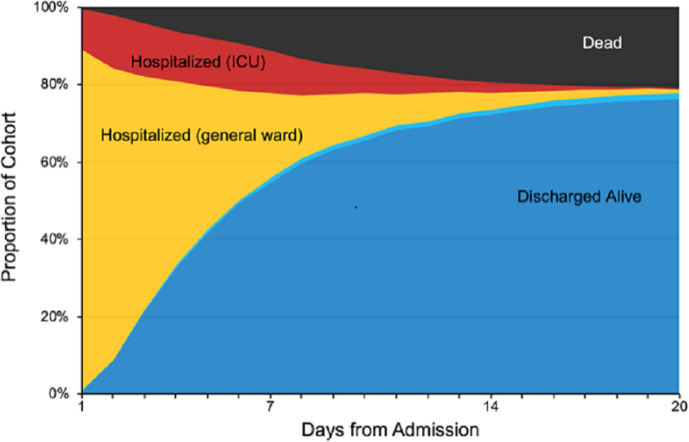
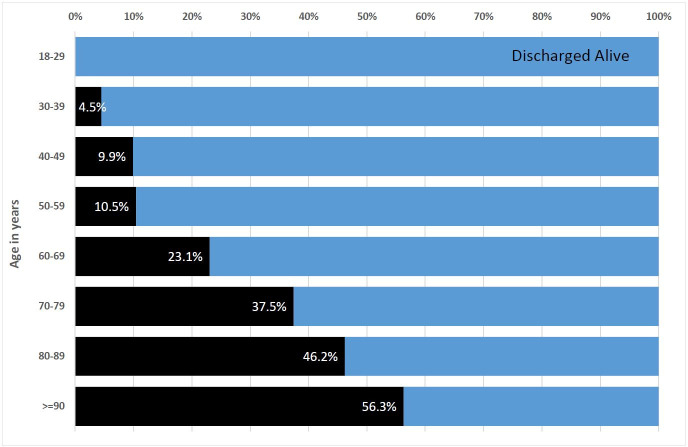
Demographic-only data from 1593 COVID-19-positive and 1259 persons under investigation discharges were collected. Among 1024 cases with detailed data, the median age was 63 years; median body mass index was 30.6; and 51.4% were black. Cough, fever and shortness of breath were the top symptoms. 37.2% reported a known COVID-19 contact; 7.0% were healthcare workers; and 16.1% presented from congregated living facilities.During hospitalisation, 232 (22.7%) patients were treated in an intensive care unit (ICU); 558 (54.9%) in a 'cohorted' unit; 161 (15.7%) received mechanical ventilation; and 90 (8.8%) received high-flow nasal cannula. ICU patients more often received hydroxychloroquine (66% vs 46%), corticosteroids (34% vs 18%) and antibiotic therapy (92% vs 71%) than general ward patients (p<0.05 for all). Overall, 219 (21.4%) patients died, with in-hospital mortality ranging from 7.9% to 45.7% across hospitals. 73% received at least one COVID-19-specific treatment, ranging from 32% to 96% across sites.Across 14 hospitals, the proportion of patients admitted directly to an ICU ranged from 0% to 43.8%; mechanical ventilation on admission from 0% to 12.8%; mortality from 7.9% to 45.7%. Use of at least one COVID-19-specific therapy varied from 32% to 96.3% across sites.
During the early days of the Michigan outbreak of COVID-19, patient characteristics, treatment and outcomes varied widely within and across hospitals.
描述密歇根州因新冠肺炎住院患者的特征、症状、护理模式及治疗结果。
多中心回顾性队列研究。
密歇根州的32家急症护理医院。
确定了2020年3月16日至5月11日出院的疑似或确诊新冠肺炎患者。经过培训的提取人员收集了所有患者的人口统计学信息以及一部分新冠肺炎阳性患者的详细临床数据。
患者特征、治疗及结果,包括各医院内及不同医院间的心肺复苏、死亡率和静脉血栓栓塞情况。
收集了1593例新冠肺炎阳性患者及1259例接受调查患者仅有的人口统计学数据。在1024例有详细数据的病例中,中位年龄为63岁;中位体重指数为30.6;51.4%为黑人。咳嗽、发热和呼吸急促是最常见的症状。37.2%的患者报告有已知的新冠肺炎接触史;7.0%为医护人员;16.1%来自集体生活设施。住院期间,232例(22.7%)患者在重症监护病房(ICU)接受治疗;558例(54.9%)在“隔离”病房;161例(15.7%)接受机械通气;90例(8.8%)接受高流量鼻导管吸氧。与普通病房患者相比,ICU患者更常接受羟氯喹(66%对46%)、皮质类固醇(34%对18%)和抗生素治疗(92%对71%)(所有p<0.05)。总体而言,219例(21.4%)患者死亡,各医院的院内死亡率在7.9%至45.7%之间。73%的患者接受了至少一种新冠肺炎特异性治疗,各医院的比例在32%至96%之间。在14家医院中,直接入住ICU的患者比例在0%至43.8%之间;入院时接受机械通气的比例在0%至12.8%之间;死亡率在7.9%至45.7%之间。各医院使用至少一种新冠肺炎特异性治疗的比例在32%至96.3%之间。
在密歇根州新冠肺炎疫情爆发的早期,各医院内及不同医院间患者的特征、治疗及结果差异很大。