McDonough Daniel J, Helgeson Melina A, Liu Wenxi, Gao Zan
School of Kinesiology, University of Minnesota-Twin Cities, Minneapolis, MN 55455, USA.
Carlson School of Management, University of Minnesota-Twin Cities, Minneapolis, MN 55455, USA.
J Sport Health Sci. 2022 Mar;11(2):145-156. doi: 10.1016/j.jshs.2021.07.009. Epub 2021 Jul 24.
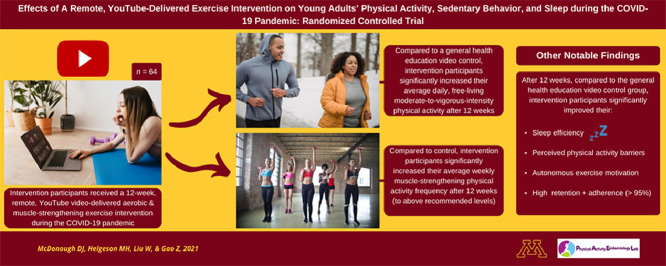
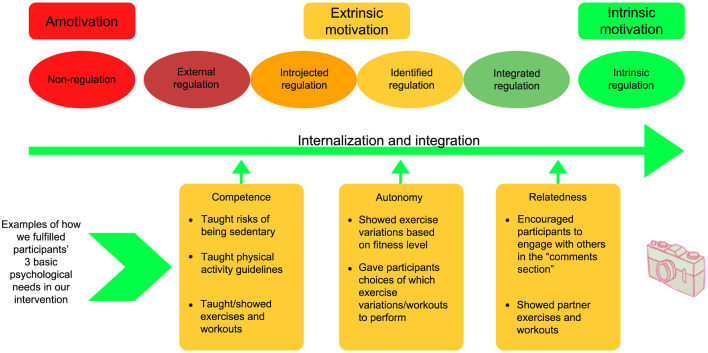
Public health guidelines have called for innovative and flexible physical activity (PA) intervention strategies to promote PA and health amid the coronavirus disease 2019 (COVID-19) pandemic. Therefore, this study's purpose was to examine the effects of a home-based, YouTube-delivered PA intervention grounded in self-determination theory on young adults' free-living PA, sedentary behavior, and sleep quality (NCT04499547).
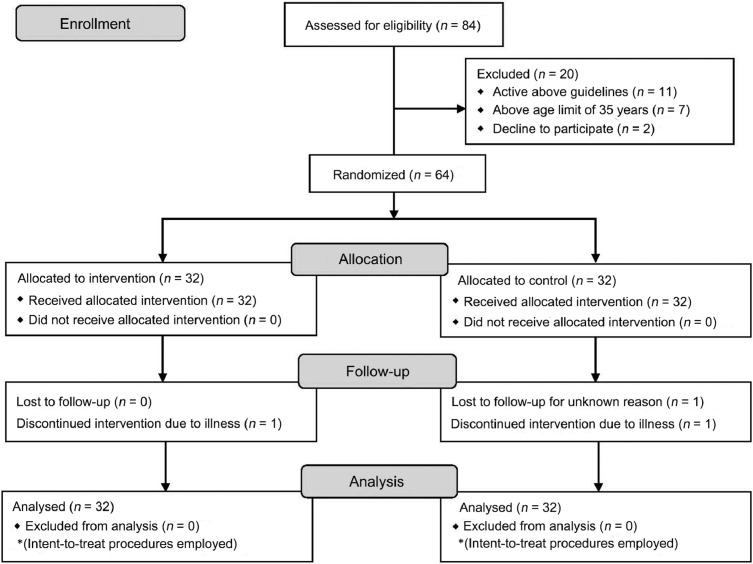
Sixty-four young adults (48 females; age = 22.8 ± 3.4 years, mean ± SD; body mass index = 23.1 ± 2.6 kg/m) were randomized (1:1) into the intervention group, which received weekly aerobic and muscle-strengthening PA videos, or control group, which received weekly general health education videos, for 12 weeks. Our primary outcome was free-living moderate-to-vigorous PA (MVPA) and our secondary outcomes were sedentary behavior, light PA, and sleep quality (measured using ActiGraph accelerometers) along with muscle-strengthening PA frequency, self-determination theory-related motivation (non-regulation, external regulation, introjected regulation, identified regulation, integrated regulation, and intrinsic regulation), and perceived PA barriers (assessed using validated questionnaires). Repeated measures analysis of variances (ANOVAs) examined between-group differences at an adjusted significance level of 0.004 and effect sizes as partial eta-squared (η).
We observed statistically significant interaction effects for MVPA, sleep efficiency, muscle-strengthening PA frequency, non-regulation, integrated regulation, intrinsic regulation, and perceived PA barriers (F(1, 62) = 10.75-77.67, p < 0.001-0.002, η = 0.15-0.56) with all outcomes favoring the intervention group. We observed no statistically significant differences in either group for sedentary behavior, light PA, sleep duration, or external, introjected, and identified regulations after 12 weeks (F(1, 62) = 1.11-3.64, p = 0.06-0.61).
With national COVID-19 restrictions still in place and uncertainty regarding post-pandemic PA environments and behaviors, a remote, YouTube-delivered PA intervention may help foster clinically meaningful improvements in young adults' free-living MVPA, muscle-strengthening PA frequency, sleep efficiency, PA-related intrinsic motivation, and perceived PA barriers.
公共卫生指南呼吁采取创新且灵活的体育活动(PA)干预策略,以在2019冠状病毒病(COVID-19)大流行期间促进体育活动和健康。因此,本研究的目的是检验基于自我决定理论、通过YouTube提供的居家PA干预对年轻人的自由生活体育活动、久坐行为和睡眠质量的影响(NCT04499547)。
64名年轻人(48名女性;年龄 = 22.8 ± 3.4岁,均值 ± 标准差;体重指数 = 23.1 ± 2.6 kg/m²)被随机(1:1)分为干预组(接受每周一次的有氧和肌肉强化PA视频)或对照组(接受每周一次的一般健康教育视频),为期12周。我们的主要结局是自由生活中的中度至剧烈体育活动(MVPA),次要结局是久坐行为、轻度体育活动和睡眠质量(使用ActiGraph加速度计测量),以及肌肉强化PA频率、与自我决定理论相关的动机(无调节、外部调节、内摄调节、认同调节、整合调节和内在调节)和感知到的体育活动障碍(使用经过验证的问卷进行评估)。重复测量方差分析(ANOVA)在调整后的显著性水平为0.004时检验组间差异,并将效应大小作为偏 eta 平方(η)。
我们观察到在MVPA、睡眠效率、肌肉强化PA频率、无调节、整合调节、内在调节和感知到的体育活动障碍方面存在统计学上显著的交互作用(F(1, 62) = 10.75 - 77.67,p < 0.001 - 0.002,η = 0.15 - 0.56),所有结局均有利于干预组。12周后,两组在久坐行为、轻度体育活动、睡眠时间或外部、内摄和认同调节方面均未观察到统计学上的显著差异(F(1, 62) = 1.11 - 3.64,p = 0.06 - 0.61)。
由于全国范围内的COVID-19限制仍然存在,且大流行后体育活动环境和行为存在不确定性,通过YouTube提供的远程PA干预可能有助于在年轻人的自由生活MVPA、肌肉强化PA频率、睡眠效率、与体育活动相关的内在动机和感知到的体育活动障碍方面带来具有临床意义的改善。