Krogh Nicolai, Asmar Fazila, Côme Christophe, Munch-Petersen Helga Fibiger, Grønbæk Kirsten, Nielsen Henrik
Department of Cellular and Molecular Medicine, The Panum Institute, University of Copenhagen, 3B Blegdamsvej, 18.2.20, DK-2200 Copenhagen N, Denmark.
Department of Hematology, Rigshospitalet, DK-2200 Copenhagen N, Denmark.
NAR Cancer. 2020 Dec 22;2(4):zcaa035. doi: 10.1093/narcan/zcaa035. eCollection 2020 Dec.
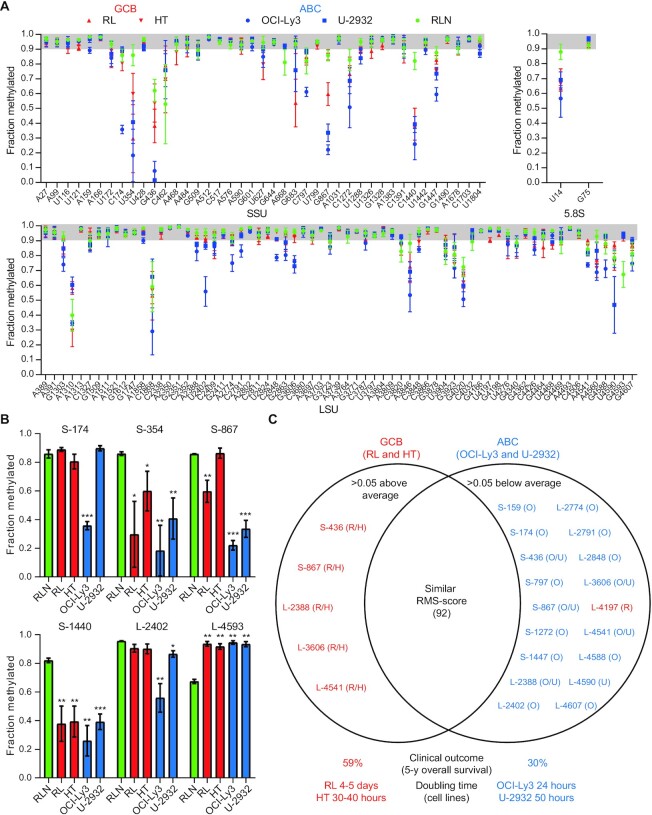
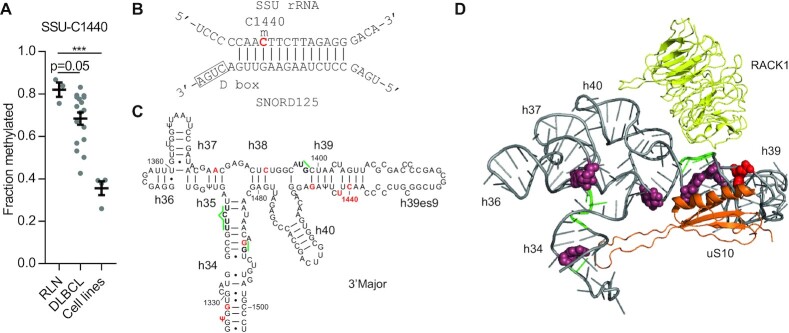
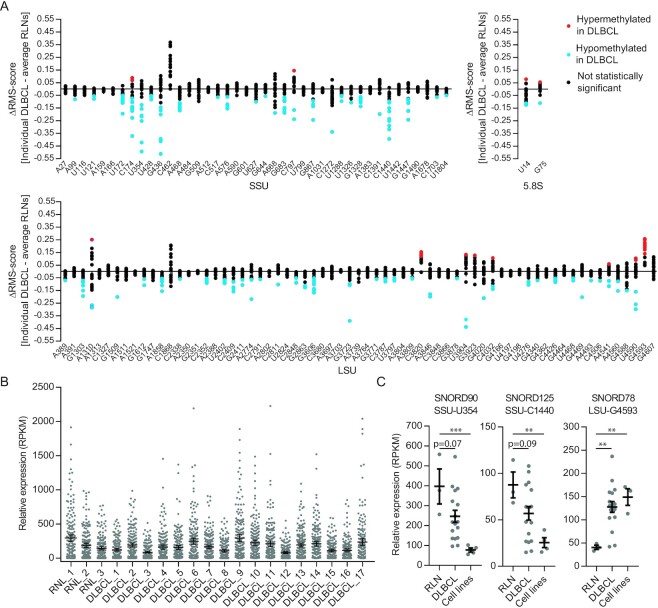
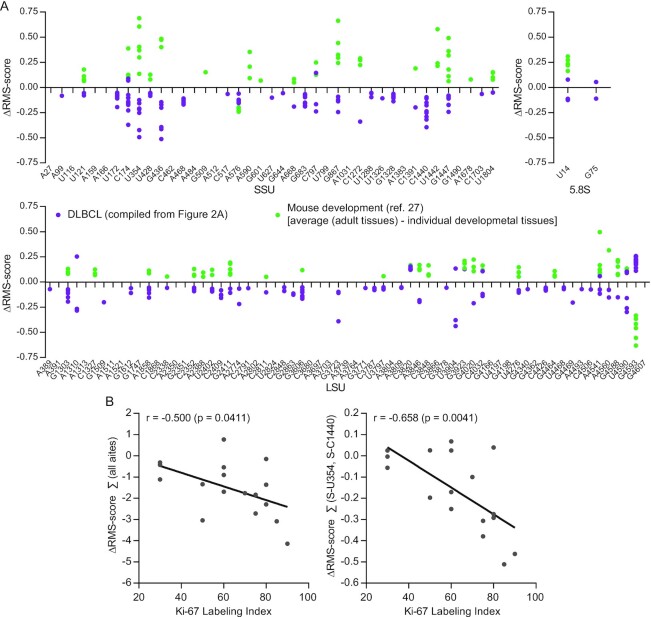
Cancer cells are addicted to ribosome biogenesis and high levels of translation. Thus, differential inhibition of cancer cells can be achieved by targeting aspects of ribosome biogenesis or ribosome function. Using RiboMeth-seq for profiling of the ∼112 2'-O-Me sites in human ribosomal RNA, we demonstrated pronounced hypomethylation at several sites in patient-derived diffuse large B-cell lymphoma (DLBCL) cell lines with a more severe perturbation in ABC-DLBCL compared to GBC-DLBCL. We extended our analysis to tumor samples from patients and demonstrated significant changes to the ribosomal modification pattern that appeared to consist of cell growth-related as well as tumor-specific changes. Sites of hypomethylation in patient samples are discussed as potential drug targets, using as an example a site in the small subunit (SSU-C1440) located in a ribosomal substructure that can be linked to DLBCL pathogenesis.
癌细胞对核糖体生物合成和高水平翻译存在依赖。因此,通过靶向核糖体生物合成或核糖体功能的各个方面,可以实现对癌细胞的差异性抑制。利用RiboMeth-seq对人类核糖体RNA中约112个2'-O-甲基化位点进行分析,我们发现在患者来源的弥漫性大B细胞淋巴瘤(DLBCL)细胞系中,几个位点存在明显的低甲基化,与生发中心B细胞样DLBCL(GBC-DLBCL)相比,ABC-DLBCL中的干扰更为严重。我们将分析扩展到患者的肿瘤样本,结果表明核糖体修饰模式发生了显著变化,这些变化似乎包括与细胞生长相关的变化以及肿瘤特异性变化。患者样本中的低甲基化位点被讨论为潜在的药物靶点,以位于核糖体亚结构中与DLBCL发病机制相关的小亚基中的一个位点(SSU-C1440)为例。