Maru Viral, Dixit Uma, Patil Rucha Shivajirao Bhise, Parekh Rupanshi
Department of Pediatric and Preventive Dentistry, DY Patil School of Dentistry, Nerul, Navi Mumbai, Maharashtra, India.
Int J Clin Pediatr Dent. 2021 Jan-Feb;14(1):30-39. doi: 10.5005/jp-journals-10005-1880.
Knowledge of the cytotoxicity and bioactivity of endodontic materials may assist in understanding their ability to promote dental pulp stem cell activity and pulp healing in primary teeth.
This systematic review was carried out by searching the electronic databases such as PubMed, Google Scholar, and Cochrane reviews for the articles published between January 2000 and December 2018 using the appropriate MeSH keywords. An independent investigator evaluated the abstracts and titles for possible inclusion, as per the stipulated inclusion and exclusion criteria. The topics considered for extracting data from each study were: cell lineage, cytotoxicity assay used, and type of material tested.
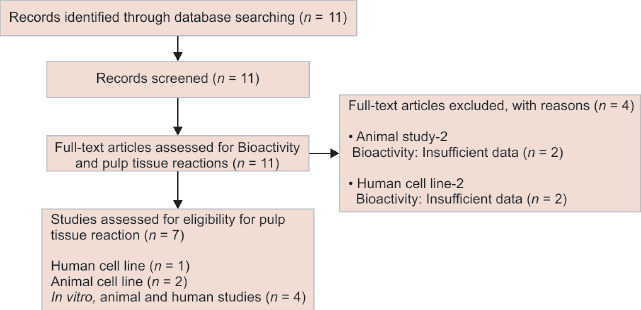
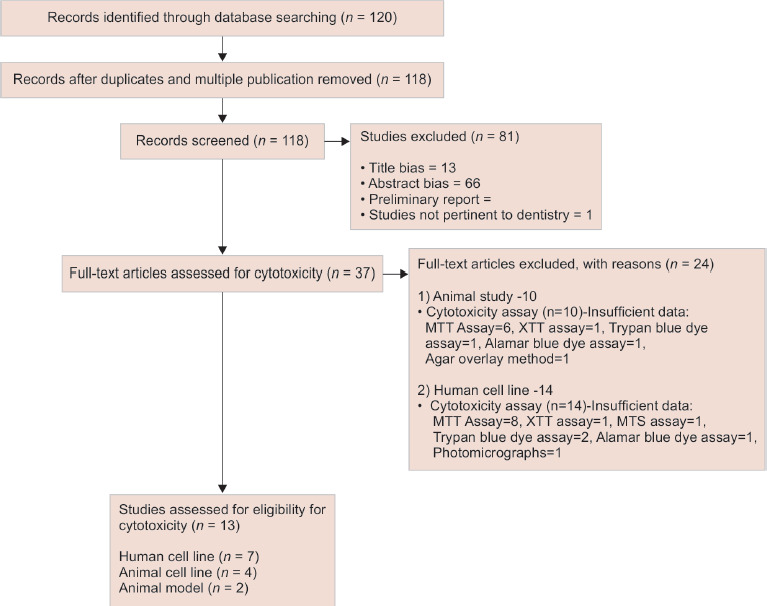
Seven eligible studies were selected for assessing the quality of evidence on the bioactivity of bioactive endodontic cements (BECs) (1 human cell line, 2 animal cell lines, and 4 , animal, and human studies) and 13 studies were selected for reviewing the quality of evidence on cytotoxicity (7 human cell lines, 4 animal cell lines, and 2 animal model studies). Very limited studies had been conducted on the bioactivity of materials other than mineral trioxide aggregate (MTA). With regards to cytotoxicity, the studies were diverse and most of the studies were based on MTT assay. Mineral trioxide aggregate is the most frequently used as well as studied root-end filling cement, and the literature evidence corroborated its reduced cytotoxicity and enhanced bioavailability.
There was a lack of sufficient evidence to arrive at a consensus on the ideal material with minimal cytotoxicity and optimal bioactivity. More focused human/cell line-based studies are needed on the available root filling materials.
The present systematic review provides an update on the available literature evidence on the cytotoxicity and bioactivity of various BECs including MTAs and their influence on the different cells with respect to their composition and strength.
Maru V, Dixit U, Patil RSB, Cytotoxicity and Bioactivity of Mineral Trioxide Aggregate and Bioactive Endodontic Type Cements: A Systematic Review. Int J Clin Pediatr Dent 2021;14(1):30-39.
了解牙髓材料的细胞毒性和生物活性,有助于理解其促进乳牙牙髓干细胞活性和牙髓愈合的能力。
本系统评价通过使用适当的医学主题词(MeSH)关键词,检索电子数据库,如PubMed、谷歌学术和Cochrane系统评价,查找2000年1月至2018年12月发表的文章。一名独立研究者根据规定的纳入和排除标准,评估摘要和标题以确定是否可能纳入。从每项研究中提取数据时考虑的主题包括:细胞谱系、使用的细胞毒性测定方法以及测试的材料类型。
七项符合条件的研究被选来评估生物活性牙髓粘固剂(BECs)生物活性证据的质量(1项人类细胞系研究、2项动物细胞系研究以及4项动物和人类研究),13项研究被选来审查细胞毒性证据的质量(7项人类细胞系研究、4项动物细胞系研究以及2项动物模型研究)。除三氧化矿物凝聚体(MTA)外,对其他材料生物活性的研究非常有限。关于细胞毒性,研究多样,且大多数研究基于MTT测定法。三氧化矿物凝聚体是最常用且研究最多的根尖充填粘固剂,文献证据证实其细胞毒性降低且生物活性增强。
缺乏足够证据就细胞毒性最小且生物活性最佳的理想材料达成共识。需要对现有的根充材料开展更有针对性的基于人类/细胞系的研究。
本系统评价提供了关于各种BECs(包括MTA)的细胞毒性和生物活性以及它们在组成和强度方面对不同细胞影响的现有文献证据的最新情况。
Maru V, Dixit U, Patil RSB, 三氧化矿物凝聚体和生物活性牙髓型粘固剂的细胞毒性和生物活性:一项系统评价。《国际临床儿科牙科学杂志》2021;14(1):30 - 39。