Ng Lauren C, Serba Eyerusalem Getachew, Dubale Benyam W, Fekadu Abebaw, Hanlon Charlotte
Department of Psychology, University of California Los Angeles, Los Angeles, CA, USA.
Department of Psychiatry, School of Medicine, College of Health Sciences, Addis Ababa University, Addis Ababa, Ethiopia.
Pilot Feasibility Stud. 2021 Jul 30;7(1):149. doi: 10.1186/s40814-021-00883-3.
In this protocol, we outline a mixed-methods randomized feasibility trial of Brief Relaxation, Education and Trauma Healing (BREATHE) Ethiopia. BREATHE Ethiopia is a culturally and contextually adapted intervention for PTSD in participants with severe mental illness. BREATHE Ethiopia maps onto the World Health Organization's guidelines for posttraumatic stress disorder (PTSD) treatment in low- and middle-income country primary care settings.
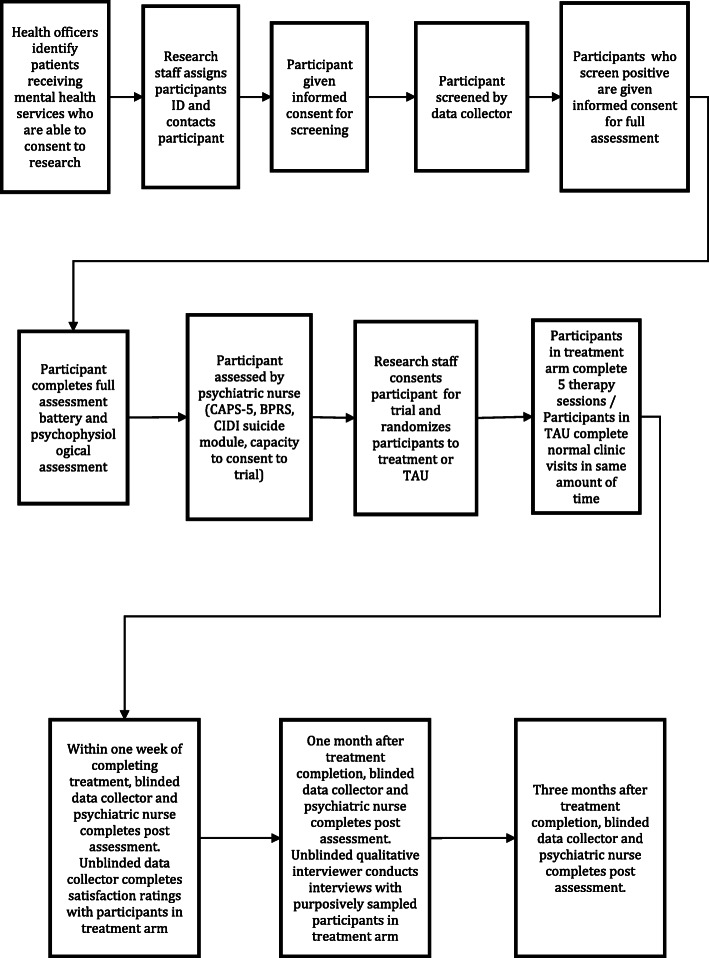
Specifically, this study includes a non-randomized pre-pilot (n = 5) and a randomized feasibility trial comparing BREATHE Ethiopia to Treatment as Usual (n = 40) to assess trial procedures, acceptability, and feasibility of intervention delivery, and investigate potential effectiveness and implementation. In a process evaluation, we will collect data that will be critical for a future fully randomized controlled trial, including the numbers of participants who are eligible, who consent, who engage in treatment, and who complete the assessments, as well as the feasibility and acceptability of assessments and the intervention. Qualitative data on facilitators and barriers to intervention delivery and quantitative data on provider fidelity to the intervention and participant and provider satisfaction will also be collected. Quantitative assessments at baseline, post-treatment, 1-month follow-up, and 3-month follow-up will assess change in mental health symptoms and functional impairment and hypothesized intervention mechanisms, including knowledge about PTSD, stigma, trauma-related cognitions, and physiological arousal.
Findings from this study will inform a future fully-powered randomized controlled trial, and if found to be effective, the intervention has the potential to be integrated into mental healthcare scale-up efforts in other low-resource settings.
Registered with ClinicalTrials.gov (NCT04385498) first posted May 13, 2020; https://www.clinicaltrials.gov/ct2/show/NCT04385498?term=ethiopia&cond=PTSD&draw=2&rank=1 .
在本方案中,我们概述了一项关于埃塞俄比亚简短放松、教育与创伤愈合(BREATHE)的混合方法随机可行性试验。埃塞俄比亚BREATHE是一种针对重度精神疾病患者创伤后应激障碍(PTSD)的经过文化和情境调整的干预措施。埃塞俄比亚BREATHE符合世界卫生组织关于低收入和中等收入国家初级保健环境中创伤后应激障碍(PTSD)治疗的指南。
具体而言,本研究包括一项非随机预试验(n = 5)和一项随机可行性试验,将埃塞俄比亚BREATHE与常规治疗进行比较(n = 40),以评估试验程序、可接受性以及干预实施的可行性,并调查潜在的有效性和实施情况。在过程评估中,我们将收集对未来全面随机对照试验至关重要的数据,包括符合条件、同意参与、接受治疗以及完成评估的参与者数量,以及评估和干预的可行性与可接受性。还将收集关于干预实施的促进因素和障碍的定性数据,以及关于提供者对干预的忠诚度、参与者和提供者满意度的定量数据。在基线、治疗后、1个月随访和3个月随访时进行的定量评估将评估心理健康症状和功能损害的变化以及假设的干预机制,包括关于创伤后应激障碍的知识、耻辱感、与创伤相关的认知和生理唤醒。
本研究的结果将为未来全面的随机对照试验提供信息,如果发现该干预措施有效,则有可能被纳入其他资源匮乏地区的精神卫生保健推广工作中。
已在ClinicalTrials.gov注册(NCT04385498),首次发布于2020年5月13日;https://www.clinicaltrials.gov/ct2/show/NCT04385498?term=ethiopia&cond=PTSD&draw=2&rank=1 。