Center for Visual and Neurocognitive Rehabilitation, Atlanta VA Healthcare System, Decatur, GA, United States; Department of Biomedical Engineering, Georgia Institute of Technology, Emory University School of Medicine, Atlanta, GA, United States.
Center for Visual and Neurocognitive Rehabilitation, Atlanta VA Healthcare System, Decatur, GA, United States.
Vision Res. 2021 Nov;188:162-173. doi: 10.1016/j.visres.2021.07.008. Epub 2021 Jul 30.
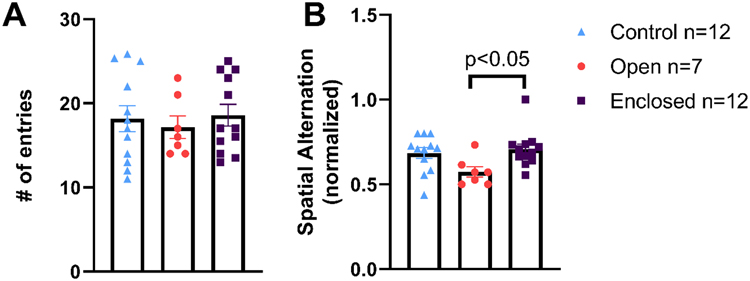
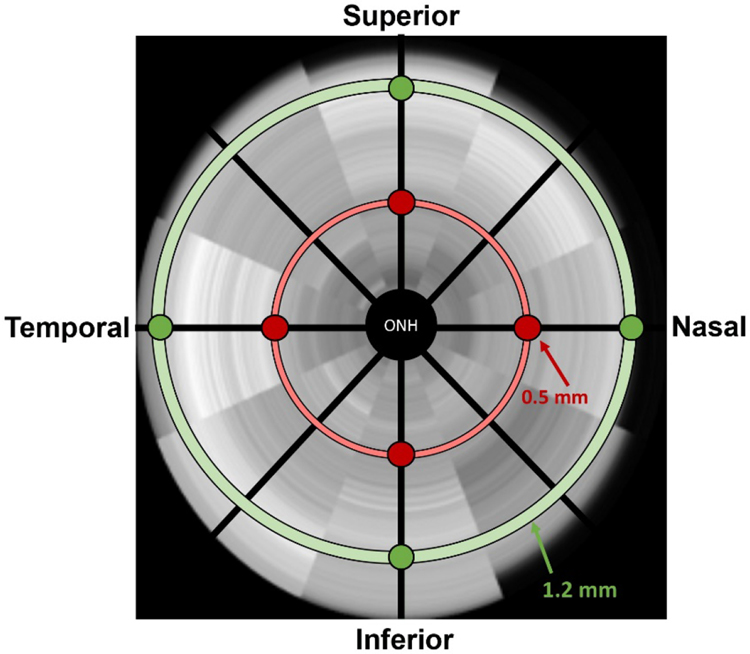
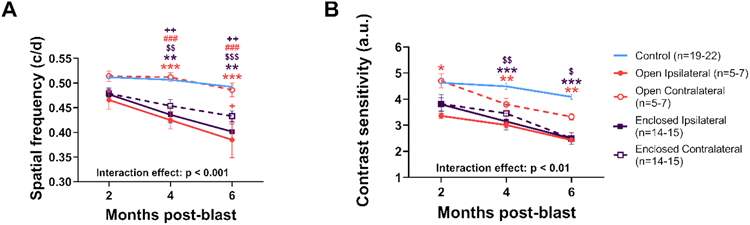
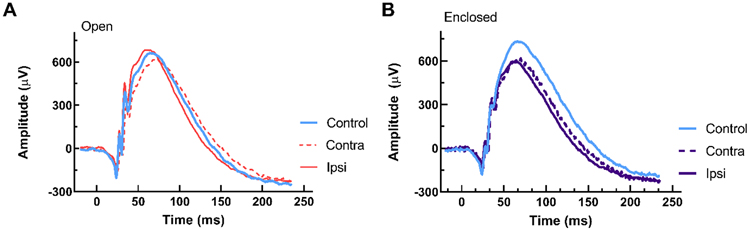
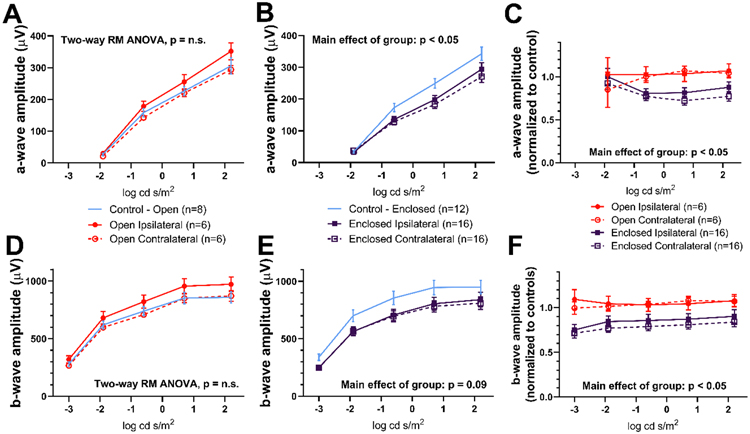
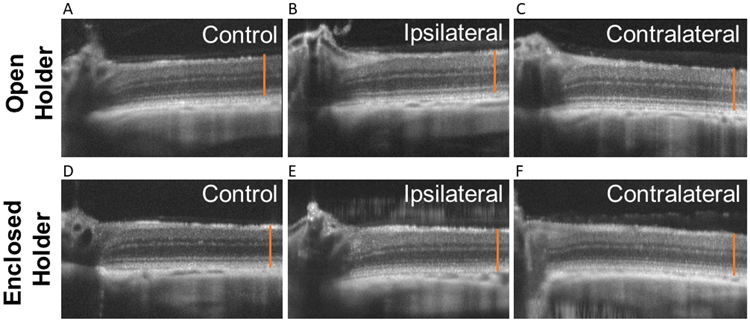
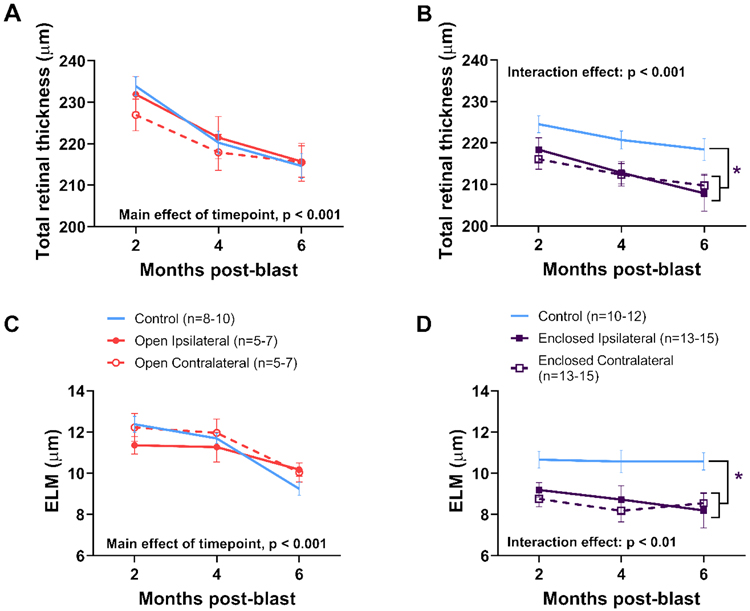
Blast-induced traumatic brain injury is the signature injury of modern military conflicts. To more fully understand the effects of blast exposure, we placed rats in different holder configurations, exposed them to blast overpressure, and assessed the degree of eye and brain injury. Anesthetized Long-Evans rats received blast exposures directed at the head (63 kPa, 195 dB-SPL) in either an "open holder" (head and neck exposed; n = 7), or an "enclosed holder" (window for blast exposure to eye; n = 15) and were compared to non-blast exposed (control) rats (n = 22). Outcomes included optomotor response (OMR), electroretinography (ERG), and spectral domain optical coherence tomography (SD-OCT) at 2, 4, and 6 months post-blast, and cognitive function (Y-maze) at 3 months. Spatial frequency and contrast sensitivity were reduced in ipsilateral blast-exposed eyes in both holders (p < 0.01), while contralateral eyes showed greater deficits with the enclosed holder (p < 0.05). Thinner retinas (p < 0.001) and reduced ERG a- and b- wave amplitudes (p < 0.05) were observed for both ipsilateral and contralateral eyes with the enclosed, but not the open, holder. Rats in the open holder showed cognitive deficits compared to rats in the enclosed holder (p < 0.05). Overall, the animal holder configuration used in blast exposure studies can significantly affect outcomes. Enclosed holders may cause secondary damage to the contralateral eye by concussive injury or blast wave reflection off the holder wall. Open holders may damage the brain via rapid head movement (contrecoup injury). These results highlight additional factors to be considered when evaluating patients with blast exposure or developing models of blast injury.
爆炸伤性脑损伤是现代军事冲突的标志性损伤。为了更全面地了解爆炸暴露的影响,我们将大鼠置于不同的固定器配置中,使其暴露于爆炸超压下,并评估眼睛和大脑损伤的程度。麻醉的 Long-Evans 大鼠接受头部指向的爆炸暴露(63kPa,195dB-SPL),分别置于“开放式固定器”(头颈部暴露;n=7)或“封闭式固定器”(用于眼睛暴露的窗口;n=15)中,并与非爆炸暴露(对照)大鼠(n=22)进行比较。结果包括爆炸后 2、4 和 6 个月的光动反应(OMR)、视网膜电图(ERG)和光谱域光学相干断层扫描(SD-OCT),以及 3 个月时的认知功能(Y 迷宫)。在两种固定器中,同侧爆炸暴露眼的空间频率和对比度敏感度均降低(p<0.01),而对侧眼的封闭固定器显示出更大的缺陷(p<0.05)。与封闭固定器相比,封闭固定器的同侧和对侧眼的视网膜变薄(p<0.001)和 ERG a 波和 b 波振幅降低(p<0.05)。与封闭固定器相比,开放式固定器中的大鼠表现出认知缺陷(p<0.05)。总之,在爆炸暴露研究中使用的动物固定器配置会显著影响结果。封闭式固定器可能会通过冲击伤或爆炸波从固定器壁反射对侧眼造成继发性损伤。开放式固定器可能会通过快速头部运动(对冲伤)损伤大脑。这些结果强调了在评估爆炸暴露患者或开发爆炸损伤模型时需要考虑的其他因素。