Research Center for Environmental Determinants of Health (RCEDH), Health Institute, Kermanshah University of Medical Sciences, Kermanshah, Iran.
Social Development and Health Promotion Research Center, Kermanshah University of Medical Sciences, Kermanshah, Iran.
Lipids Health Dis. 2021 Aug 1;20(1):82. doi: 10.1186/s12944-021-01505-w.
Visceral adiposity index (VAI) and atherogenic index of plasma (AIP) are relatively new indicators for predicting non-communicable diseases (NCDs). Therefore, the present study was done to assess the association of AIP and VAI with risk of cardiovascular diseases (CVDs).
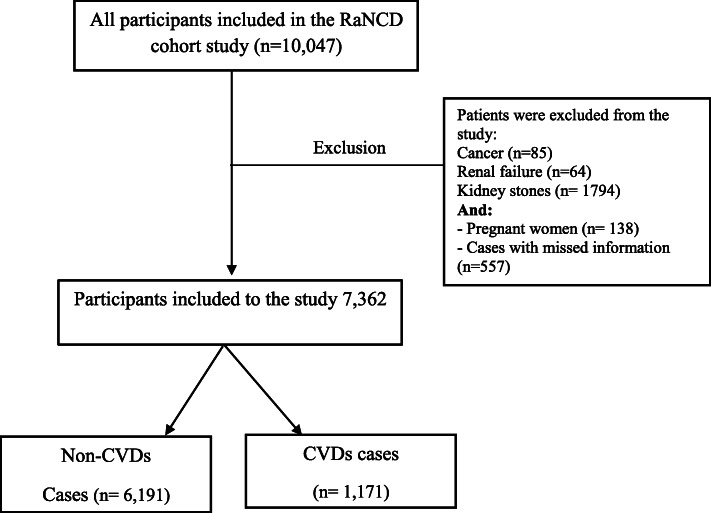
This cross-sectional study was conducted on 7,362 individuals aged between 35 and 65 years old participated in Ravansar non-communicable diseases (RaNCD) cohort study. AIP was calculated based on levels of triglyceride and high -density lipoprotein cholesterol (HDL-C). VAI was calculated using values of body mass index (BMI), waist circumference (WC), triglyceride, and HDL-C. Logistic regression models were used to assess the association of AIP and VAI with risk of CVDs.
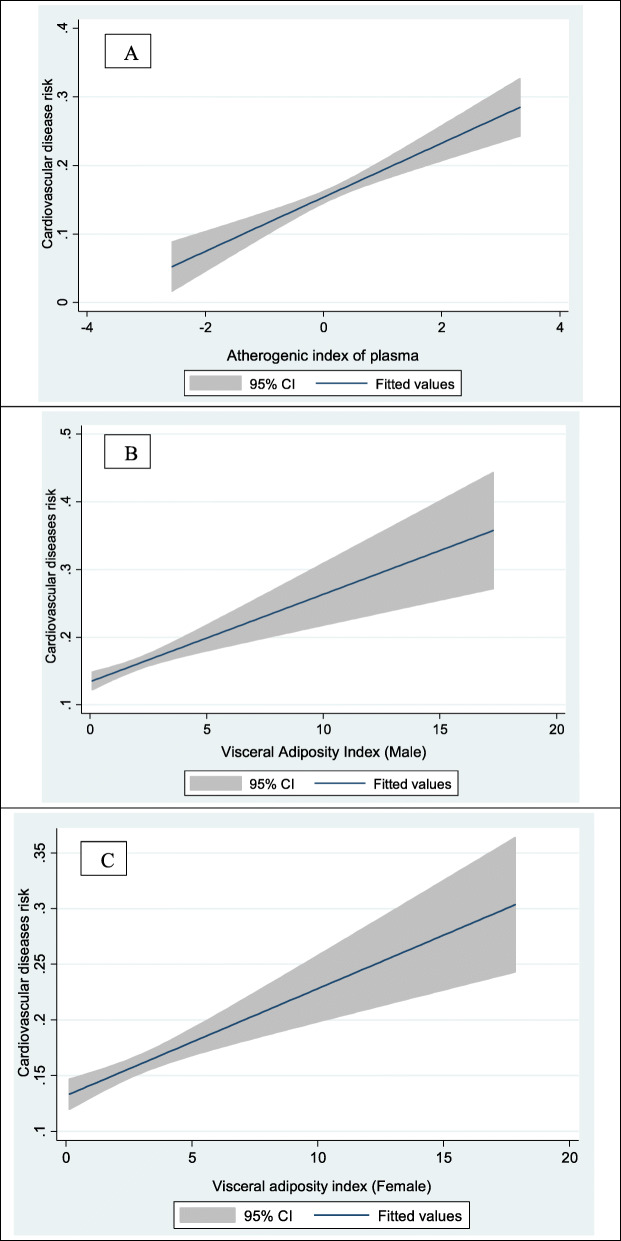
Mean values of anthropometric indices, lipid profile, AIP, and VAI were significantly higher in patients with CVDs than individuals without CVDs (P < 0.001). Mean values of anthropometric indices, lipid profile, and NCDs including hypertension, dyslipidemia, diabetes, metabolic syndrome (MetS), and CVDs in the third tertile of AIP and VAI were significantly increased compared to the first tertile (P < 0.001). After adjusting confounding factors, risk of CVDs in the third tertile of AIP was (OR = 1.32, 95 % CI: 1.03, 1.69) significantly increased compared to the first tertile. Risk of CVDs in the third tertile of VAI was (OR = 1.48, 95 % CI: 1.12, 1.97) significantly increased compared to the first tertile.
According to the findings, AIP and VAI were positively associated with risk of CVDs. Therefore, AIP and VAI can be useful in identifying high-risk subgroups of CVDs in general population.
内脏脂肪指数(VAI)和血浆致动脉粥样硬化指数(AIP)是预测非传染性疾病(NCD)的相对较新的指标。因此,本研究旨在评估 AIP 和 VAI 与心血管疾病(CVD)风险的相关性。
本横断面研究纳入了 7362 名年龄在 35 至 65 岁之间的个体,他们参加了 Ravansar 非传染性疾病(RaNCD)队列研究。AIP 是根据甘油三酯和高密度脂蛋白胆固醇(HDL-C)水平计算得出的。VAI 是使用体重指数(BMI)、腰围(WC)、甘油三酯和 HDL-C 值计算得出的。使用逻辑回归模型评估 AIP 和 VAI 与 CVD 风险的相关性。
与无 CVD 的个体相比,CVD 患者的人体测量指数、血脂谱、AIP 和 VAI 的平均值显著更高(P<0.001)。与 AIP 和 VAI 的第一 tertile 相比,第三 tertile 的人体测量指数、血脂谱和 NCD 包括高血压、血脂异常、糖尿病、代谢综合征(MetS)和 CVD 的平均值显著增加(P<0.001)。在调整混杂因素后,与第一 tertile 相比,AIP 第三 tertile 的 CVD 风险(OR=1.32,95%CI:1.03,1.69)显著增加。与第一 tertile 相比,VAI 第三 tertile 的 CVD 风险(OR=1.48,95%CI:1.12,1.97)显著增加。
根据研究结果,AIP 和 VAI 与 CVD 风险呈正相关。因此,AIP 和 VAI 可用于识别一般人群中 CVD 的高危亚组。