Tsinda Emmanuel Kagning, Mmbando Gideon Sadikiel
Graduate School of Medicine, Tohoku University, Sendai, 980-8575 Japan.
Graduate School of Life Sciences, Tohoku University, Sendai, 980-8577 Japan.
Bull Natl Res Cent. 2021;45(1):133. doi: 10.1186/s42269-021-00589-9. Epub 2021 Jul 23.
The COVID-19 respiratory illness caused by the SARS-CoV-2 has been a major cause of morbidity and mortality worldwide since the first reported case in Wuhan, China. A year has passed since pandemic began, and the reasons for different COVID-19 burden variation across continents keep puzzling the general public.
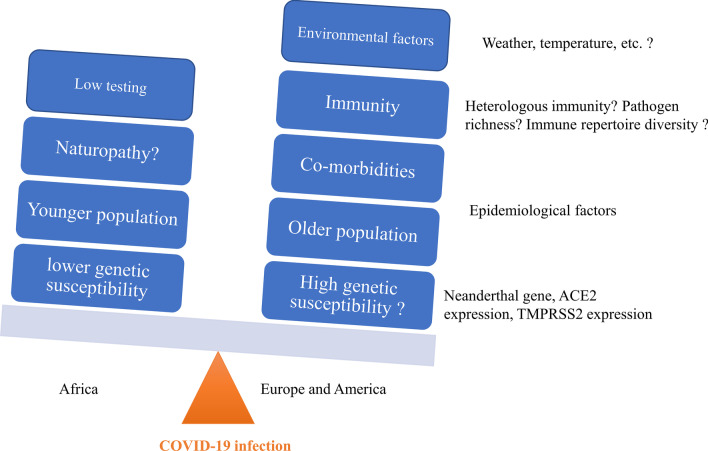
Since the COVID-19 pandemic started, published research articles have addressed the epidemiological risk factors, host factors, susceptibility and immunity. To ascertain possible reasons for the different rates of COVID-19 infections between Africa and other continents, we summarized the up-to-date scientific literature to identify possible arguments in this regard. Available literature suggests that demographic, epidemiological, sociological, genetic and immunological factors contribute in the COVID-19 severity and the susceptibly to SARS-CoV-2.
This review summarizes existing data and discusses reasons for differential COVID-19 burden across continents. The arguments mentioned herein will be helpful to guide future experimental studies to test different hypotheses.
自中国武汉首次报告病例以来,由严重急性呼吸综合征冠状病毒2(SARS-CoV-2)引起的2019冠状病毒病呼吸道疾病一直是全球发病和死亡的主要原因。自疫情开始以来已过去一年,各大洲2019冠状病毒病负担差异的原因一直困扰着公众。
自2019冠状病毒病疫情开始以来,已发表的研究文章探讨了流行病学风险因素、宿主因素、易感性和免疫力。为了确定非洲与其他大洲之间2019冠状病毒病感染率不同的可能原因,我们总结了最新的科学文献,以找出这方面可能的论据。现有文献表明,人口统计学、流行病学、社会学、遗传学和免疫学因素会影响2019冠状病毒病的严重程度以及对SARS-CoV-2的易感性。
本综述总结了现有数据,并讨论了各大洲2019冠状病毒病负担差异的原因。本文提及的论据将有助于指导未来的实验研究来检验不同的假设。