Buehler Center for Health Policy and Economics, Feinberg School of Medicine, Northwestern University, Chicago, IL, United States.
Feinberg School of Medicine, Northwestern University, Chicago, IL, United States.
J Med Internet Res. 2021 Jan 15;23(1):e25830. doi: 10.2196/25830.
The COVID-19 pandemic has disrupted the lives of millions and forced countries to devise public health policies to reduce the pace of transmission. In the Middle East and North Africa (MENA), falling oil prices, disparities in wealth and public health infrastructure, and large refugee populations have significantly increased the disease burden of COVID-19. In light of these exacerbating factors, public health surveillance is particularly necessary to help leaders understand and implement effective disease control policies to reduce SARS-CoV-2 persistence and transmission.
The goal of this study is to provide advanced surveillance metrics, in combination with traditional surveillance, for COVID-19 transmission that account for weekly shifts in the pandemic speed, acceleration, jerk, and persistence to better understand a country's risk for explosive growth and to better inform those who are managing the pandemic. Existing surveillance coupled with our dynamic metrics of transmission will inform health policy to control the COVID-19 pandemic until an effective vaccine is developed.
Using a longitudinal trend analysis study design, we extracted 30 days of COVID-19 data from public health registries. We used an empirical difference equation to measure the daily number of cases in MENA as a function of the prior number of cases, the level of testing, and weekly shift variables based on a dynamic panel data model that was estimated using the generalized method of moments approach by implementing the Arellano-Bond estimator in R.
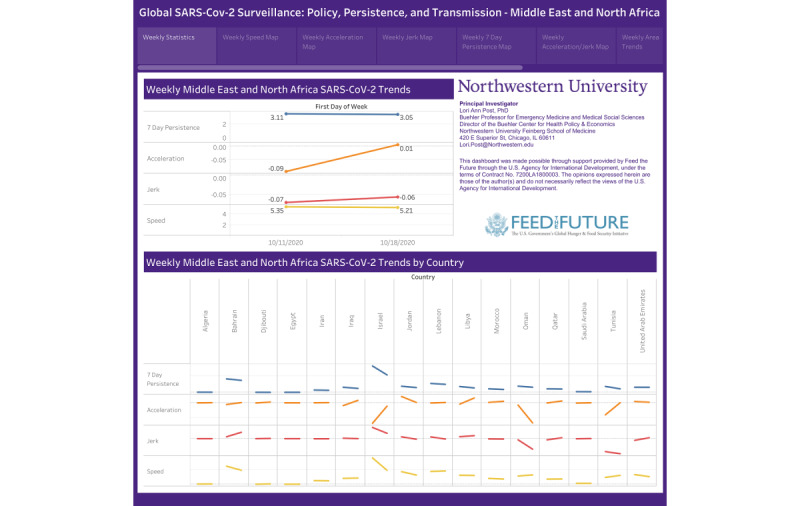
The regression Wald statistic was significant (χ=859.5, P<.001). The Sargan test was not significant, failing to reject the validity of overidentifying restrictions (χ=16, P=.99). Countries with the highest cumulative caseload of the novel coronavirus include Iran, Iraq, Saudi Arabia, and Israel with 530,380, 426,634, 342,202, and 303,109 cases, respectively. Many of the smaller countries in MENA have higher infection rates than those countries with the highest caseloads. Oman has 33.3 new infections per 100,000 population while Bahrain has 12.1, Libya has 14, and Lebanon has 14.6 per 100,000 people. In order of largest to smallest number of cumulative deaths since January 2020, Iran, Iraq, Egypt, and Saudi Arabia have 30,375, 10,254, 6120, and 5185, respectively. Israel, Bahrain, Lebanon, and Oman had the highest rates of COVID-19 persistence, which is the number of new infections statistically related to new infections in the prior week. Bahrain had positive speed, acceleration, and jerk, signaling the potential for explosive growth.
Static and dynamic public health surveillance metrics provide a more complete picture of pandemic progression across countries in MENA. Static measures capture data at a given point in time such as infection rates and death rates. By including speed, acceleration, jerk, and 7-day persistence, public health officials may design policies with an eye to the future. Iran, Iraq, Saudi Arabia, and Israel all demonstrated the highest rate of infections, acceleration, jerk, and 7-day persistence, prompting public health leaders to increase prevention efforts.
COVID-19 大流行扰乱了数百万人的生活,并迫使各国制定公共卫生政策以降低传播速度。在中东和北非(MENA)地区,油价下跌、贫富差距和公共卫生基础设施差异以及大量难民人口,使得 COVID-19 的疾病负担显著增加。鉴于这些加剧的因素,公共卫生监测对于帮助领导人了解和实施有效的疾病控制政策以减少 SARS-CoV-2 的持续传播尤为必要。
本研究的目的是提供先进的监测指标,结合传统监测,以更好地了解 COVID-19 传播的速度、加速度、冲击和持久性的每周变化,从而更好地了解一个国家的爆炸性增长风险,并为管理大流行的人员提供更好的信息。现有的监测以及我们对传播的动态指标将为控制 COVID-19 大流行提供信息,直到开发出有效的疫苗。
我们使用纵向趋势分析研究设计,从公共卫生登记处提取了 30 天的 COVID-19 数据。我们使用经验差分方程来衡量 MENA 地区的每日病例数,作为先前病例数、检测水平以及基于动态面板数据模型的每周变化变量的函数,该模型使用广义矩估计方法通过在 R 中实现 Arellano-Bond 估计器进行估计。
回归 Wald 统计量具有统计学意义(χ=859.5,P<.001)。Sargan 检验不显著,未拒绝过度识别限制的有效性(χ=16,P=.99)。新型冠状病毒累计病例数最高的国家包括伊朗、伊拉克、沙特阿拉伯和以色列,分别为 530380、426634、342202 和 303109 例。MENA 地区的许多较小国家的感染率高于病例数最高的国家。阿曼每 10 万人中有 33.3 例新感染,而巴林为 12.1 例,利比亚为 14 例,黎巴嫩为 14.6 例。自 2020 年 1 月以来,伊朗、伊拉克、埃及和沙特阿拉伯按累计死亡人数从大到小的顺序分别为 30375、10254、6120 和 5185 人。以色列、巴林、黎巴嫩和阿曼的 COVID-19 持续性最高,即与前一周新感染相关的新感染数量。巴林的速度、加速度和冲击为正,表明存在爆发式增长的潜力。
静态和动态公共卫生监测指标提供了对 MENA 国家大流行进展更全面的了解。静态措施在给定时间点捕获数据,例如感染率和死亡率。通过包括速度、加速度、冲击和 7 天持续性,公共卫生官员可以着眼于未来制定政策。伊朗、伊拉克、沙特阿拉伯和以色列的感染率、加速度、冲击和 7 天持续性均最高,促使公共卫生领导人加大预防力度。