Calaza Karin C, Erthal Fátima C S, Pereira Mirtes G, Macario Kita C D, Daflon Verônica T, David Isabel P A, Castro Helena C, Vargas Maria D, Martins Laura B, Stariolo Jasmin B, Volchan Eliane, de Oliveira Leticia
Department of Neurobiology, Institute of Biology, Universidade Federal Fluminense, Niterói, Brazil.
Laboratory of Neurobiology, Instituto de Biofísica Carlos Chagas Filho, Universidade Federal do Rio de Janeiro, Rio de Janeiro, Brazil.
Front Psychol. 2021 Jul 16;12:671481. doi: 10.3389/fpsyg.2021.671481. eCollection 2021.
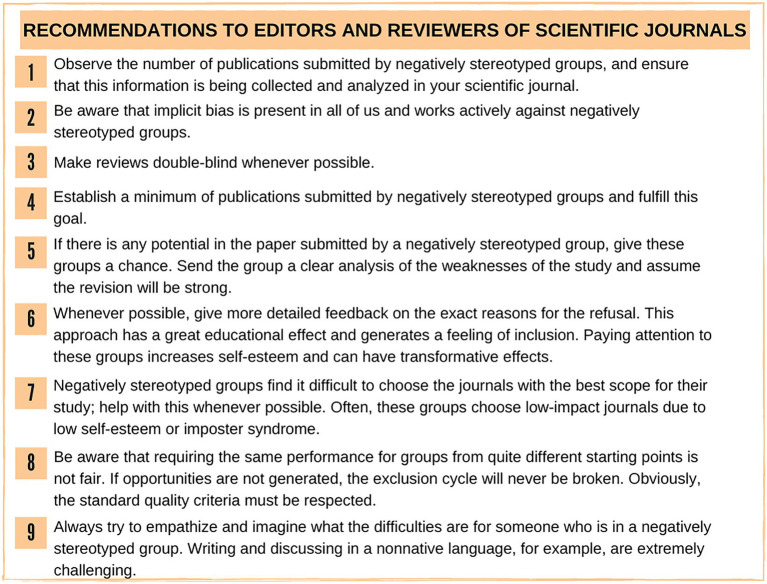
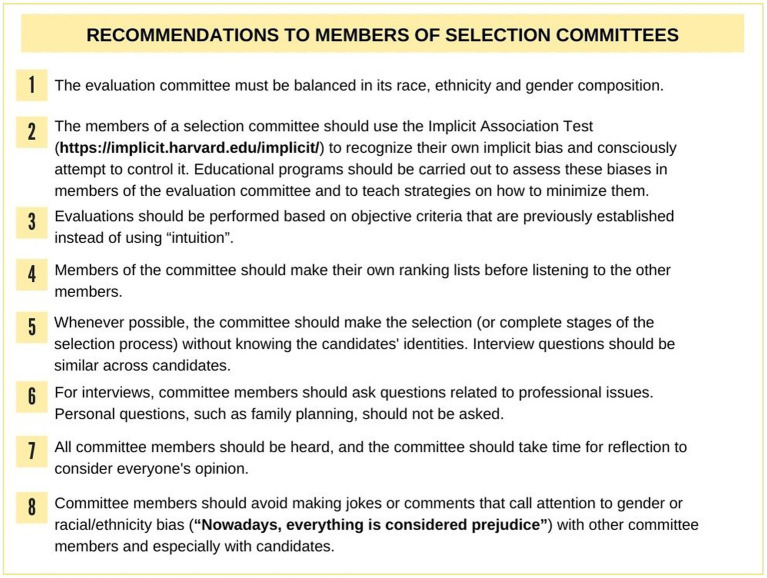
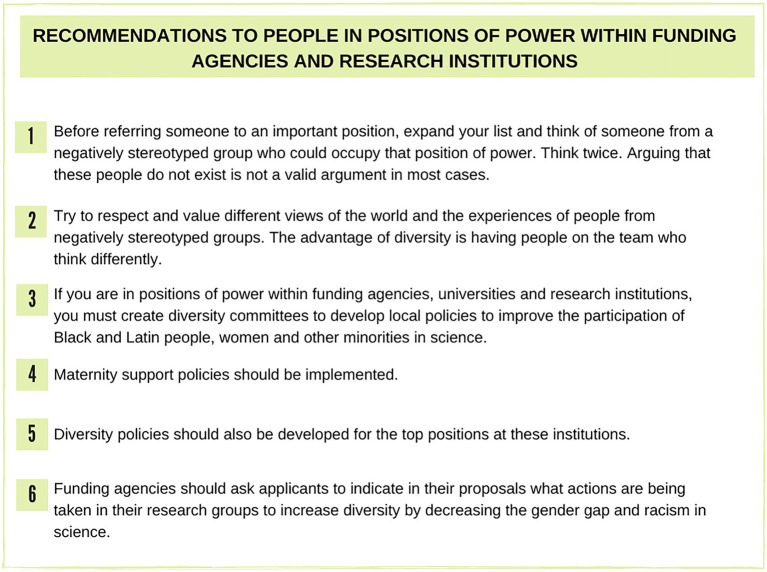
The editors of several major journals have recently asserted the importance of combating racism and sexism in science. This is especially relevant now, as the COVID-19 pandemic may have led to a widening of the gender and racial/ethnicity gaps. Implicit bias is a crucial component in this fight. Negative stereotypes that are socially constructed in a given culture are frequently associated with implicit bias (which is unconscious or not perceived). In the present article, we point to scientific evidence that shows the presence of implicit bias in the academic community, contributing to strongly damaging unconscious evaluations and judgments of individuals or groups. Additionally, we suggest several actions aimed at (1) editors and reviewers of scientific journals (2) people in positions of power within funding agencies and research institutions, and (3) members of selection committees to mitigate this effect. These recommendations are based on the experience of a group of Latinx American scientists comprising Black and Latina women, teachers, and undergraduate students who participate in women in science working group at universities in the state of Rio de Janeiro, Brazil. With this article, we hope to contribute to reflections, actions, and the development of institutional policies that enable and consolidate diversity in science and reduce disparities based on gender and race/ethnicity.
几家主要期刊的编辑最近强调了在科学界反对种族主义和性别歧视的重要性。这一点在当下尤为重要,因为新冠疫情可能导致了性别和种族/族裔差距的扩大。隐性偏见是这场斗争的关键因素。在特定文化中社会建构的负面刻板印象常常与隐性偏见(无意识的或未被察觉的)相关联。在本文中,我们指出科学证据表明学术群体中存在隐性偏见,这导致对个人或群体产生极具破坏性的无意识评价和判断。此外,我们针对(1)科学期刊的编辑和审稿人、(2)资助机构和研究机构中有权力的人员以及(3)选拔委员会成员提出了几项旨在减轻这种影响的行动建议。这些建议基于一群拉丁裔美国科学家的经验,他们包括黑人及拉丁裔女性、教师和本科生,这些人参与了巴西里约热内卢州各大学的科学界女性工作组。通过本文,我们希望为思考、行动以及机构政策的制定做出贡献,这些政策能够促进并巩固科学界的多样性,减少基于性别和种族/族裔的差异。