Department of Head and Neck Surgery, The University of Texas MD Anderson Cancer Center, Houston, TX, United States.
Department of Endocrine Neoplasia and Hormonal Disorders, The University of Texas MD Anderson Cancer Center, Houston, TX, United States.
Front Endocrinol (Lausanne). 2021 Jul 15;12:720723. doi: 10.3389/fendo.2021.720723. eCollection 2021.
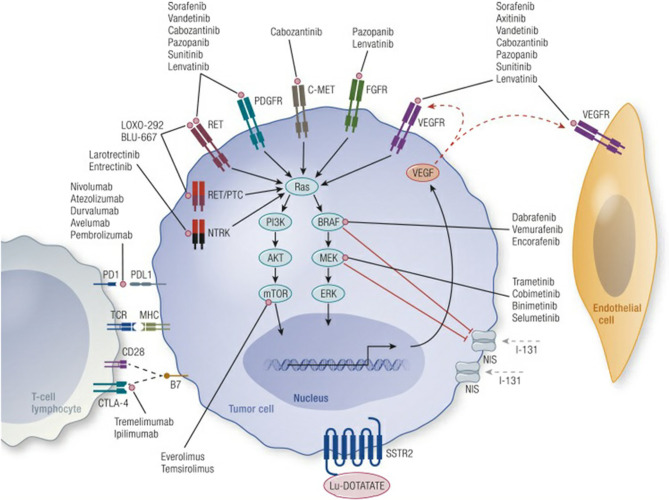
Iodine-resistant cancers account for the vast majority of thyroid related mortality and, until recently, there were limited therapeutic options. However, over the last decade our understanding of the molecular foundation of thyroid function and carcinogenesis has driven the development of many novel therapeutics. These include FDA approved tyrosine kinase inhibitors and small molecular inhibitors of VEGFR, BRAF, MEK, NTRK and RET, which collectively have significantly changed the prognostic outlook for this patient population. Some therapeutics can re-sensitize de-differentiated cancers to iodine, allowing for radioactive iodine treatment and improved disease control. Remarkably, there is now an FDA approved treatment for BRAF-mutated patients with anaplastic thyroid cancer, previously considered invariably and rapidly fatal. The treatment landscape for iodine-resistant thyroid cancer is changing rapidly with many new targets, therapeutics, clinical trials, and approved treatments. We provide an up-to-date review of novel therapeutic options in the treatment of iodine-resistant thyroid cancer.
碘难治性癌症占甲状腺相关死亡的绝大多数,直到最近,治疗选择有限。然而,在过去的十年中,我们对甲状腺功能和致癌作用的分子基础的理解推动了许多新疗法的发展。这些包括 FDA 批准的酪氨酸激酶抑制剂和血管内皮生长因子受体(VEGFR)、BRAF、MEK、NTRK 和 RET 的小分子抑制剂,它们共同显著改变了这部分患者人群的预后前景。一些疗法可以使去分化的癌症重新对碘敏感,从而能够进行放射性碘治疗并改善疾病控制。值得注意的是,现在有一种 FDA 批准的治疗方法可用于治疗具有 BRAF 突变的间变性甲状腺癌患者,这种癌症以前被认为是不可避免且迅速致命的。碘难治性甲状腺癌的治疗领域正在迅速变化,出现了许多新的靶点、疗法、临床试验和已批准的治疗方法。我们提供了碘难治性甲状腺癌治疗中新型治疗选择的最新综述。