Chu Liwei, He Xuejiao, Shu Wenbo, Wang Lijuan, Tang Fang
State Key Laboratory of Tree Genetics and Breeding, Key Laboratory of Tree Breeding and Cultivation of the National Forestry and Grassland Administration, Research Institute of Forestry, Chinese Academy of Forestry, Beijing, China.
Key Laboratory of Horticultural Plant Biology of Ministry of Education, College of Horticulture and Forestry Sciences, Huazhong Agricultural University, Wuhan, China.
Front Plant Sci. 2021 Jul 14;12:714907. doi: 10.3389/fpls.2021.714907. eCollection 2021.
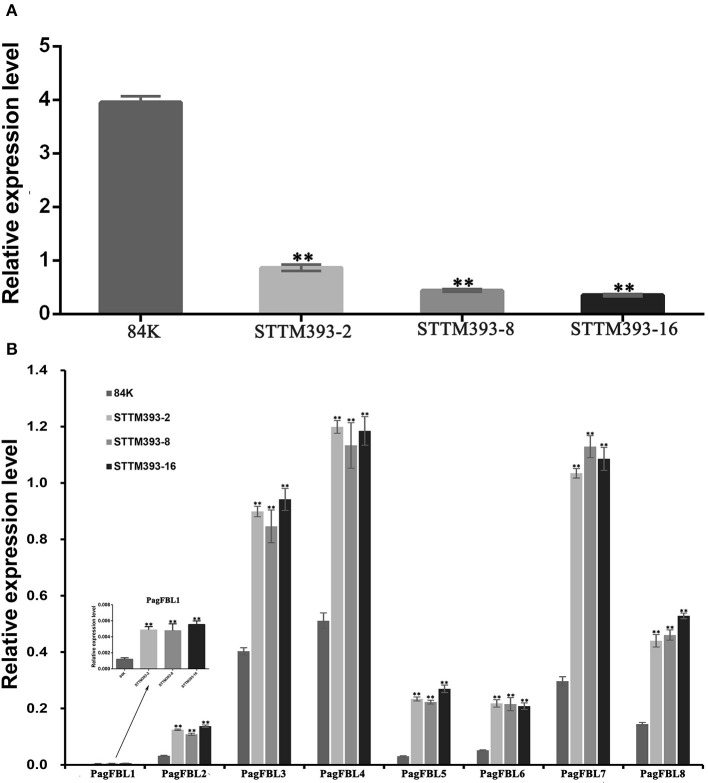
Short tandem target mimic (STTM), which is composed of two short sequences mimicking small RNA target sites, separated by a linker of optimal size, can block the functions of all members in a miRNA family. microRNA393 (miR393), which is one of the conserved miRNA families in plants, can regulate plant root growth, leaf development, plant architecture, and stress resistance. In order to verify the role of miR393 in the secondary growth of trees, we created its STTM transgenic poplar lines (STTM393). The expression of miR393 in STTM393 lines was reduced by over 10 times compared with the control plants. STTM393 lines showed promoted growth with about 20% higher, 15% thicker, and 2-4 more internodes than the control plants after 3 months of growth. The cross-section of the stems showed that STTM393 lines had wider phloem, xylem, and more cambium cell layers than control plants, and the lignin content in STTM393 lines was also higher as revealed by staining and chemical determination. Based on the transcriptome analysis, the genes related to the auxin signaling pathway, cell cyclin, cell expansion, and lignin synthesis had higher expression in STTM393 lines than that in control plants. The higher expression levels of family members suggested that the auxin signaling pathway was strengthened in STTM393 lines to promote plant growth. Therefore, the knockdown of miR393 using the STTM approach provides a way to improve poplar growth and biomass production.
短串联靶标模拟物(STTM)由模仿小RNA靶位点的两个短序列组成,中间由最佳大小的接头隔开,可阻断miRNA家族中所有成员的功能。微小RNA393(miR393)是植物中保守的miRNA家族之一,可调节植物根系生长、叶片发育、株型和抗逆性。为了验证miR393在树木次生生长中的作用,我们构建了其STTM转基因杨树株系(STTM393)。与对照植株相比,STTM393株系中miR393的表达降低了10倍以上。生长3个月后,STTM393株系的生长得到促进,与对照植株相比,高度高出约20%,茎粗粗15%,节间多2 - 4个。茎的横切面显示,STTM393株系的韧皮部、木质部更宽,形成层细胞层数更多,染色和化学测定结果表明,STTM393株系中的木质素含量也更高。基于转录组分析,与生长素信号通路、细胞周期蛋白、细胞扩张和木质素合成相关的基因在STTM393株系中的表达高于对照植株。该家族成员较高的表达水平表明,STTM393株系中生长素信号通路得到增强,从而促进植物生长。因此,利用STTM方法敲低miR393为提高杨树生长和生物量生产提供了一种途径。