Zhang Yuanjie, Chen Lin, Luo Gang
Department of Urology, Central Hospital of Wuhan, Tongji Medical College, Huazhong University of Science and Technology, Wuhan, Hubei 430014, P.R. China.
Exp Ther Med. 2021 Sep;22(3):947. doi: 10.3892/etm.2021.10379. Epub 2021 Jul 1.
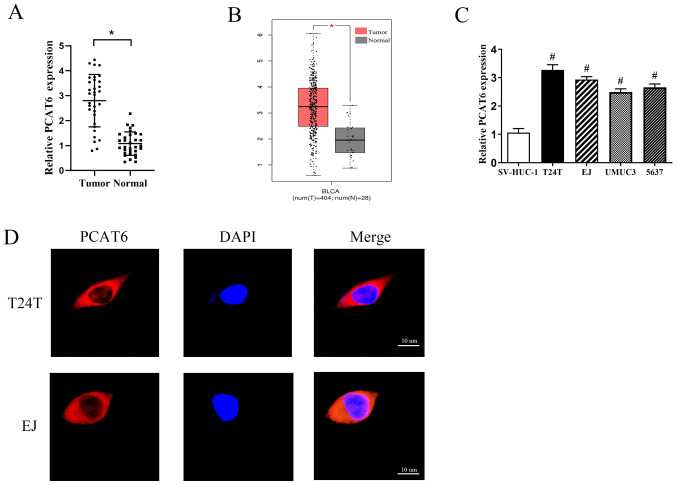
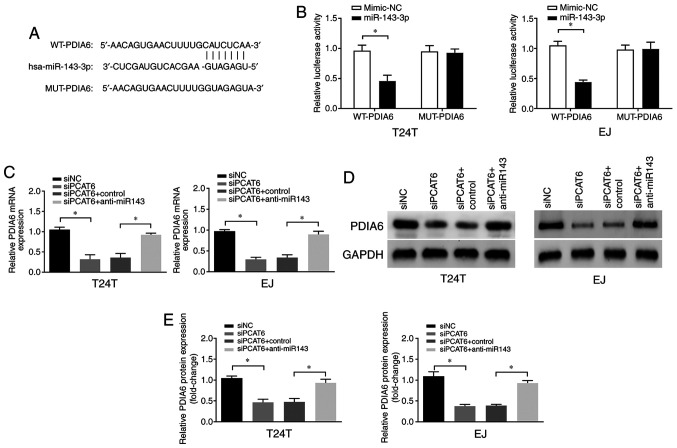
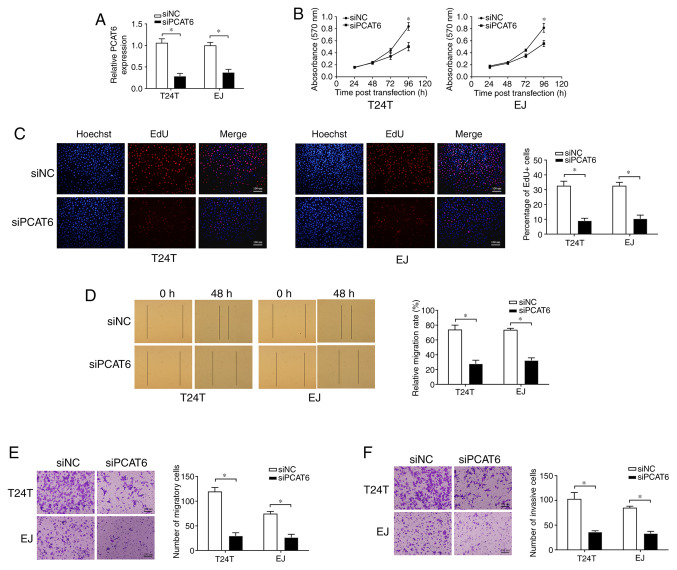
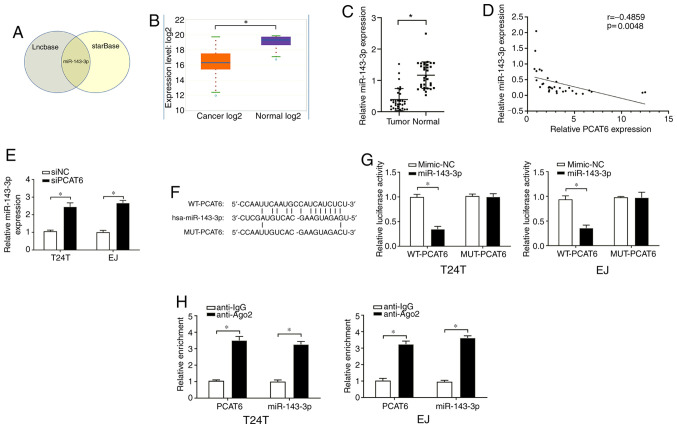
Although long non-coding (lnc)RNAs have been reported to be involved in the pathological development of bladder cancer, the functions of lncRNA prostate cancer-associated transcript 6 (PCAT6) and its underlying mechanism of action in bladder cancer remain unknown. The present study aimed to investigate the effect of PCAT6 in bladder cancer progression and explore its potential application as a novel treatment target. The expression of PCAT6 and miR-143-3p in bladder cancer tissues, adjacent normal tissues and cell lines was measured using reverse transcription-quantitative PCR. Fluorescence hybridization assay was used to detect the subcellular localization of PCAT6. MTT, EdU, Transwell and wound healing assays were conducted to assess the biological function of PCAT6 on cell proliferation, migration and invasion. Putative binding sites between miR-143-3p and PCAT6 or PDIA6 were predicted using starBase, Lncbase and TargetScan analyzes. Dual-luciferase reporter assay was also used to confirm the potential binding between PCAT6 and miR-143-3p. RNA immunoprecipitation assay was performed to verify the possible interaction between PCAT6 and miR-143-3p. Western blotting was used to measure the expression of PDIA6. The results demonstrated that the expression levels of PCAT6 were upregulated in bladder cancer tissues relative to those in adjacent normal bladder tissues. Knockdown of PCAT6 served a role in suppressing the proliferation, migration and invasion of T24T and EJ bladder cancer cells. PCAT6 knockdown contributed to a reduction of PDIA6 expression at the mRNA and protein levels compared with that in negative control-transfected cells, whilst the miR-143-3p inhibitor partially mitigated this reduction effect. In addition, rescue experiments revealed that the miR-143-3p inhibitors reversed the effects of PCAT6 silencing on the malignant phenotypes of bladder cancer. Collectively, the results of the present study demonstrated that PCAT6 may serve an oncogenic role in bladder cancer via the miR-143-3p/PDIA6 axis. These results may provide a potential therapeutic target for the treatment of bladder cancer.
尽管已有报道称长链非编码(lnc)RNA参与膀胱癌的病理发展,但lncRNA前列腺癌相关转录本6(PCAT6)在膀胱癌中的功能及其潜在作用机制仍不清楚。本研究旨在探讨PCAT6在膀胱癌进展中的作用,并探索其作为新型治疗靶点的潜在应用。采用逆转录-定量PCR检测PCAT6和miR-143-3p在膀胱癌组织、癌旁正常组织及细胞系中的表达。荧光杂交试验用于检测PCAT6的亚细胞定位。进行MTT、EdU、Transwell和伤口愈合试验,以评估PCAT6对细胞增殖、迁移和侵袭的生物学功能。使用starBase、Lncbase和TargetScan分析预测miR-143-3p与PCAT6或PDIA6之间的假定结合位点。双荧光素酶报告基因试验也用于证实PCAT6与miR-143-3p之间的潜在结合。进行RNA免疫沉淀试验以验证PCAT6与miR-143-3p之间可能的相互作用。采用蛋白质印迹法检测PDIA6的表达。结果表明,与癌旁正常膀胱组织相比,PCAT6在膀胱癌组织中的表达水平上调。敲低PCAT6对抑制T24T和EJ膀胱癌细胞的增殖、迁移和侵袭具有作用。与阴性对照转染细胞相比,敲低PCAT6导致PDIA6在mRNA和蛋白质水平的表达降低,而miR-143-3p抑制剂部分减轻了这种降低作用。此外,拯救实验表明,miR-143-3p抑制剂逆转了PCAT6沉默对膀胱癌恶性表型的影响。本研究结果表明,PCAT6可能通过miR-143-3p/PDIA6轴在膀胱癌中发挥致癌作用。这些结果可能为膀胱癌的治疗提供潜在的治疗靶点。