Grammatikopoulou Maria G, Gkiouras Konstantinos, Dardiotis Efthimios, Zafiriou Efterpi, Tsigalou Christina, Bogdanos Dimitrios P
Department of Rheumatology and Clinical Immunology, Faculty of Medicine, School of Health Sciences, University of Thessaly, Larissa, Greece.
Department of Nutritional Sciences & Dietetics, Faculty of Health Sciences, International Hellenic University, Alexander Campus, Thessaloniki, Greece.
Metabol Open. 2021 Jul 13;11:100109. doi: 10.1016/j.metop.2021.100109. eCollection 2021 Sep.
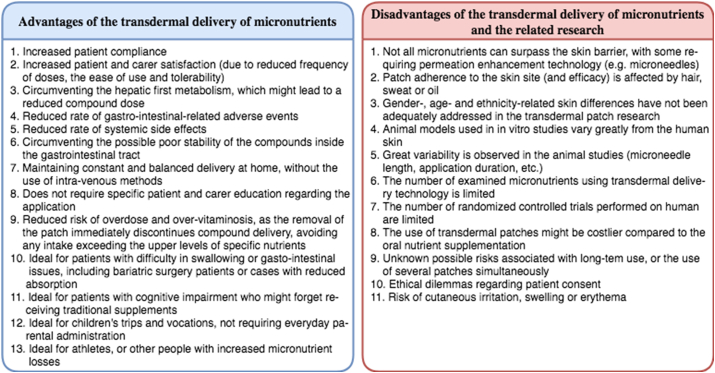
Adhesive transdermal delivery devices (patches) are the latest advancement in the delivery of micronutrients. A common challenge in this mode of delivery includes surpassing the physical barrier of the skin, while the use of microneedle (MN) arrays, or pretreatment of the skin with MNs can be used for a more successful outcome. Limited evidence from human non-randomized trials point to a sub-optimal delivery of iron through skin patches, although no MNs were used in those trials. Moreover, the use of patches proved inefficient in reducing the prevalence of micronutrient deficiencies in post-bariatric surgery patients. The delivery of minerals was tested in animals using reservoir-type patches, gel/foam patches, MNs and iontophoresis. Results from these studies indicate a possible interplay between the dietary manipulation of mineral intake and the trandermal delivery through patches, as reduced, or regular dietary intake seems to increase absorption of the delivered mineral. Moreover, intervention duration could be an additional factor affecting absorption. Possible adverse events from animal studies include redness or decolorization of skin. and studies revealed an increase in vitamin K, vitamin D and iron delivery, however a variety of methodological discrepancies are apparent in these studies, including the models used, the length of the MNs, the duration of application, temperature control and total micronutrient load in the patches. Data indicate that pre-treating the skin with MNs might enhance delivery; however, a source of variability in the observed effectiveness might include the different molecular weights of the nutrients used, skin factors, the ideal tip radius and MN wall thickness. Non-human studies indicate a potential benefit in combining MN with iontophoresis. Presently, the transdermal delivery seems promising with regard to nutritional supplementation, however limited evidence exists for its efficacy in humans. Future research should aim to control for both intervention duration, possible deficiency status and for the dietary intake of participants.
粘贴式透皮给药装置(贴片)是微量营养素给药方面的最新进展。这种给药方式的一个常见挑战是要突破皮肤的物理屏障,而使用微针阵列或用微针对皮肤进行预处理可获得更理想的效果。来自人类非随机试验的有限证据表明,通过皮肤贴片补铁的效果欠佳,尽管这些试验中未使用微针。此外,事实证明,贴片在降低减肥手术后患者微量营养素缺乏症患病率方面效果不佳。在动物身上使用储库型贴片、凝胶/泡沫贴片、微针和离子电渗疗法对矿物质给药进行了测试。这些研究结果表明,矿物质摄入量的饮食调控与通过贴片进行的透皮给药之间可能存在相互作用,因为减少或正常饮食摄入似乎会增加所递送矿物质的吸收。此外,干预持续时间可能是影响吸收的另一个因素。动物研究中可能出现的不良事件包括皮肤发红或脱色。而且 研究显示维生素K、维生素D和铁的递送有所增加,然而这些研究中存在各种方法上的差异,包括所使用的模型、微针的长度、应用持续时间、温度控制以及贴片中微量营养素的总负荷。数据表明,用微针预处理皮肤可能会增强递送效果;然而,观察到的有效性存在差异的一个原因可能包括所使用营养素的不同分子量、皮肤因素、理想的针尖半径和微针壁厚。非人类研究表明,将微针与离子电渗疗法相结合可能有益。目前,透皮给药在营养补充方面似乎很有前景,但在人体中的疗效证据有限。未来的研究应旨在控制干预持续时间、可能的缺乏状态以及参与者的饮食摄入。