Myers-JDC-Brookdale Institute, JDC Hill, Jerusalem, Israel.
Hebrew University Paul Baerwald School of Social Work and Social Welfare, Jerusalem, Israel.
Isr J Health Policy Res. 2021 Aug 2;10(1):43. doi: 10.1186/s13584-021-00481-x.
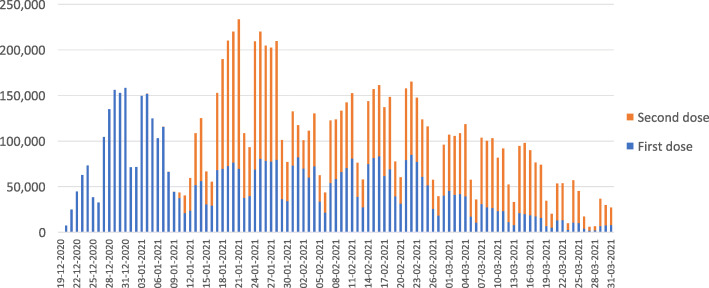
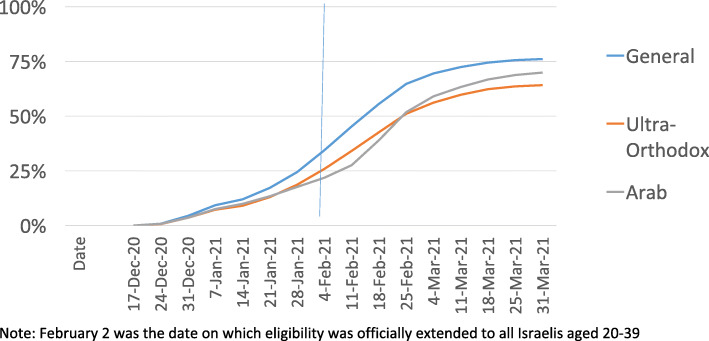
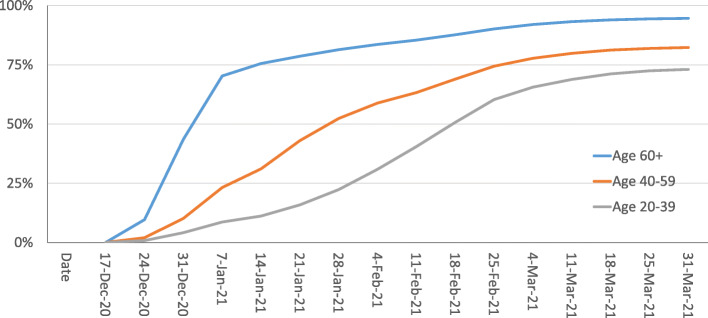
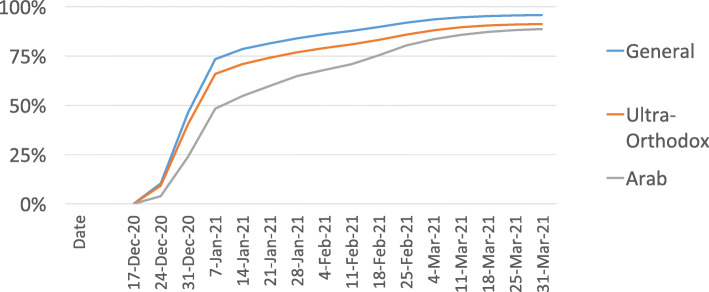
As of March 31, 2021, Israel had administered 116 doses of vaccine for COVID-19 per 100 population (of any age) - far more than any other OECD country. It was also ahead of other OECD countries in terms of the share of the population that had received at least one vaccination (61%) and the share that had been fully vaccinated (55%). Among Israelis aged 16 and over, the comparable figures were 81 and 74%, respectively. In light of this, the objectives of this article are: 1. To describe and analyze the vaccination uptake through the end of March 2021 2. To identify behavioral and other barriers that likely affected desire or ability to be vaccinated 3. To describe the efforts undertaken to overcome those barriers Israel's vaccination campaign was launched on December 20, and within 2.5 weeks, 20% of Israelis had received their first dose. Afterwards, the pace slowed. It took an additional 4 weeks to increase from 20 to 40% and yet another 6 weeks to increase from 40 to 60%. Initially, uptake was low among young adults, and two religious/cultural minority groups - ultra-Orthodox Jews and Israeli Arabs, but their uptake increased markedly over time.In the first quarter of 2021, Israel had to enhance access to the vaccine, address a moderate amount of vaccine hesitancy in its general population, and also address more intense pockets of vaccine hesitancy among young adults and religious/cultural minority groups. A continued high rate of infection during the months of February and March, despite broad vaccination coverage at the time, created confusion about vaccine effectiveness, which in turn contributed to vaccine hesitancy. Among Israeli Arabs, some residents of smaller villages encountered difficulties in reaching vaccination sites, and that also slowed the rate of vaccination.The challenges were addressed via a mix of messaging, incentives, extensions to the initial vaccine delivery system, and other measures. Many of the measures addressed the general population, while others were targeted at subgroups with below-average vaccination rates. Once the early adopters had been vaccinated, it took hard, creative work to increase population coverage from 40 to 60% and beyond.Significantly, some of the capacities and strategies that helped Israel address vaccine hesitancy and geographic access barriers are different from those that enabled it to procure, distribute and administer the vaccines. Some of these strategies are likely to be relevant to other countries as they progress from the challenges of securing an adequate vaccine supply and streamlining distribution to the challenge of encouraging vaccine uptake.
截至 2021 年 3 月 31 日,以色列每 100 人(任何年龄)接种了 116 剂 COVID-19 疫苗——这一数字远超经合组织(OECD)的其他任何国家。此外,该国的至少接种一剂疫苗人群比例(61%)和完全接种疫苗人群比例(55%)也在 OECD 国家中位列前茅。在以色列,16 岁及以上人群中这两项数据分别为 81%和 74%。鉴于此,本文的目的如下:1. 描述并分析截至 2021 年 3 月底的疫苗接种情况;2. 确定可能影响接种意愿或能力的行为和其他障碍;3. 描述克服这些障碍所做的努力。以色列的疫苗接种活动于 2020 年 12 月 20 日启动,在 2.5 周内,20%的以色列人接种了第一剂疫苗。之后,接种速度放缓。又用了 4 周时间将这一比例从 20%增加到 40%,再用 6 周时间将其从 40%增加到 60%。最初,年轻人和两个宗教/文化少数群体——极端正统派犹太人和以色列阿拉伯人接种率较低,但随着时间的推移,他们的接种率显著上升。2021 年第一季度,以色列必须增加疫苗接种机会,解决其普通民众中适度的疫苗犹豫问题,并解决年轻人和宗教/文化少数群体中更强烈的疫苗犹豫问题。尽管当时疫苗接种覆盖面很广,但 2 月和 3 月期间感染率持续居高不下,导致人们对疫苗有效性产生困惑,从而助长了疫苗犹豫情绪。在以色列阿拉伯人中,一些小村庄的居民在前往接种点方面遇到困难,这也减缓了接种速度。通过混合使用信息传递、激励措施、扩大初始疫苗交付系统等措施来应对这些挑战。许多措施针对的是普通民众,而另一些措施则针对接种率较低的亚群。一旦早期接种者接种了疫苗,就需要付出艰苦、创造性的努力,将人口覆盖率从 40%提高到 60%及以上。重要的是,帮助以色列解决疫苗犹豫和地理获取障碍的一些能力和策略与帮助其采购、分发和管理疫苗的策略不同。随着各国从确保获得足够疫苗供应和简化分配的挑战过渡到鼓励疫苗接种的挑战,其中一些策略可能与其他国家相关。