Division of Plastic & Reconstructive Surgery, University of Miami Miller School of Medicine, Miami, Florida, United States of America.
Anne Arundel Medical Center, Annapolis, Maryland, United States of America.
PLoS One. 2021 Aug 3;16(8):e0255541. doi: 10.1371/journal.pone.0255541. eCollection 2021.
Recently, several single center studies have suggested a protective effect of the influenza vaccine against severe acute respiratory syndrome coronavirus-2 (SARS-CoV-2). This study utilizes a continuously updated Electronic Medical Record (EMR) network to assess the possible benefits of influenza vaccination mitigating critical adverse outcomes in SARS-CoV-2 positive patients from 56 healthcare organizations (HCOs).
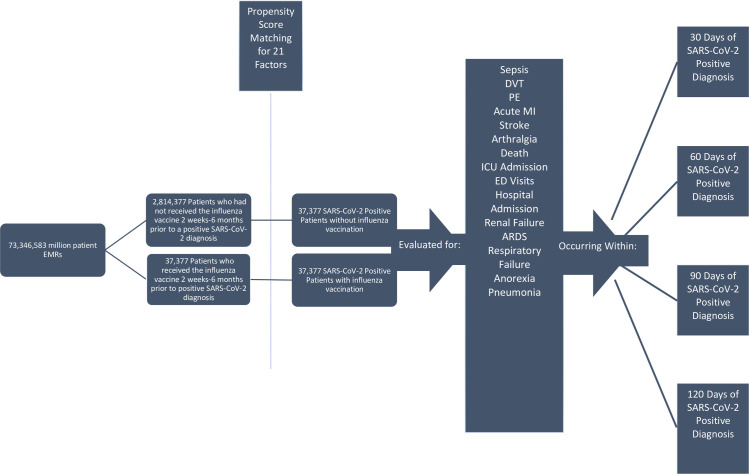
The de-identified records of 73,346,583 patients were retrospectively screened. Two cohorts of 37,377 patients, having either received or not received influenza vaccination six months-two weeks prior to SARS-CoV-2 positive diagnosis, were created using Common Procedural Terminology (CPT) and logical observation identifiers names and codes (LOINC) codes. Adverse outcomes within 30, 60, 90, and 120 days of positive SARS-CoV-2 diagnosis were compared between cohorts. Outcomes were assessed with stringent propensity score matching including age, race, ethnicity, gender, hypertension, diabetes, hyperlipidemia, chronic obstructive pulmonary disease (COPD), obesity, heart disease, and lifestyle habits such as smoking.
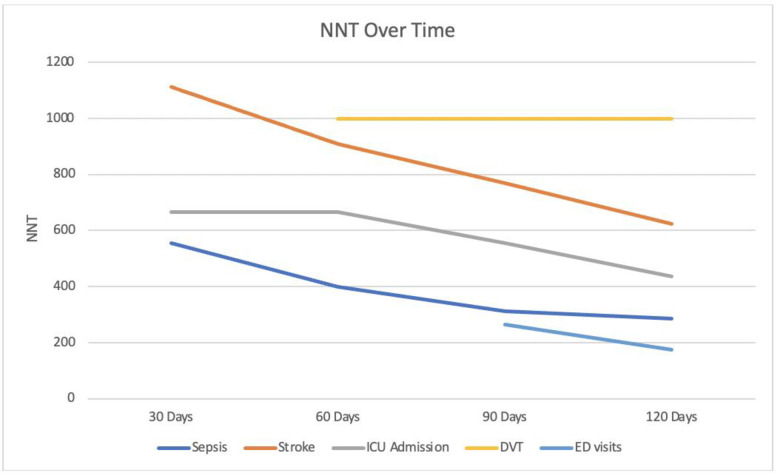
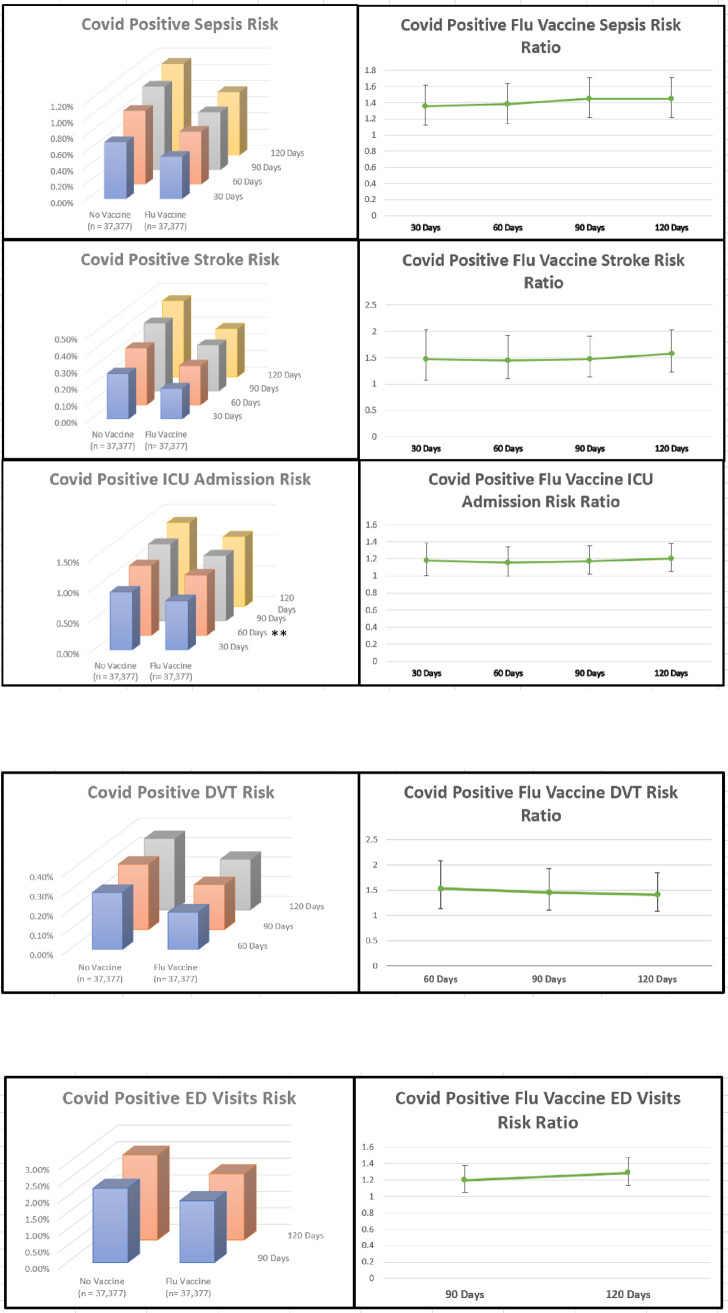
SARS-CoV-2-positive patients who received the influenza vaccine experienced decreased sepsis (p<0.01, Risk Ratio: 1.361-1.450, 95% CI:1.123-1.699, NNT:286) and stroke (p<0.02, RR: 1.451-1.580, 95% CI:1.075-2.034, NNT:625) across all time points. ICU admissions were lower in SARS-CoV-2-positive patients receiving the influenza vaccine at 30, 90, and 120 days (p<0.03, RR: 1.174-1.200, 95% CI:1.003-1.385, NNT:435), while approaching significance at 60 days (p = 0.0509, RR: 1.156, 95% CI:0.999-1.338). Patients who received the influenza vaccine experienced fewer DVTs 60-120 days after positive SARS-CoV-2 diagnosis (p<0.02, RR:1.41-1.530, 95% CI:1.082-2.076, NNT:1000) and experienced fewer emergency department (ED) visits 90-120 days post SARS-CoV-2-positive diagnosis (p<0.01, RR:1.204-1.580, 95% CI: 1.050-1.476, NNT:176).
Our analysis outlines the potential protective effect of influenza vaccination in SARS-CoV-2-positive patients against adverse outcomes within 30, 60, 90, and 120 days of a positive diagnosis. Significant findings favoring influenza vaccination mitigating the risks of sepsis, stroke, deep vein thrombosis (DVT), emergency department (ED) & Intensive Care Unit (ICU) admissions suggest a potential protective effect that could benefit populations without readily available access to SARS-CoV-2 vaccination. Thus further investigation with future prospective studies is warranted.
最近,几项单中心研究表明流感疫苗对严重急性呼吸综合征冠状病毒 2(SARS-CoV-2)有保护作用。本研究利用不断更新的电子病历(EMR)网络,从 56 家医疗机构(HCO)评估流感疫苗接种对 SARS-CoV-2 阳性患者严重不良结局的可能益处。
回顾性筛选了 73346583 名患者的匿名记录。使用通用程序术语(CPT)和逻辑观察标识符名称和代码(LOINC)代码创建了两组 37377 名患者,一组在 SARS-CoV-2 阳性诊断前 6 个月至 2 周接受过流感疫苗接种,另一组未接种。在 SARS-CoV-2 阳性诊断后 30、60、90 和 120 天内比较了两个队列的不良结局。使用严格的倾向评分匹配评估结局,包括年龄、种族、民族、性别、高血压、糖尿病、高血脂、慢性阻塞性肺疾病(COPD)、肥胖、心脏病和生活方式习惯,如吸烟。
接受流感疫苗接种的 SARS-CoV-2 阳性患者在所有时间点均降低了败血症(p<0.01,风险比:1.361-1.450,95%置信区间:1.123-1.699,NNH:286)和中风(p<0.02,RR:1.451-1.580,95%CI:1.075-2.034,NNH:625)的发生率。在 SARS-CoV-2 阳性患者中,在 30、90 和 120 天接受流感疫苗接种的 ICU 入院率较低(p<0.03,RR:1.174-1.200,95%CI:1.003-1.385,NNH:435),而在 60 天则接近显著水平(p=0.0509,RR:1.156,95%CI:0.999-1.338)。接受流感疫苗接种的患者在 SARS-CoV-2 阳性诊断后 60-120 天内发生深静脉血栓形成(DVT)的风险降低(p<0.02,RR:1.41-1.530,95%CI:1.082-2.076,NNH:1000),在 SARS-CoV-2 阳性诊断后 90-120 天内发生急诊(ED)就诊的风险降低(p<0.01,RR:1.204-1.580,95%CI:1.050-1.476,NNH:176)。
我们的分析概述了流感疫苗接种对 SARS-CoV-2 阳性患者在阳性诊断后 30、60、90 和 120 天内不良结局的潜在保护作用。支持流感疫苗接种可降低败血症、中风、深静脉血栓形成(DVT)、急诊(ED)和重症监护病房(ICU)入院风险的显著发现表明,流感疫苗接种可能具有保护作用,这可能使那些难以获得 SARS-CoV-2 疫苗接种的人群受益。因此,需要进一步进行未来前瞻性研究。